HCP Terraform ended its free tier March 31, 2026, and its per-resource pricing grows with your infrastructure. This covers what to look for in an alternative and breaks down how env zero compares on pricing, multi-framework support, governance, and migration.
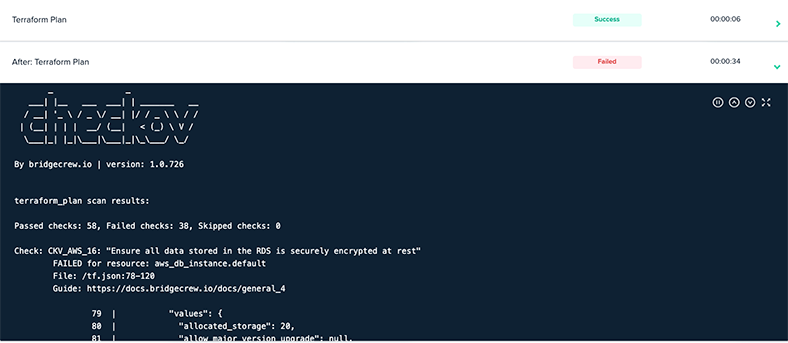
In this webinar, env0 DevOps Advocate Tim Davis will be joined by Ryder Damen, the new Developer Advocate with Indeni. We'll go over the complex topic of Compliance in continuous automation, and even show a demo of Cloudrail in action in the env0 platform!
Are you currently automating your Infrastructure as Code/Terraform deployments, or are you investigating that ability now? One key piece of being successful is making sure you don't overrun the budget when you open up the ability to deploy to teams.
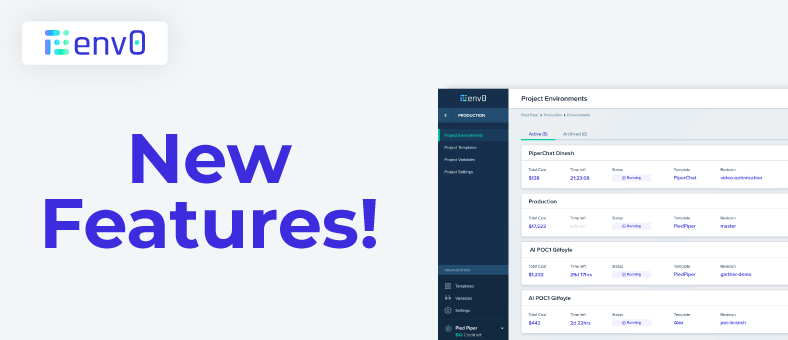
env0 has worked hard putting new stuff into the platform to make your life easier. Top priority is User Experience and so we do not overload the platform with unnecessary features that get in the way, we added amazing useful features only!
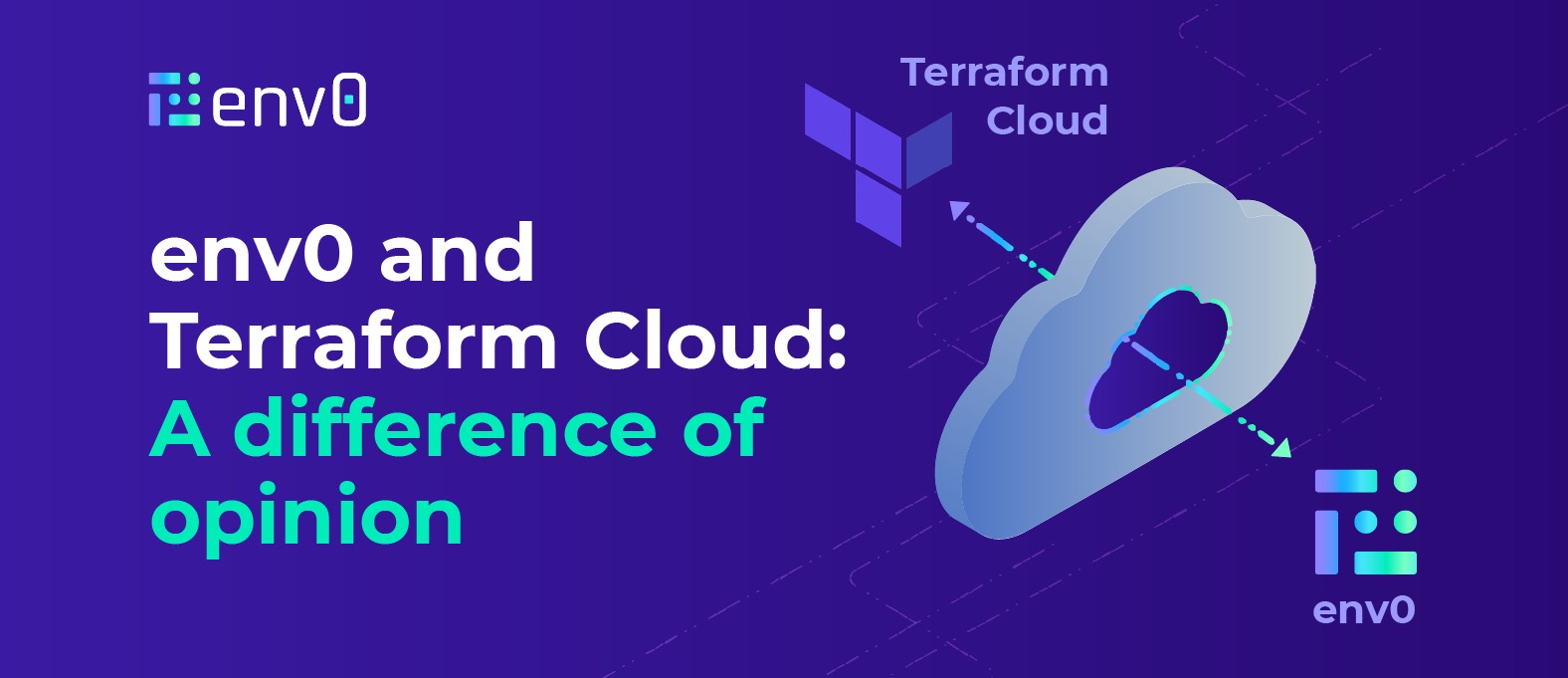
At this point, if you’re familiar with Infrastructure as Code, you surely know what Terraform is. If you’ve used Terraform and tried to manage it at scale, you’ve probably heard of Terraform Cloud. If you’re reading this, you may or may not have heard of env0 before. Today we’re going to go over some of the differences between the two offerings, and highlight some of the key value adds env0 can bring to your Infrastructure as Code workflows.
Centralizing Terraform runs becomes critical as organizations scale their use. This webinar discusses best practices for automating your Terraform runs, and why you may want to look at automation and centralized management of your IaC.
In this webinar, Ohad Maislish and Tim Davis will explain the specific workflow challenges DevOps encounter today, and will explore how you can automate the deployment of cloud resources on platforms like AWS, Azure and Google Cloud, without having to go into the provider's portal each time by using Terraform and env0.
I would like to start a tradition - I am going to gather all the discussions I had last year with customers, and will craft my predictions on how DevOps and related technologies will evolve and impact business in 2021.
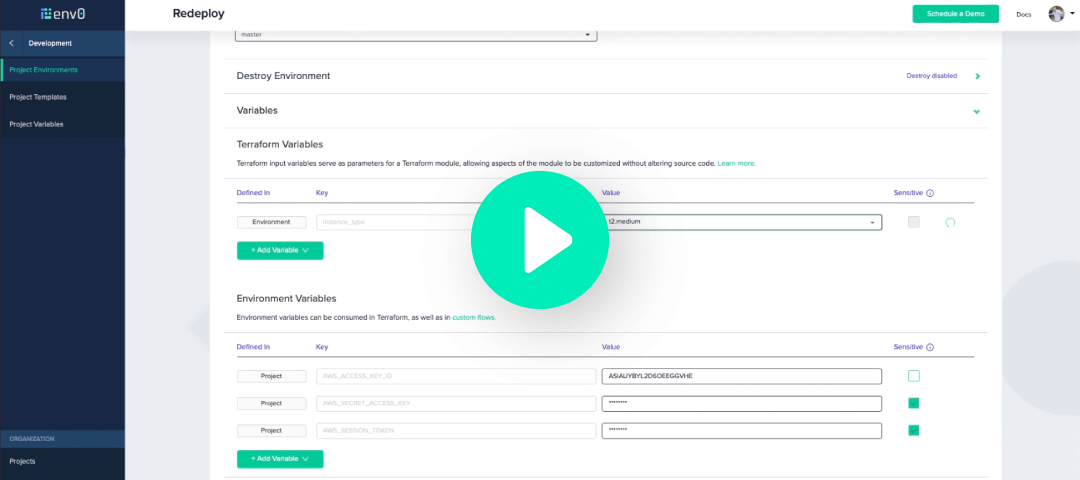
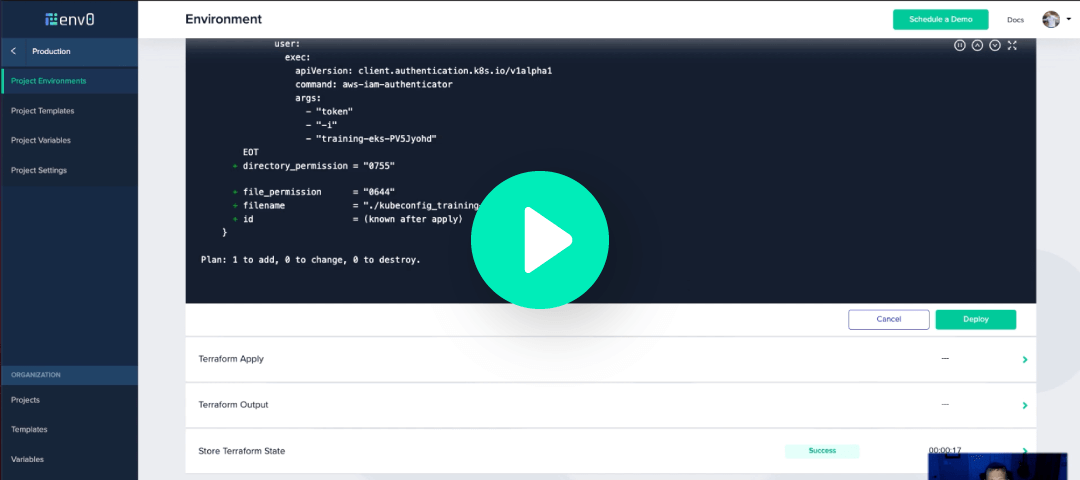
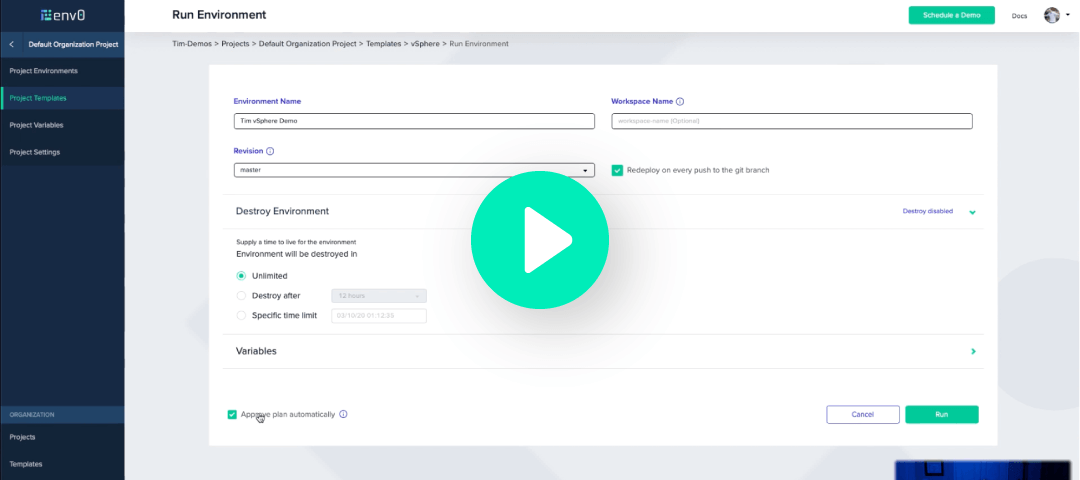
This video demonstrates how env0 can help you empower your teams and add governance to your Infrastructure as Code workflows. We show the RBAC configuration for our teams, then show the deployment process with different user rights levels. From there, one of our deployments has a costing issue. We'll use Open Policy Agent enforcement to ensure that deployments fit within our predefined policies.
This is a demo of RBAC using Teams in env0. It is a full Infrastructure as Code automation demo, utilizing multiple accounts, and Slack notifications as part of the workflow.
This video demonstrates how env0 automates Infrastructure as Code pull request and merges to a development environment, and how the same change to production is submitted for approval.
Implementing a Continuous Deployment flow is a very common and important way of allowing developers to be as productive as possible. In this guide I will show you how to easily create a CD pipeline using env0
Per-pull request environments for the front-end are commonly called “Preview environments” and can be achieved in many ways, one of which is using Terraform. Rolling this out on your own, will give you better control over your infrastructure, allowing you to create preview environments which are closer to your production environment.
Thanks to Infrastructure as Code, it’s easy to get rid of your traditional staging environments and start using a dynamic, dedicated environment for each pull request. Adopting per-pull request environments will help you shorten feedback loops, reduce bottlenecks and conflicts, and increase your team’s velocity.
Kubernetes is the "go to" for orchestrating containers but managing multiple environments in a single cluster can get tricky. We're diving into how you can easily use namespaces and Terraform to manage lots of environments for many users.
In a modern application there’s also a public (or private) API that also needs to have a maintenance mode. Let’s see how we can do that using Terraform on API Gateway.
Even the most highly available applications from the most experienced providers sometimes need to be able to be taken offline for a short period of time.
Learn how to do it using Terraform and Github pages.
Discover the essentials of Terraform state file management with this in-depth guide. Uncover best practices, learn how to handle state file locking and troubleshooting, and keep your infrastructure secure and efficient.