.avif)
.webp)



New to either tool? Our Terraform getting-started tutorial covers the core workflow for both Terraform and OpenTofu, so you have the right foundation before reading this comparison.
The discussion around OpenTofu vs. Terraform is often framed as a tooling comparison. In practice, it is an operational decision that affects how infrastructure is governed, audited, and evolved over time.
Most organizations evaluating this change are not starting from zero. They already manage production cloud infrastructure defined with Terraform, supported by mature Infrastructure-as-Code practices, established change management processes, and strict compliance requirements. The real concern is whether the alternative can be adopted without disrupting existing environments, workflows, or reliability guarantees.
This article focuses on that reality. It explains what changes and what does not in OpenTofu vs. Terraform, how migration paths work for existing environments, and what enterprise teams should evaluate around governance, state, and long-term operations.
Terraform vs OpenTofu – A Practical Comparison for Existing Infrastructure
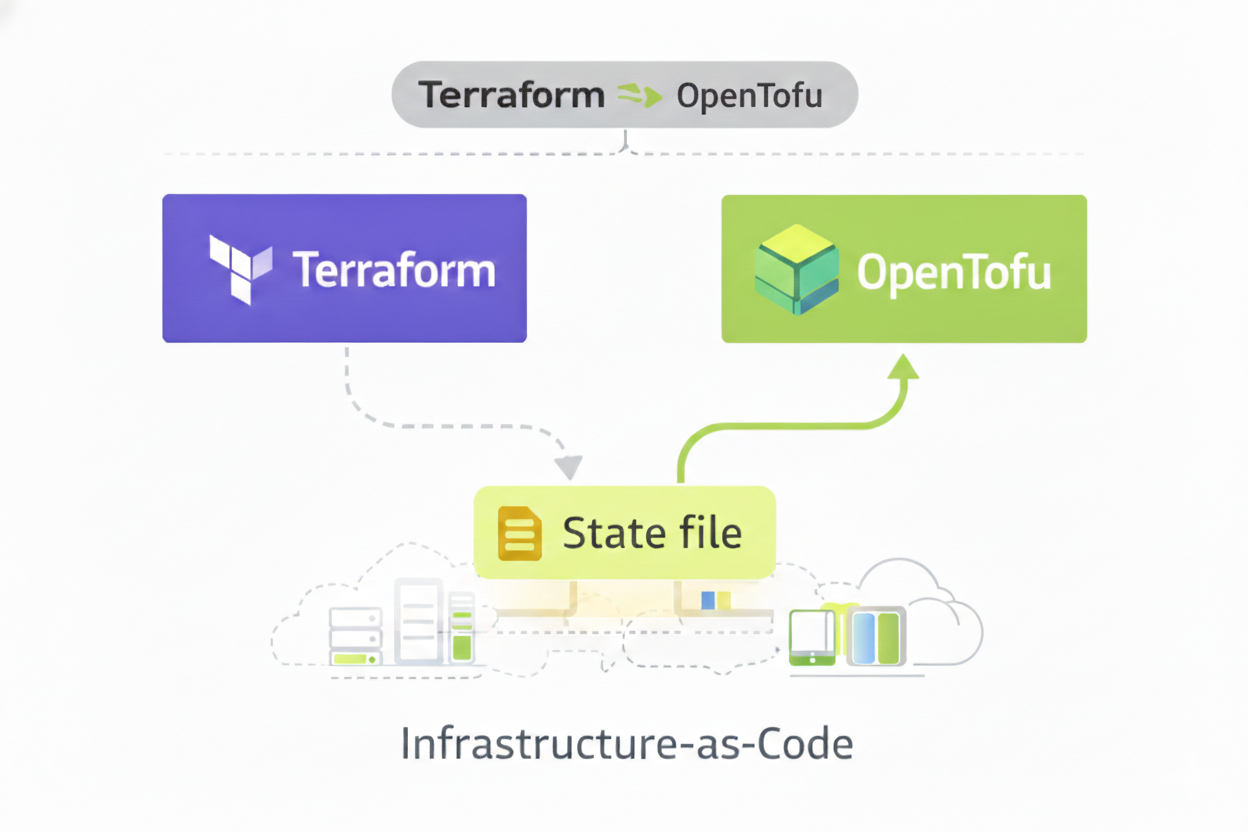
When teams compare Terraform vs OpenTofu, the similarities are immediately apparent.
Both tools rely on declarative configuration, use HashiCorp Configuration Language (HCL), and share the same provider ecosystem. The execution lifecycle (plan, review, and apply) remains unchanged, as does the underlying state file format. Reusable modules, provider integrations, and configuration patterns continue to function without modification.
Because the project was designed with backward compatibility in mind, existing Terraform configurations do not require refactoring. For most teams, this means the comparison does not hinge on syntax or feature gaps. Instead, the OpenTofu vs. Terraform discussion quickly shifts toward operational impact once infrastructure is already provisioned and actively managed.
Why OpenTofu Exists
The project emerged after HashiCorp changed Terraform’s license to the Business Source License (BSL). While Terraform remains widely used, the license change introduced uncertainty for organizations that depend on open-source tooling for long-term commercial use.
The alternative is released under the Mozilla Public License 2.0 (MPL 2.0) and governed by the Linux Foundation. This governance model emphasizes transparent decision-making, open contribution, and predictable licensing terms. For enterprise teams, this reduces concerns around vendor lock-in and future licensing changes that could affect internal platforms.
In the OpenTofu vs. Terraform comparison, licensing is not a daily operational concern, but it strongly influences long-term platform strategy, especially in regulated environments.
Infrastructure as Code Remains the Foundation
Both tools follow the same Infrastructure-as-Code principles.
Infrastructure definitions are declarative, version-controlled, reviewed before execution, and applied through automated workflows. These characteristics support repeatability, auditability, and reliability across environments.
Because compatibility is preserved, existing Infrastructure-as-Code repositories do not need to be restructured. Configuration management practices remain intact, allowing DevOps and platform engineering teams to continue working with established workflows rather than relearning fundamentals.
This continuity is the foundation that makes adoption feasible in large organizations.
What Migration Actually Means in OpenTofu vs. Terraform
In enterprise contexts, migration is often misunderstood.
Migration does not mean rewriting configuration, rebuilding environments, or replacing providers. Instead, it refers to switching the execution engine while preserving everything around it.
Most organizations already operate environments with production-ready controls: access restrictions, approval gates, compliance checks, and audit logging. A valid migration must preserve these guarantees.
In practical terms, migration means existing environments continue to run as they are today, using the same state, the same approvals, and the same operational safeguards.
Migration Path from Terraform to OpenTofu
A realistic migration path includes several non-negotiable characteristics.
Existing environments remain unchanged. The same state file continues to be used. Approval workflows and compliance requirements remain intact. Rollback to Terraform remains possible until a tofu apply is executed. Because OpenTofu may update state metadata, teams should treat the migration of a specific state file as a forward-only move unless they maintain a pre-migration state backup.
Any approach that requires duplicating environments, copying state, or introducing parallel pipelines increases risk and operational complexity. The safest migration path treats the new engine as a drop-in execution replacement, not as a separate system.
This allows organizations to migrate incrementally, environment by environment, rather than through a single disruptive cutover.
State Management in Terraform vs OpenTofu
State management is one of the most sensitive aspects of Infrastructure-as-Code.
Both Terraform and its alternative share the same state file structure, enabling environments to transition execution engines without state conversion. Preserving state continuity is critical for maintaining historical context, enabling reliable drift detection, and supporting disaster recovery processes.
Recreating or duplicating state files introduces avoidable risk and complicates recovery scenarios. In the OpenTofu vs. Terraform discussion, preserving state management continuity is a prerequisite for production readiness.
Operational Impact of OpenTofu vs. Terraform in Large Environments
Enterprise infrastructure rarely consists of a single team or environment. Most organizations manage development, staging, and production environments across multiple cloud providers, often with different ownership boundaries.
At this scale, reliability depends less on tooling choice and more on operational consistency. Predictable execution, stable state handling, and clear change management processes are what keep Infrastructure-as-Code sustainable.
Platform engineering teams evaluate OpenTofu vs. Terraform through this lens. The question is not how infrastructure is defined, but whether existing operational guarantees continue to hold as execution changes underneath.
Running Terraform and OpenTofu Side by Side

In practice, the decision is rarely all-or-nothing.
Common patterns include legacy environments remaining on Terraform while new environments adopt the alternative, or gradual migration based on risk profile. Temporary coexistence during evaluation is also common.
Supporting these scenarios requires tooling that can manage mixed environments without fragmenting governance, configuration management, or audit trails. env zero enables this model by allowing Terraform and OpenTofu environments to coexist under a single operational framework.
Automating the Terraform to OpenTofu Migration Process
When teams look for tools to automate migration, they are not looking for scripts.
They want to avoid manual cutovers, one-time projects, and irreversible changes. Automation, in this context, means making migration repeatable and low-risk.
With env zero, automation focuses on reusing existing state, preserving environment configuration, maintaining approval workflows, and allowing execution engine selection per environment. This aligns migration with established change management best practices.
Managing Mixed Terraform and OpenTofu Deployments Long Term
Many organizations continue operating mixed environments long after migration begins.
Long-term success depends on unified governance, centralized visibility, consistent approvals, reliable drift detection, and strong audit logging. These requirements apply regardless of which engine executes infrastructure changes.
env zero manages both execution paths under the same governance model, preventing fragmentation and reducing cognitive overhead for platform teams.
IaC Governance Does Not Change with OpenTofu
Governance requirements exist because of organizational scale, not tooling choice.
Enterprise Infrastructure as Code governance typically includes role-based access control, policy as code enforcement, compliance requirements, and structured change management processes.
In OpenTofu vs. Terraform, the key question is whether governance remains engine-agnostic. env zero applies the same controls regardless of execution engine, ensuring consistency across environments.
Related reading: Atlantis for Terraform: A practical guide to PR-driven infrastructure automation. Atlantis works with both Terraform and OpenTofu at the execution layer — relevant if your team uses PR comment-driven plan and apply alongside either engine.
OpenTofu vs Terraform for Platform Engineering Teams
From a platform engineering perspective, this decision is about operability.
Key questions include whether environments can migrate incrementally, whether state continuity is preserved, whether reliability guarantees remain intact, and whether audit logging continues without gaps.
Separating execution engines from operational workflows allows platform teams to adopt the alternative without redesigning their internal platforms.
Reliability, Compliance, and Production Readiness
Production readiness depends on predictable execution, stable state handling, compliance with internal controls, and clear rollback paths.
When adoption does not weaken these properties, it becomes a low-risk evolution rather than a disruptive change. This is where enterprise teams draw the line in the OpenTofu vs. Terraform discussion.
Cloud Providers and Provider Compatibility
Both tools rely on the same provider ecosystem, ensuring compatibility across cloud providers and infrastructure platforms.
Provider compatibility allows organizations to continue managing cloud infrastructure without modifying existing configurations or reusable modules, which is critical for operating at scale.
Best Practices for OpenTofu Adoption
For enterprise teams, proven best practices include migrating environment by environment, preserving state files, maintaining consistent governance, avoiding parallel pipelines, and monitoring drift continuously.
These practices reduce operational risk and support reliable infrastructure automation over time.
Technical Considerations for Enterprise Migration
While OpenTofu is a drop-in replacement, enterprise teams must account for these three technical realities before the first apply:
- The Forward-Only State Rule: OpenTofu is backward compatible with Terraform 1.5.x - 1.6.x. However, once you run tofu apply, the state file may be updated with OpenTofu-specific metadata. Standard Terraform CLI will likely view this state as unsupported. Always perform a state backup before the initial migration.
- Registry Whitelisting: OpenTofu uses registry.opentofu.org to source providers. If your CI/CD runners sit behind a strict firewall or use a private proxy (like Artifactory), you must whitelist this endpoint to avoid Provider Not Found errors during initialization.
- Feature Divergence and Lock-in: OpenTofu v1.7+ introduces features like Native State Encryption and Early Variable Evaluation. While these provide significant security and flexibility advantages, utilizing them makes your configuration incompatible with Terraform. Decide early if you are staying agnostic or moving to Tofu-first features.
Final Thoughts on OpenTofu vs. Terraform
At the configuration level, OpenTofu vs. Terraform is largely settled.
At the operational level, the decision depends on migration safety, state continuity, governance consistency, and long-term reliability.
env zero enables organizations to adopt the alternative while keeping existing Terraform environments stable, governed, and auditable.
That is what makes the OpenTofu vs. Terraform decision practical for enterprise infrastructure teams.
Looking for a broader comparison of IaC tools? Our guide to the best infrastructure as code tools and Terraform alternatives covers Pulumi, Crossplane, Ansible, and more.
Adopt OpenTofu Without Disrupting Existing Terraform Environments
Evaluating OpenTofu vs. Terraform does not have to be a high-risk, all-or-nothing decision.
env zero allows teams to run Terraform and OpenTofu side by side, reuse existing state files, and preserve approvals, audit logging, and governance throughout the migration process. Environments can transition incrementally, without rebuilding infrastructure or introducing parallel workflows.
If you’re exploring OpenTofu and want a practical way to migrate existing Terraform environments safely, env zero provides the control plane to do it without disruption.
To see how env zero supports Terraform and OpenTofu in practice, schedule your personal demo today.
FAQ's
Is OpenTofu a drop-in replacement for Terraform in existing environments?
Yes, OpenTofu is designed to be a drop-in replacement for Terraform, especially for versions up to Terraform 1.5.x–1.6.x. Both tools use the same configuration language (HCL), provider ecosystem, and execution model, which means existing infrastructure code can typically run without modification.
For most organizations, this means there is no need to refactor configurations, rewrite modules, or rebuild environments. The infrastructure definitions, workflows, and deployment processes remain intact, allowing teams to switch the execution engine without disrupting operations.
However, while compatibility is high, teams must still approach migration carefully. Once OpenTofu-specific features are used or state metadata is updated after a tofu apply, reverting back to Terraform may not be straightforward. This makes initial planning and state backup critical.
What does “migration” actually involve when moving from Terraform to OpenTofu?
Migration in this context does not mean rebuilding infrastructure or rewriting code. Instead, it refers to switching the execution engine that runs your existing Infrastructure-as-Code workflows while keeping everything else unchanged.
This includes preserving the same state files, approval workflows, compliance checks, and access controls. A proper migration ensures that infrastructure continues to operate exactly as before, without introducing new risks or inconsistencies.
The safest approach treats OpenTofu as a direct replacement for Terraform’s execution layer. This allows teams to migrate incrementally, environment by environment, rather than performing a risky, large-scale cutover.
How does state management work between Terraform and OpenTofu?
Terraform and OpenTofu share the same state file structure, which is what enables seamless transition between the two tools. This compatibility allows teams to reuse existing state files without needing conversion or duplication.
Maintaining state continuity is critical because the state file tracks the real-world infrastructure and ensures accurate planning, drift detection, and change execution. Any disruption to state can lead to unintended resource changes or loss of infrastructure context.
One important consideration is that after running tofu apply, the state file may be updated with OpenTofu-specific metadata. This makes the migration effectively forward-only unless a backup of the original Terraform state is maintained.
Can Terraform and OpenTofu be used together in the same organization?
Yes, many organizations run Terraform and OpenTofu side by side, especially during migration or evaluation phases. This allows teams to gradually transition environments based on risk, complexity, or business priorities.
For example, legacy or production-critical environments may remain on Terraform initially, while newer or lower-risk environments adopt OpenTofu. This phased approach reduces risk and provides flexibility in decision-making.
However, managing mixed environments requires consistent governance, visibility, and operational control. Without a unified system, teams may face fragmentation in workflows, audit trails, and compliance enforcement.
What should enterprise teams evaluate before adopting OpenTofu?
Enterprise teams should focus less on syntax or features and more on operational impact. Key considerations include whether migration can be done incrementally, whether state continuity is preserved, and whether existing governance and compliance controls remain intact.
Additional technical factors such as registry access (for provider downloads), state backup strategies, and potential feature divergence should also be evaluated. These elements directly impact production stability and long-term maintainability.
Ultimately, the decision should be based on whether OpenTofu can be adopted without weakening reliability, auditability, or control. For most enterprise teams, maintaining these guarantees is more important than the tooling choice itself.
If your evaluation is partly driven by HCP Terraform's pricing changes or the March 2026 free tier end, see The Best Terraform Cloud Alternative in 2026 for the full breakdown of env zero versus HCP Terraform.
Related: env0’s OpenTofu integration gives you policy enforcement, drift detection, and team governance on top of OpenTofu — out of the box.
Further reading: Can OpenTofu Become the HTTP of Infrastructure as Code? — exploring whether OpenTofu can become the universal open standard for IaC.
![Using Open Policy Agent (OPA) with Terraform: Tutorial and Examples [2026]](https://cdn.prod.website-files.com/63eb9bf7fa9e2724829607c1/69d6a3bde2ffe415812d9782_post_th.png)
