.webp)
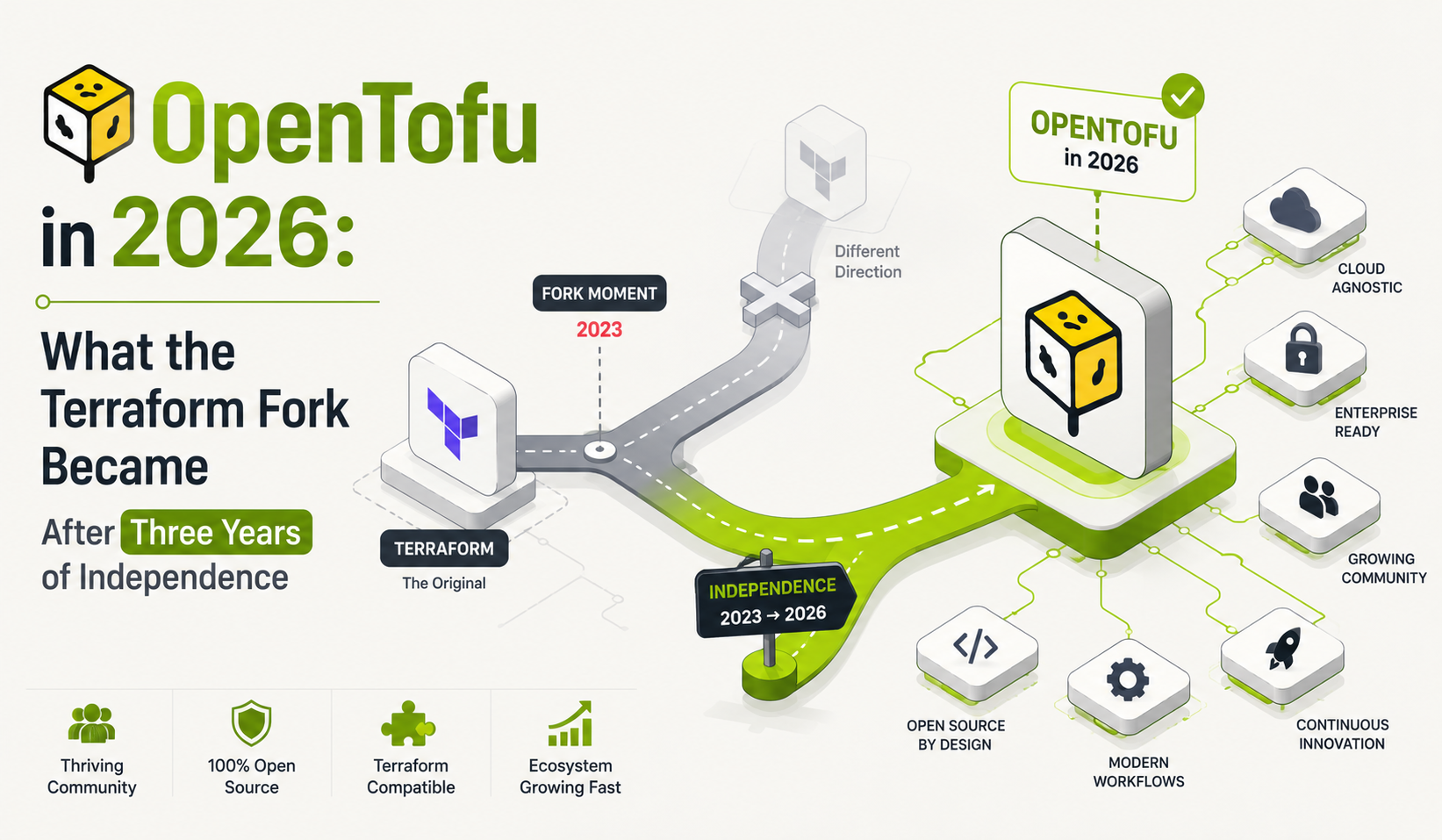
OpenTofu has moved from being a reactive Terraform fork to a serious infrastructure as code option for platform teams evaluating their long-term IaC strategy.
What started as a response to Terraform’s license change has become a community-driven project with Linux Foundation roots, CNCF Sandbox status, and a growing role in enterprise infrastructure conversations.
For DevOps teams, platform engineering leaders, and enterprise IT teams, the question is no longer whether OpenTofu is real.
The better question is whether OpenTofu is mature enough for your operating model, and how your team should govern it if you adopt it.
That distinction matters. OpenTofu can help teams preserve familiar Terraform-style workflows while reducing some vendor-lock-in concerns.
But it does not automatically solve infrastructure governance.
Teams still need policy controls, RBAC, drift detection, cost visibility, approval workflows, auditability, and a safe path for terraform-to-opentofu migration.
That is where env0’s IaC Platform & Terraform Automation service becomes valuable.
Why OpenTofu Matters in 2026
OpenTofu matters because it gives platform teams a practical alternative to Terraform without forcing them to completely rethink how infrastructure code is written.
For teams with large Terraform estates, this is important. Rewriting infrastructure into a completely different tool can create risk, slow adoption, and require major retraining.
OpenTofu keeps a familiar HCL-based workflow, which makes migration more realistic for teams that already have Terraform modules, state files, providers, and pipelines.
At the same time, OpenTofu is no longer just a fork trying to prove itself. It has developed its own governance path, community momentum, and feature direction.
That makes OpenTofu especially relevant for teams that want more flexibility but are not ready to abandon Terraform-style infrastructure management.
What OpenTofu Became After the Fork
The first stage of OpenTofu was about trust. Teams wanted to know whether the project would survive, whether it would stay compatible enough with Terraform, and whether it would be taken seriously by the infrastructure community.
By 2026, the conversation has shifted. Platform teams now want to know how OpenTofu fits into production workflows, enterprise governance, provider compatibility, security requirements, and long-term IaC planning.
OpenTofu has also started to develop its own direction. Its roadmap and feature set are no longer only about matching Terraform.
For enterprise teams, this is both an opportunity and a planning requirement.
OpenTofu may preserve familiar workflows, but teams should still treat adoption as a strategic platform decision.
A mature OpenTofu strategy is not “replace Terraform everywhere immediately.
A better approach is to identify where OpenTofu fits, test lower-risk workloads, define governance rules, and use a platform like env0 to manage Terraform and OpenTofu together during the transition.
OpenTofu vs Terraform: What Changed?
OpenTofu and Terraform still share a familiar foundation. Both are used to define, plan, and apply infrastructure changes.
Both are relevant for teams managing cloud and on-prem infrastructure through code.
Both are familiar to teams already using HCL-based infrastructure workflows.
The difference is increasingly about governance, licensing posture, roadmap direction, and ecosystem strategy.
Terraform remains deeply established and closely connected to HashiCorp’s commercial ecosystem.
Many organizations will continue using Terraform because their workflows, modules, teams, and enterprise contracts are already built around it.
OpenTofu is attractive for teams that want a more open governance model while preserving Terraform-style workflows.
It gives platform teams a way to reduce strategic dependency without forcing an immediate rewrite.
The important point is that OpenTofu vs Terraform is not always an either-or decision. Many teams will run both for a period of time.
Existing Terraform workloads may stay in place while new projects move to OpenTofu. That dual-engine phase requires strong governance, visibility, and workflow consistency.
Should You Migrate Terraform to OpenTofu?
Teams should consider OpenTofu when they want Terraform-style infrastructure management with a more open long-term direction.
It is especially worth evaluating if your organization is concerned about vendor dependency, wants OpenTofu support in future workflows, or is planning a broader IaC governance strategy.
However, a decision to migrate Terraform to OpenTofu should not be rushed. Production infrastructure is too important for a casual tool swap.
Teams should review current Terraform versions, providers, modules, state storage, secrets, CI/CD pipelines, policy rules, and approval processes before moving workloads.
A safe migration usually starts with non-critical environments.
Teams can test OpenTofu against existing configurations, compare plan results, validate provider behavior, and confirm that state handling works as expected. Only after that should production workloads be considered.
This is also why a terraform-to-opentofu migration should be handled as a platform initiative, not just a command-line change.
What OpenTofu Does Not Solve by Itself
OpenTofu is an IaC engine. It helps teams define and apply infrastructure changes, but it is not a complete enterprise governance platform by itself.
A platform team still needs to answer important questions. Who can deploy to production? Which policies must pass before changes are approved?
How will the team detect drift? How will cloud cost be reviewed before deployment? Where are audit logs stored?
Can developers request approved infrastructure without waiting on manual tickets?
These problems become more serious as infrastructure grows across teams, environments, and cloud accounts.
A small team may manage OpenTofu through a basic pipeline. An enterprise platform team usually needs more control.
Without a governance layer, teams may simply recreate the same problems they had with unmanaged Terraform workflows.
They may have a new IaC engine, but still struggle with inconsistent approvals, unclear ownership, drift, access gaps, and limited visibility.
How env0 Helps Teams Adopt OpenTofu
Env0 is built for teams that need to govern infrastructure as code at scale.
It supports OpenTofu along with Terraform, Terragrunt, Pulumi, Helm, Kubernetes, and broader IaC workflows.
For platform teams, env0 adds the operating layer around OpenTofu.
Teams can standardize workflows, enforce policies, manage access, monitor drift, improve cost visibility, and enable developer self-service from one platform.
This is especially useful during migration. Many organizations do not want to move every workspace from Terraform to OpenTofu at once.
With env0, teams can support Terraform and OpenTofu side by side while keeping governance consistent.
That reduces migration pressure and gives platform leaders more control over timing, risk, and adoption.
env0 also helps prevent IaC sprawl. As teams experiment with OpenTofu, Terragrunt, and other frameworks, platform leaders can keep workflows centralized instead of letting every team create its own disconnected automation process.
A Practical OpenTofu Adoption Framework
The best OpenTofu strategy begins with evaluation, not immediate replacement. Start by identifying which Terraform workspaces are good migration candidates.
Lower-risk environments, internal tools, and non-production workloads are usually better starting points than critical production infrastructure.
Next, review providers, modules, state storage, secrets, pipelines, and policy requirements.
Teams should also decide whether OpenTofu will become a full Terraform replacement or one supported engine in a multi-IaC strategy.
After that, test migration with a limited workload. Compare plan outputs, validate state, confirm approval workflows, and make sure rollback plans are clear.
Once the process is reliable, platform teams can expand adoption in phases.
The final step is governance. OpenTofu should be managed through clear controls for permissions, approvals, drift, audit logs, and cost visibility.
This is where env0 helps turn OpenTofu from a tool decision into a scalable operating model.
Conclusion: OpenTofu Is Ready to Evaluate, But Governance Still Matters
OpenTofu has become a credible Terraform alternative in 2026.
Its community-driven direction, CNCF Sandbox status, and Terraform-compatible workflow make it worth serious evaluation for platform teams.
But OpenTofu should not be treated as a magic fix. It can reduce licensing concerns and preserve familiar workflows, but it does not automatically solve enterprise governance.
Teams still need a safe migration path, clear operating controls, and visibility across infrastructure changes.
For organizations planning to migrate Terraform to OpenTofu, env0 provides the governance layer needed to adopt OpenTofu without losing control.
Adopt OpenTofu Securely with a Centralized Platform
env0 enables teams to govern and streamline OpenTofu alongside Terraform, Terragrunt, Pulumi, Helm, and Kubernetes from a single platform.
In 2026, as organizations evaluate OpenTofu, env0 helps plan migrations, enforce policies, detect drift, monitor costs, and provide developer self-service with built-in guardrails.
Connect with env0 to establish a controlled, scalable, and compliant OpenTofu adoption strategy.
FAQs
What is OpenTofu?
OpenTofu is an open-source infrastructure as code tool created as a fork of Terraform. It keeps familiar Terraform-style workflows while following an independent governance and roadmap path. In 2026, it is a serious option for teams evaluating open-source IaC strategy.
Is OpenTofu mature enough for enterprise use?
OpenTofu is mature enough for many teams to evaluate seriously, especially those already using Terraform-style workflows. Enterprise adoption should still include testing, governance, policy controls, auditability, and migration planning. The tool may be ready, but the operating model still matters.
How is OpenTofu different from Terraform?
OpenTofu and Terraform share a familiar configuration style, but they now differ in governance, licensing posture, roadmap direction, and some features. OpenTofu is attractive for teams that want a more open path while preserving Terraform-like workflows. Many teams may run both during a transition period.
Should we migrate Terraform to OpenTofu?
Teams should consider migration if they want more open governance, reduced vendor dependency, or long-term flexibility. The decision should be based on Terraform versions, providers, state, modules, CI/CD workflows, and compliance needs. Start with lower-risk workloads before moving production systems.
What is the safest way to handle terraform-to-opentofu migration?
The safest approach is to back up state and code, test OpenTofu in a non-production environment, validate plans, check providers, and move workloads in phases. Teams should also define rollback plans and governance rules. env0 can help manage both Terraform and OpenTofu during migration.
Does OpenTofu replace Terraform Cloud?
OpenTofu can replace the Terraform engine in some workflows, but it does not replace every Terraform Cloud platform capability by itself. Teams still need state governance, policies, approvals, drift detection, cost visibility, and access control. env0 helps provide that platform layer.
Can env0 support OpenTofu?
Yes. env0 supports OpenTofu along with Terraform, Terragrunt, Pulumi, Helm, Kubernetes, and other IaC workflows. This helps platform teams adopt OpenTofu while keeping governance, access control, drift detection, cost visibility, and self-service workflows consistent.
What should platform teams check before adopting OpenTofu?
Platform teams should review Terraform versions, providers, modules, state storage, secrets, pipelines, policies, approvals, and rollback plans. They should also decide whether OpenTofu is a full replacement or part of a dual-engine strategy with Terraform.