.webp)
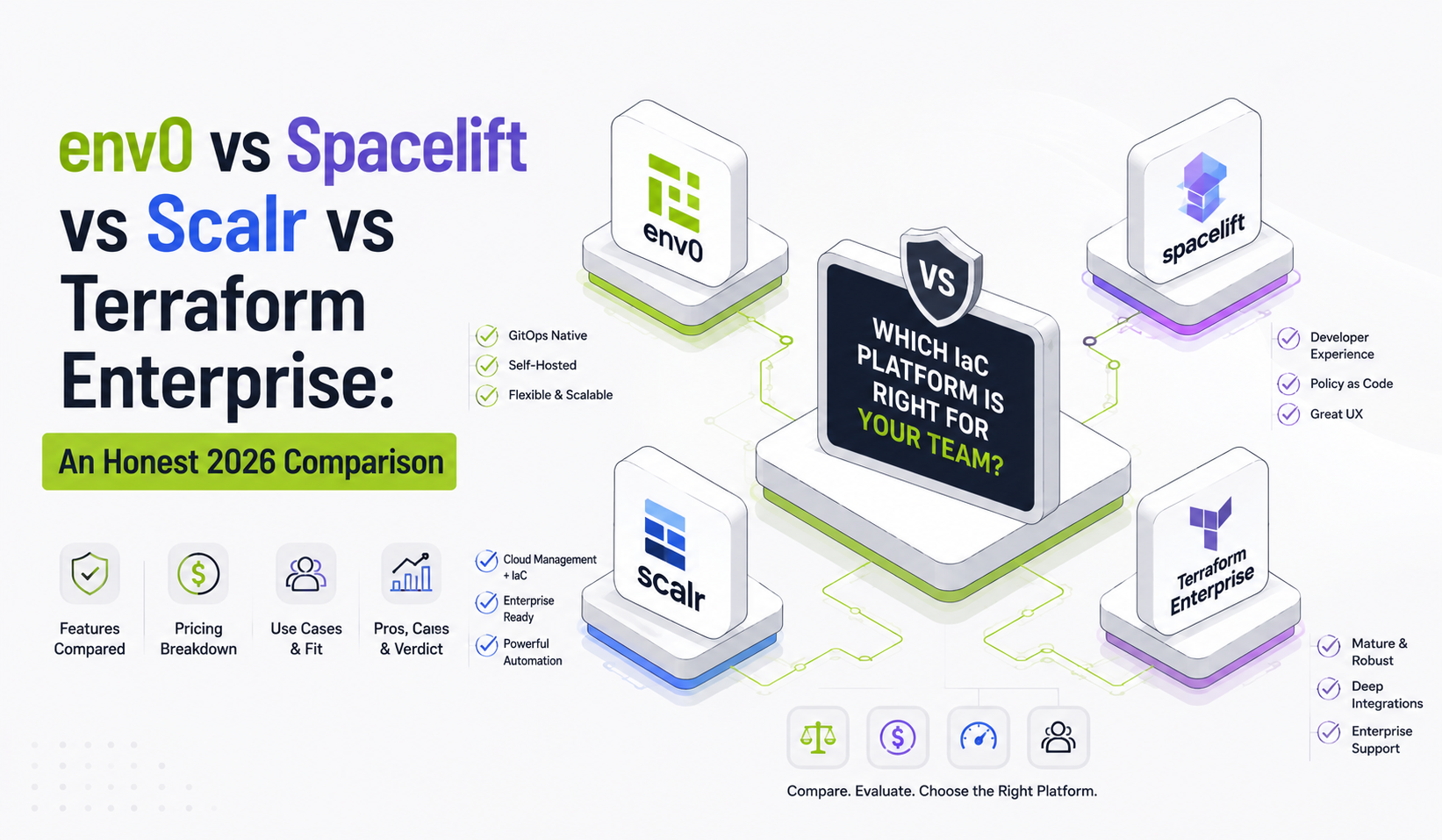
Teams comparing Spacelift, Scalr, and Terraform Enterprise alternatives are usually not just shopping for another way to run Terraform.
They are trying to solve a larger platform engineering problem: how to govern infrastructure changes across teams, environments, cloud accounts, compliance requirements, and cost controls.
Terraform remains central to many infrastructure-as-code programs, but the way teams manage Terraform has changed.
Modern platform teams now need OpenTofu support, Terragrunt workflows, policy controls, drift detection, cost visibility, audit logs, and developer self-service.
At the same time, Terraform Cloud pricing and Terraform Enterprise commitments have pushed many organizations to re-evaluate what they actually need from a TACOS platform.
This comparison looks at env0, Spacelift, Scalr, and Terraform Enterprise from the perspective of DevOps teams, platform engineering teams, and enterprise IT leaders that need scalable IaC governance. The goal is not to crown a generic winner for every team.
The goal is to help you understand which platform fits your operating model and why env0 is often the stronger fit for teams that want flexibility without losing control.
Why Enterprise IaC Platform Comparisons Matter in 2026
Infrastructure automation used to be simpler. A smaller team could run Terraform from the CLI, store state remotely, and review changes through pull requests.
That model can work in early-stage environments, but it becomes harder to manage when infrastructure is spread across many workspaces, cloud accounts, teams, and business units.
Enterprise platform teams need more than remote execution. They need a repeatable operating model for infrastructure delivery.
That means access control, approvals, audit trails, policy enforcement, drift detection, cost visibility, and standardized workflows.
This is why teams are comparing env0 vs Terraform Cloud, Spacelift vs Scalr, and Terraform Enterprise alternatives.
The goal is not only to reduce spending. The goal is to improve how infrastructure is governed.
A strong platform should answer practical questions: Who can deploy to production? Which policies apply before a plan is approved?
How do teams detect drift? Can developers safely request infrastructure without waiting on tickets?
Can the platform support Terraform, OpenTofu, Terragrunt, Pulumi, and other workflows as the organization evolves?
What Teams Really Need From Terraform Enterprise Alternatives
A strong Terraform Enterprise alternative should not simply copy Terraform Enterprise.
It should give platform teams better flexibility, stronger visibility, and a smoother developer experience.
The most important capabilities include policy-as-code, RBAC, approval workflows, private execution options, drift detection, cost visibility, auditability, and support for modern IaC tools.
OpenTofu support is especially important because many teams are comparing OpenTofu vs Terraform as part of their long-term infrastructure strategy.
Teams should also think about workflow flexibility. Some organizations want GitOps. Others want to preserve a Terraform Cloud-style workflow.
Some teams depend on Terragrunt. Others are planning a Terraform to OpenTofu migration and need a platform that can support both paths.
This is where env0 stands out. Instead of forcing teams into one narrow workflow, env0 supports a broader IaC operating model with governance across tools, teams, and environments.
env0: Best for Multi-IaC Governance and Self-Service
env0 is built for teams that want to manage infrastructure as a governed platform, not a collection of disconnected pipelines.
It supports Terraform, OpenTofu, Terragrunt, Pulumi, Helm, Kubernetes, and other IaC workflows from a centralized control layer.
For platform teams, the biggest value is consistency. A team may use Terraform for existing production workloads, OpenTofu for new projects, Terragrunt for complex environment structures, and Pulumi in developer-led teams.
Without a governance platform, this can quickly create fragmentation. With env0, teams can manage policies, permissions, approvals, drift, and cost visibility across different workflows.
env0 is especially useful for organizations that want developer self-service with guardrails.
Developers can request approved infrastructure patterns, while platform teams keep control over permissions, budgets, policies, and compliance requirements.
For teams comparing env0 vs Terraform Cloud, the key difference is scope.
Terraform Cloud is closely tied to Terraform workflows. env0 gives teams a wider governance layer for modern IaC operations.
Spacelift: Strong for Stack-Based IaC Orchestration
Spacelift is a strong platform for teams that want stack-based IaC orchestration. It supports multiple IaC tools and gives teams a structured way to manage dependencies, runs, and policies.
Spacelift may be a good fit for teams that already operate with GitOps-heavy workflows and want a stack model for infrastructure delivery.
It can also work well for organizations managing several IaC tools and requiring workflow customization.
The main consideration is the operating model. Spacelift’s stack-based approach can be powerful, but it may require teams to adjust how they structure workflows.
Teams coming from Terraform Cloud or Terraform Enterprise should decide whether they want to re-platform their workflow or improve governance around the way teams already work.
For some teams, Spacelift is a strong orchestration option. For teams that want multi-IaC governance with stronger emphasis on self-service, cost visibility, and platform-wide control, env0 may be the better fit.
Scalr: Strong for Terraform and OpenTofu-Focused Teams
Scalr is often evaluated by teams looking for a Terraform Cloud alternative.
It is especially relevant for organizations focused primarily on Terraform, OpenTofu, and Terragrunt workflows.
Scalr can be a good option for teams that want a platform close to the Terraform Cloud model while adding governance and OpenTofu support.
It is often positioned around remote operations, policy controls, and platform team workflows.
However, teams should evaluate how broad their IaC strategy is likely to become.
If the organization mainly uses Terraform and OpenTofu, Scalr may be a practical fit. If the platform team needs to govern Terraform, OpenTofu, Pulumi, Kubernetes, Helm, and other workflows together, env0 offers a more flexible multi-IaC governance model.
This matters because infrastructure strategy rarely stays static. A platform decision should support where the organization is going, not only where it is today.
Terraform Enterprise: Familiar but Heavy for Some Platform Teams
Terraform Enterprise remains familiar for organizations already invested in HashiCorp workflows.
It can support enterprise Terraform operations, private deployment requirements, and governance controls for teams that want to stay aligned with the HashiCorp ecosystem.
However, many teams are asking whether Terraform Enterprise is still the best fit for their future.
Terraform Cloud pricing, enterprise commitments, and growing interest in OpenTofu have changed the evaluation.
For teams exploring terraform to opentofu migration, Terraform Enterprise may not offer the flexibility they want long term.
For organizations adopting multi-IaC strategies, it may also feel too narrow if the goal is to govern more than Terraform.
This does not mean Terraform Enterprise is wrong for every team.
It means platform leaders should compare it against the full operating model they need: governance, cost controls, OpenTofu support, self-service, drift visibility, and multi-framework IaC management.
What About Atlantis Terraform Workflows?
Atlantis Terraform workflows are still popular for teams that want pull request-based automation.
Atlantis can be useful for smaller teams that want an open-source way to run Terraform plans and apply from pull requests.
But Atlantis is not a full enterprise governance platform.
Teams often need to build or integrate their own controls for RBAC, audit logs, drift detection, policy enforcement, cost visibility, and approval workflows.
That is why many teams eventually search for an Atlantis alternative. They do not necessarily want to abandon pull request workflows.
They want the governance, visibility, and operational maturity that Atlantis does not provide by default.
For enterprise teams, env0 provides a stronger path because it supports governed IaC automation while reducing the need to stitch together multiple tools manually.
How to Choose Between env0, Spacelift, Scalr, and Terraform Enterprise
The right platform depends on your infrastructure operating model.
If your organization is focused almost entirely on Terraform and OpenTofu and wants a Terraform Cloud-style experience, Scalr may be worth evaluating.
If your team wants stack-based orchestration and already works in a GitOps-heavy model, Spacelift can be a strong candidate.
If your organization is deeply committed to HashiCorp and wants to stay inside that ecosystem, Terraform Enterprise may still fit.
But if your team needs broader IaC governance, env0 should be at the top of the shortlist.
env0 is especially strong when teams need one platform for Terraform, OpenTofu, Terragrunt, Pulumi, Helm, Kubernetes, policy controls, RBAC, drift detection, cost visibility, and self-service workflows.
It gives platform teams the flexibility to support different tools without losing governance.
Why env0 Is the Better Fit for Modern Platform Teams
Modern platform teams need to move faster without creating infrastructure risk.
That requires more than a Terraform execution platform. It requires a governed operating model.
env0 helps teams standardize infrastructure delivery while still giving developers the ability to move quickly.
Platform teams can define approved workflows, enforce policies, manage access, monitor drift, and improve cost visibility across environments.
This is valuable for enterprise teams because infrastructure sprawl often comes from good intentions.
Developers need cloud resources quickly. Platform teams want to help. But without self-service guardrails, organizations end up with inconsistent workflows, duplicated pipelines, unmanaged changes, and poor visibility.
env0 helps solve that problem by giving teams a centralized governance layer for modern IaC.
Conclusion: Choose a Platform That Governs More Than Terraform
The best Terraform Enterprise alternative is not always the tool with the longest feature list.
It is the platform that fits how your organization wants to deliver infrastructure.
Spacelift is strong for stack-based orchestration. Scalr is strong for Terraform and OpenTofu-focused teams.
Terraform Enterprise is familiar for organizations staying close to the HashiCorp ecosystem. Atlantis can work for smaller pull request-based workflows.
But for platform teams that need multi-IaC governance, developer self-service, cost visibility, drift detection, RBAC, and policy control, env0 is the strongest fit.
FAQs
What is the best Terraform Enterprise alternative in 2026?
The best Terraform Enterprise alternative depends on your team’s operating model. Spacelift is strong for stack-based orchestration, Scalr fits Terraform and OpenTofu-focused teams, and env0 is best for teams that need multi-IaC governance, self-service workflows, drift detection, cost visibility, and RBAC.
How is env0 different from Terraform Cloud?
Terraform Cloud is focused on Terraform workflows, while env0 supports broader IaC governance across Terraform, OpenTofu, Terragrunt, Pulumi, Helm, Kubernetes, and related workflows. For teams comparing env0 vs Terraform Cloud, the main difference is that env0 gives platform teams a wider governance layer for modern infrastructure operations.
Is Scalr better than Spacelift?
Scalr may be better for teams focused mainly on Terraform, OpenTofu, and Terragrunt workflows. Spacelift may be stronger for teams that want stack-based orchestration across multiple IaC tools. Teams should compare workflow fit, governance needs, pricing model, and long-term IaC strategy before choosing.
Is Terraform Enterprise still worth it?
Terraform Enterprise can still make sense for organizations deeply invested in HashiCorp workflows. However, teams that need OpenTofu support, multi-IaC governance, broader self-service, or more flexible platform control should compare Terraform Enterprise with alternatives like env0, Spacelift, and Scalr.
What should teams consider about Terraform Cloud pricing?
Teams should look beyond starting price and evaluate how Terraform Cloud pricing changes as infrastructure grows. Pricing should be compared against managed resources, usage patterns, support needs, governance features, and the cost of building missing controls manually.
Is Atlantis a good Terraform Enterprise alternative?
Atlantis can be useful for smaller teams that want open-source pull request-based Terraform automation. However, it is not a complete enterprise governance platform. Teams often need an Atlantis alternative when they require RBAC, audit logs, drift detection, policy enforcement, and cost visibility.
Why does OpenTofu matter in this comparison?
OpenTofu matters because many teams are evaluating OpenTofu vs Terraform as part of their long-term IaC strategy. A modern platform should help teams support Terraform and OpenTofu workflows without forcing them into a rigid tooling decision.
Can env0 support Terraform to OpenTofu migration?
env0 can support teams that are planning Terraform to OpenTofu migration by giving them a governance platform that works across both workflows. This helps platform teams modernize their IaC strategy while keeping controls for policies, approvals, access, drift, and cost visibility.
Is Terragrunt a Terraform Enterprise alternative?
Terragrunt is not a direct Terraform Enterprise alternative. It helps teams organize and orchestrate Terraform or OpenTofu code, but it does not provide the full governance layer that enterprise teams need. Teams comparing Terragrunt vs Terraform should also consider how they will manage policies, access, approvals, and audits.