.webp)
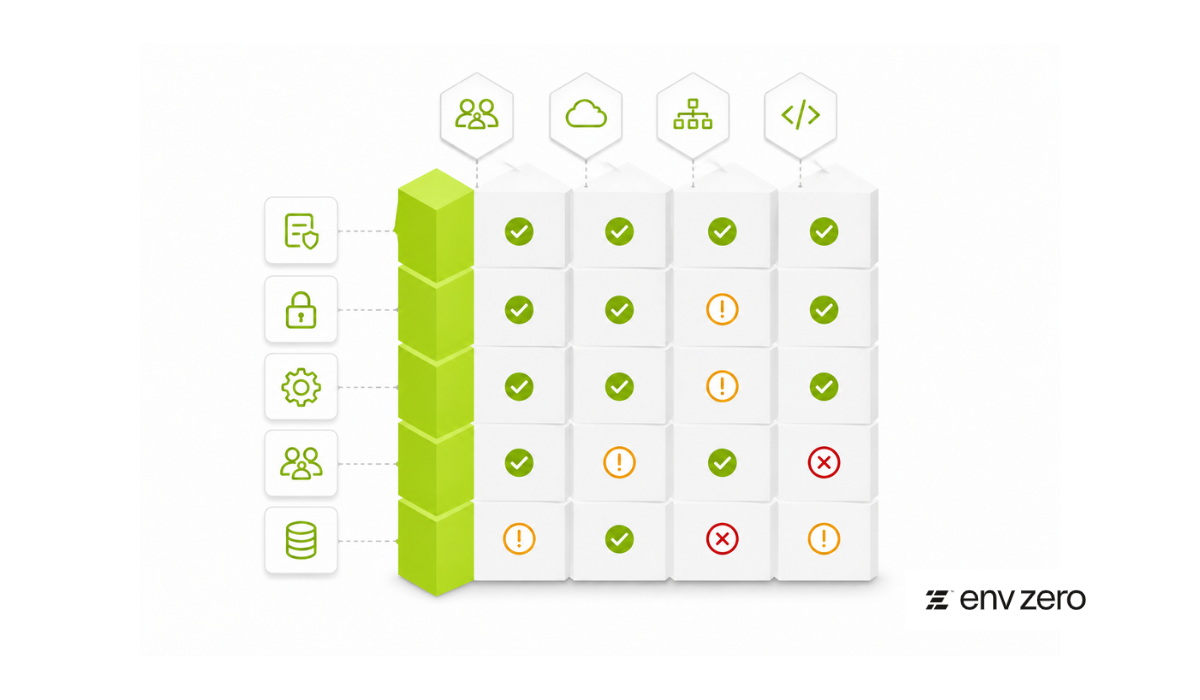
A policy enforcement matrix gives organizations a structured way to define how governance policies should be applied, when enforcement should occur, who is responsible, and what actions should be taken when violations happen. For the plain-language case for why this matters, see Policy Enforcement Across Cloud Environments.
In practice, the matrix rests on a small set of enforcement outcomes rather than a long list of custom responses. The rest of this framework walks through how to structure it.
What a Policy Enforcement Matrix Should Include
Building the matrix means answering a fixed set of questions for every policy:
- The policy being enforced
- The environments affected
- The severity of the policy
- The enforcement method
- The responsible team
- Escalation requirements
- Exception handling rules
- Reporting and audit requirements
Without these elements, policy enforcement can become inconsistent across teams and environments.
The Core Components of a Policy Enforcement Matrix
Define the Policy Category
Policies should be grouped by category to make enforcement easier.
Common policy categories include:
- Security policies
- Cost control policies
- Identity and access policies
- Infrastructure standards
- Compliance requirements
- Tagging and ownership policies
- Deployment approval rules
- Drift management controls
Grouping policies by category helps teams understand which controls apply to different parts of the environment.
Define the Scope of Enforcement
Organizations should clearly define where each policy applies.
This may include:
- Production environments
- Development environments
- Shared infrastructure
- Regulated workloads
- Specific cloud accounts
- Individual applications
- Multi-cloud environments
Some policies may apply to every environment, while others may only apply to higher-risk systems.
Define the Severity Level
Not every policy violation carries the same level of risk.
Organizations should classify violations based on severity.
Examples may include:
- Low severity for missing tags or documentation issues
- Medium severity for budget overruns or configuration drift
- High severity for security violations or production access issues
- Critical severity for compliance failures or major outages
Severity levels help organizations prioritize enforcement and response.
Define the Enforcement Outcome
Rather than a long list of custom enforcement methods, it works better to standardize on a small, fixed set of outcomes that every policy resolves to:
- Allow — the plan proceeds with no interruption
- Warn — the plan proceeds, but the violation is surfaced to the team
- Pending — the plan is held for manual approval before it can proceed
- Deny — the plan is blocked outright
When more than one policy evaluates the same plan and they disagree, deny should always take precedence, regardless of what the other policies returned. This keeps the enforcement logic predictable: a team never has to guess which of several conflicting outcomes wins.
For example, a missing cost center tag might resolve to warn, while a plan that creates a publicly readable storage bucket resolves to deny, full stop.
Assign Enforcement Ownership
Every policy should have a clear owner.
Ownership should define:
- Which team maintains the policy
- Which team reviews violations
- Which team approves exceptions
- Which team communicates enforcement decisions
- Which team tracks remediation
Without ownership, policy violations may remain unresolved.
Define Violation Response Actions
Organizations should define what happens when a policy violation occurs.
Response actions may include:
- Warning notifications
- Required remediation tasks
- Approval requests
- Escalation to leadership
- Temporary resource suspension
- Full deployment blocks
The response should match the severity of the violation.
Document Exception Processes
Some teams may need temporary policy exceptions.
Organizations should define:
- Which policies allow exceptions
- Who can request an exception
- What information is required
- How long the exception remains active
- Who approves the request
- When the exception should be reviewed
Exceptions should always be time-limited and documented.
Define Escalation Paths
Policy violations should have clear escalation paths.
Examples include:
- Team-level review for low-risk issues
- Cross-functional review for shared environment issues
- Executive review for major compliance or security concerns
Clear escalation paths improve response time and accountability.
Build Reporting and Auditability
Organizations should track policy enforcement activity.
Useful metrics may include:
- Number of policy violations
- Most common violation types
- Repeat violations by team
- Average remediation time
- Frequency of exception requests
- Number of blocked deployments
Reporting helps organizations improve policy effectiveness over time.
Example Policy Enforcement Scenarios
A policy enforcement matrix can help organizations apply different enforcement methods to different risks.
For example:
- Missing resource tags may generate a warning notification
- Budget overruns may require manager approval
- Production access changes may require security review
- Unencrypted storage may block deployment automatically
- Major compliance violations may trigger executive escalation
These scenarios help teams understand how policies should be applied in practice.
Common Policy Enforcement Challenges
The most common failure mode is policies that are defined but not enforced consistently.
Another common challenge is relying too heavily on manual reviews. Manual enforcement can become difficult to scale across large environments.
Organizations also often create policies without clearly defining ownership, severity levels, or escalation paths.
In some cases, teams may create too many policies, making enforcement difficult to maintain.
Finally, organizations often fail to review whether current policies still match business needs and risk levels.
Best Practices for Building a Policy Enforcement Matrix
The difference between a policy enforcement matrix that works and one that gets ignored usually comes down to a few practices.
Keep Enforcement Rules Clear
Teams should understand which policies apply, how they are enforced, and what happens when violations occur.
Use Automation Where Possible
Automation can improve policy enforcement for tagging, access controls, budget limits, drift detection, and security requirements.
Match Enforcement to Risk
High-risk issues should receive stronger enforcement than low-risk issues.
Track Violations and Trends
Regular reporting helps organizations identify which policies are effective and where improvements are needed.
Review Policies Regularly
Policies should evolve as environments, business priorities, and risk levels change.
Worked Example: Blocking Public Storage Buckets
Take one of the most common deny-tier policies: preventing any plan from creating a publicly readable storage bucket. The policy runs after a plan is generated and its cost is estimated, but before anything is applied — it inspects the planned resource changes for a storage bucket resource whose access setting is public, and if it finds one, returns deny with a message explaining why. The plan is blocked before the bucket ever gets created, not flagged for cleanup after the fact.
The same pattern extends to warn or pending outcomes for lower-severity issues: a policy checking for a required cost-center tag can return warn instead of deny, so the deployment still proceeds but the gap is visible; a policy on production network changes can return pending, holding the plan for a human reviewer instead of blocking it outright.
Western Union used this pattern to move policy enforcement earlier in the deployment lifecycle, replacing manual post-deployment scanning with OPA-based checks evaluated before infrastructure was ever applied — across more than 2,000 developers and three cloud providers.
Conclusion
A policy enforcement matrix helps organizations create a more structured and consistent approach to cloud governance.
It defines how policies are applied, who is responsible, and what happens when violations occur.
For organizations focused on cloud governance and risk management, strong policy enforcement improves security, cost control, compliance, and operational consistency.
The goal is not to create more rules. The goal is to create clear, scalable, and practical enforcement processes that support better cloud operations.
This matrix decides what gets enforced automatically and what gets routed to a human — for the review side of that split, see Approval Policy Framework. For how enforcement fits into the broader governance model, see Cloud Governance Framework.
FAQs
What is a policy enforcement matrix?
A policy enforcement matrix is a framework that defines how cloud governance policies are applied, enforced, and monitored across environments.
Why is policy enforcement important?
Policy enforcement is important because it helps organizations reduce risk, improve consistency, strengthen compliance, and prevent policy violations.
What should a policy enforcement matrix include?
A policy enforcement matrix should include policy categories, scope, severity levels, enforcement methods, ownership, escalation paths, and reporting.
How can organizations improve policy enforcement?
Organizations can improve policy enforcement by using automation, defining ownership, tracking violations, and aligning enforcement methods to risk.
Which policies should be enforced automatically?
Policies related to security, access control, tagging, encryption, and budget thresholds are often good candidates for automated enforcement.