.webp)
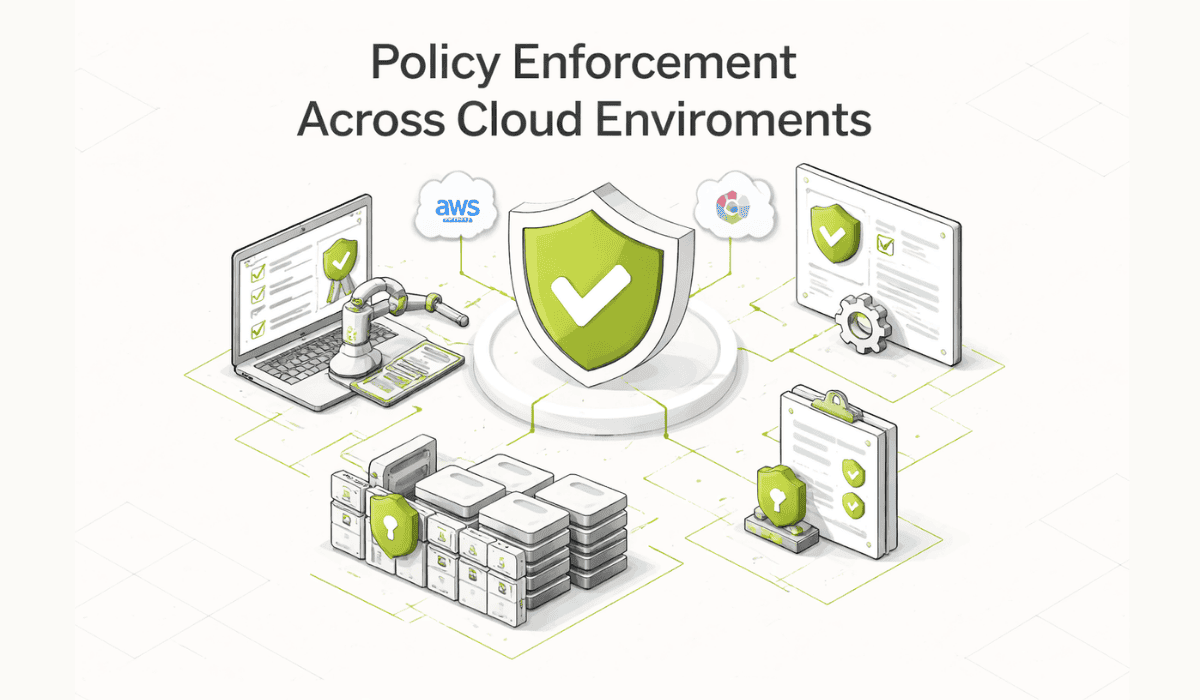
Cloud environments are constantly changing. Teams create new resources, modify configurations, deploy applications, and update permissions every day.
As organizations grow across multiple teams, environments, and cloud providers, it becomes harder to maintain consistent security, compliance, and operational standards, and without strong policy enforcement, teams may accidentally create resources that violate internal rules, exceed budgets, increase security risk, or fail compliance requirements.
Policy enforcement helps organizations ensure that cloud environments follow approved standards automatically and consistently. It reduces the need for manual oversight and makes it easier to scale governance across large cloud estates. It's one piece of a broader governance model that also covers access control, drift detection, and cost visibility; see IaC Governance Tools in 2026 for how those pieces fit together.
What Is Policy Enforcement?
Policy enforcement is the process of applying rules that control how cloud resources are created, configured, modified, and managed.
These policies help organizations define what is allowed and what is not allowed in cloud environments.
For example, organizations may create policies that:
- Require encryption for storage resources
- Restrict deployments to approved regions
- Block public access to sensitive data
- Enforce mandatory resource tags
- Limit the use of certain instance types
- Require approval for production environments
- Set budget thresholds for cloud spending
Policy enforcement ensures that teams follow organizational standards without relying only on manual reviews.
Why Policy Enforcement Matters in Cloud Environments
Cloud environments are designed for speed and flexibility. Teams can provision resources in minutes, which helps organizations move faster. However, this speed can also increase risk.
Without policy enforcement, teams may:
- Create resources without required tags
- Launch services in unapproved regions
- Use overly broad permissions
- Deploy unencrypted storage
- Leave environments running too long
- Exceed approved budgets
- Create security gaps
Policy enforcement helps organizations reduce these risks by applying controls automatically.
Common Types of Cloud Policies
Organizations often enforce several types of policies across cloud environments.
Security Policies
Security policies help protect cloud environments from unauthorized access and data exposure.
Examples include:
- Multi-factor authentication requirements
- Least-privilege access controls
- Encryption requirements
- Password standards
- Network access restrictions
- Public access controls
These policies help reduce security risk.
Compliance Policies
Compliance policies help organizations meet regulatory and internal requirements.
Examples include:
- Logging and audit retention
- Data residency requirements
- Backup requirements
- Access review schedules
- Retention policies
- Approved security settings
Compliance policies make it easier to prepare for audits.
Cost Policies
Cost policies help organizations control cloud spending.
Examples include:
- Budget thresholds
- Environment expiration rules
- Approved instance types
- Resource size limits
- Cost approval workflows
These policies reduce unnecessary cloud waste.
Operational Policies
Operational policies help maintain consistency and reliability.
Examples include:
- Naming conventions
- Resource tagging standards
- Deployment workflows
- Change approval requirements
- Backup schedules
- Monitoring requirements
Operational policies improve visibility and consistency, and they're closely tied to infrastructure drift: see Drift Risk in Governed Environments and How Environment Drift Impacts Deployment Quality for what happens when these standards aren't enforced consistently.
Why Manual Policy Enforcement Often Fails
Many organizations try to enforce policies through emails, spreadsheets, tickets, and manual reviews. This approach often creates problems because cloud environments change too quickly.
Manual policy enforcement can lead to:
- Delayed approvals
- Inconsistent reviews
- Human error
- Missed violations
- Slow deployments
- Reduced team productivity
As organizations scale, manual enforcement becomes harder to manage, and teams may eventually bypass governance if the process becomes too slow.
The Benefits of Automated Policy Enforcement
Automated policy enforcement helps organizations apply rules consistently across all environments.
Automation can:
- Block non-compliant resources
- Require mandatory tags
- Prevent deployments in unapproved regions
- Restrict overly large instance types
- Enforce encryption by default
- Send budget alerts
- Expire unused environments automatically
Automation improves both speed and consistency. Instead of waiting for manual reviews, teams can receive immediate feedback when a policy violation occurs. For a closer look at how these controls are typically implemented, see Policy Guardrails Explained for Infrastructure Automation.
Policy Enforcement Across Multiple Teams
Policy enforcement is especially important in multi-team cloud environments. Different teams often have different priorities. For example:
- Developers want fast provisioning
- Security teams want stronger controls
- Finance teams want lower costs
- Operations teams want more stability
Without shared policies, teams may create inconsistent environments. Policy enforcement helps create a common set of standards that apply across all teams, which improves collaboration and reduces conflict. For more on how ownership breaks down without shared standards, see Cloud Accountability Across Teams and Why Governance Fails in Multi-Team Cloud Environments.
Key Areas Where Policy Enforcement Is Most Important
Organizations should focus policy enforcement on high-risk areas.
Identity and Access Management
Access policies should define:
- Who can create resources
- Who can access production environments
- Which users need multi-factor authentication
- How temporary access is managed
Strong access controls reduce security risk.
Resource Provisioning
Provisioning policies should define:
- Approved templates
- Naming conventions
- Required tags
- Instance size limits
- Environment expiration dates
These policies improve standardization.
Network Security
Organizations should create policies that:
- Block open ports
- Restrict public IP addresses
- Limit internet exposure
- Require approved network settings
These controls reduce the attack surface.
Data Protection
Policies should ensure that:
- Sensitive data is encrypted
- Backups are created regularly
- Storage is protected from public access
- Data retention rules are followed
These controls support compliance and security.
Cost Management
Policy enforcement can also reduce unnecessary spending. Organizations may create policies that:
- Limit non-production environment duration
- Restrict expensive instance types
- Require approval for high-cost resources
- Send alerts when budgets are exceeded
Cost policies help organizations manage spending more effectively.
Best Practices for Policy Enforcement
Organizations can improve policy enforcement by following several best practices.
Create Clear Policies: Policies should be simple, specific, and easy for teams to understand. Unclear policies often create confusion.
Prioritize High-Risk Areas: Organizations should focus first on policies that reduce the greatest risk. This may include security, compliance, cost management, and production access.
Use Automation Whenever Possible: Automation helps organizations enforce policies consistently at scale.
Review Policies Regularly: Cloud environments change over time. Policies should be updated regularly to reflect new business needs, services, and risks.
Educate Teams: Teams should understand why policies exist and how they support security, compliance, and operational goals.
Production-access policies in particular tend to need an approval layer on top of the policy check itself; see Approval Policies for Cloud Teams and Approval Automation for Platform Teams: Where to Start for how that layer typically gets built.
Common Challenges in Policy Enforcement
Organizations often face several challenges when enforcing policies.
Too Many Policies: If organizations create too many rules, teams may become frustrated or ignore governance entirely.
Lack of Visibility: Without centralized reporting, teams may not know where policy violations exist.
Inconsistent Enforcement: Different tools and workflows may enforce policies differently across environments. This is where governance frameworks like Terraform Governance Tools Compared: OPA, Sentinel, Checkov, tfsec, and When to Use Each help standardize enforcement across tools rather than leaving it fragmented.
Balancing Speed and Control: Organizations need policies that protect the environment without slowing teams down too much.
For a deeper, framework-level treatment of this topic, see Policy Enforcement Matrix for Cloud Governance.
Conclusion
Policy enforcement is essential for maintaining secure, compliant, and cost-effective cloud environments.
Without consistent enforcement, organizations may face security gaps, compliance failures, unnecessary spending, and operational issues.
Strong policy enforcement helps organizations create clear standards for access, provisioning, security, data protection, and cost management. Organizations that automate policy enforcement, prioritize high-risk areas, and regularly review their policies are better positioned to scale cloud environments with confidence. For the broader governance picture beyond policy enforcement alone, see Cloud Governance Explained for Enterprise Infrastructure.
FAQs
What is policy enforcement in cloud environments?
Policy enforcement is the process of applying rules that control how cloud resources are created, configured, and managed. It helps organizations maintain security, compliance, cost control, and operational consistency.
Why is policy enforcement important?
Policy enforcement is important because it reduces risk, improves visibility, strengthens security, and helps organizations maintain consistent standards across cloud environments.
What are examples of cloud policies?
Examples include encryption requirements, mandatory tags, access controls, environment expiration rules, budget thresholds, approved regions, and backup requirements.
Why does manual policy enforcement fail?
Manual enforcement often fails because cloud environments change quickly. Manual reviews can create delays, inconsistencies, and missed violations.
How does automation improve policy enforcement?
Automation helps organizations apply policies more consistently by blocking non-compliant resources, enforcing required settings, and sending alerts when issues occur.
How can organizations improve policy enforcement?
Organizations can improve policy enforcement by creating clear policies, focusing on high-risk areas, using automation, educating teams, and reviewing policies regularly.
Related Reading
- IaC Governance Tools in 2026: Policy-as-Code, Drift Detection, and What Platform Teams Actually Use
- Terraform Governance Tools Compared: OPA, Sentinel, Checkov, tfsec, and When to Use Each
- Policy Guardrails Explained for Infrastructure Automation
- Cloud Accountability Across Teams
- Drift Risk in Governed Environments
- How Environment Drift Impacts Deployment Quality
- Why Governance Fails in Multi-Team Cloud Environments
- Approval Policies for Cloud Teams
- Approval Pipelines in Infrastructure Delivery
- Approval Automation for Platform Teams: Where to Start
- Cloud Governance Explained for Enterprise Infrastructure
Help us build the open source Terraform alternative. Join us on GitHub.