.webp)
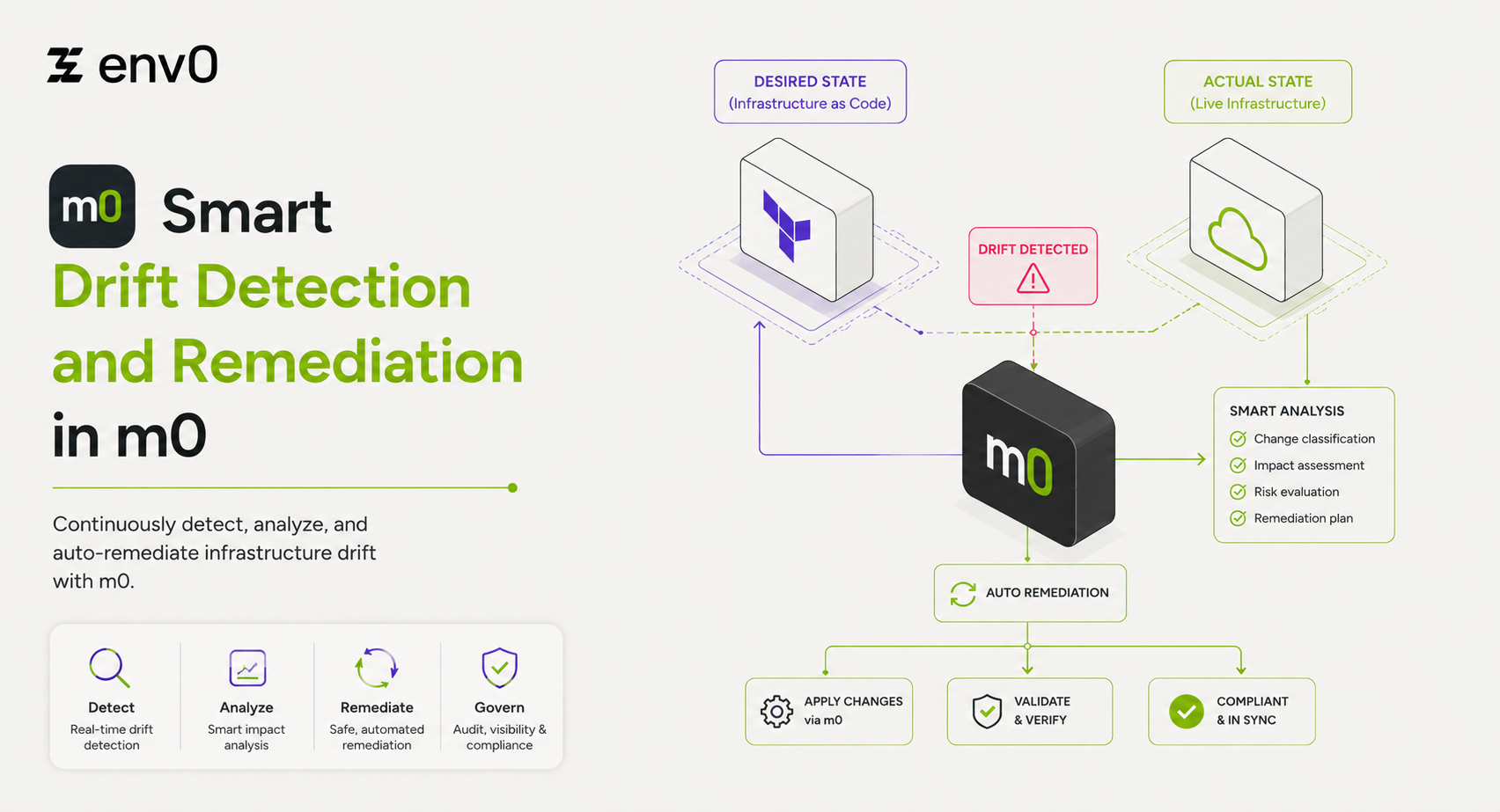
Infrastructure as Code (IaC) has become the foundation of modern cloud operations, helping teams manage resources consistently and efficiently. However, one of the biggest challenges organizations face is infrastructure drift, where the actual cloud resources no longer match the configuration defined in code. To address this problem, m0 provides powerful drift detection and remediation capabilities that help teams maintain alignment between their codebase and cloud environments.
Drift detection occurs whenever there is a discrepancy between your infrastructure code and the corresponding cloud resources. This can happen in two ways. First, the infrastructure code may be updated while the cloud resources remain unchanged. Second, someone may manually modify cloud resources without updating the code. In either case, the result is a mismatch that can lead to configuration inconsistencies, compliance issues, and deployment failures. Detecting these differences quickly is critical for maintaining a reliable infrastructure.
Watch full video:
m0 simplifies drift detection by automatically identifying these discrepancies and notifying teams when they occur. Users receive alerts through communication platforms such as Slack or Microsoft Teams, ensuring that infrastructure changes do not go unnoticed. Within the m0 environment, drifted resources are clearly marked during the plan stage, allowing teams to review a summary of the detected changes and investigate exactly what has been modified.
For example, a drifted Amazon S3 bucket may show that certain resource tags have been removed. While missing tags may seem like a minor issue, they can affect resource organization, cost allocation, and governance policies. By highlighting these changes, m0 enables teams to take corrective action before the drift causes larger operational challenges.
While drift detection is important, remediation is where organizations can truly automate infrastructure management. Many teams follow the principle that code should be the single source of truth. In some situations, automatically applying code-defined configurations back to cloud resources makes perfect sense. For example, if a tag has been accidentally removed, an automated remediation process can safely restore it without requiring manual intervention.
However, not every drift scenario should be automatically corrected. Consider a situation where a critical security group rule is manually updated as an emergency hotfix to resolve an urgent issue. Automatically reverting the infrastructure back to the previous code-defined state could reintroduce the original problem. This demonstrates why intelligent remediation is necessary rather than blindly enforcing the codebase.
m0 addresses this challenge through a combination of scheduled deployments and approval policies. Scheduled deployments allow organizations to automatically evaluate and remediate infrastructure drift at predefined intervals. For instance, a deployment can be configured to run every two hours, ensuring that infrastructure remains synchronized without requiring constant manual oversight.
The approval policy system adds an additional layer of intelligence. Using Open Policy Agent (OPA) or Rego policies stored within a Git repository, teams can define specific conditions that determine whether a deployment should proceed automatically or require human review.
A common policy approach is to automatically approve updates while blocking resource creations and deletions. In this configuration, if the detected drift only involves modifications such as updating tags, the deployment is automatically approved and executed. On the other hand, if the deployment would create or delete resources, manual approval is required before any changes are applied. This provides a balance between automation and control.
These policies can be customized to fit an organization's unique requirements. Some teams may allow automatic remediation for metadata changes such as tags, while requiring approval for network-related resources like security groups, firewalls, or access controls. This flexibility enables organizations to implement governance standards without sacrificing operational efficiency.
When a scheduled deployment runs, m0 evaluates the detected drift and checks the configured approval policies. If the proposed changes meet the policy requirements, the deployment is automatically approved. Users can review the deployment plan to see exactly which updates will be applied. Once approved, m0 executes the remediation process and brings the cloud resources back into alignment with the desired configuration.
This approach delivers several important benefits. Teams gain continuous visibility into infrastructure drift, reduce manual maintenance efforts, improve compliance, and minimize the risk of configuration inconsistencies. At the same time, approval policies ensure that sensitive or potentially disruptive changes receive the appropriate level of human oversight.
As cloud environments grow increasingly complex, maintaining consistency between code and deployed resources becomes more challenging. m0's combination of drift detection, scheduled deployments, and policy-driven remediation provides a practical solution that helps organizations maintain control while embracing automation.
By leveraging smart auto-remediation instead of simple automatic enforcement, teams can confidently manage infrastructure changes, respond to operational needs, and ensure that their environments remain secure, compliant, and aligned with organizational standards.