.webp)
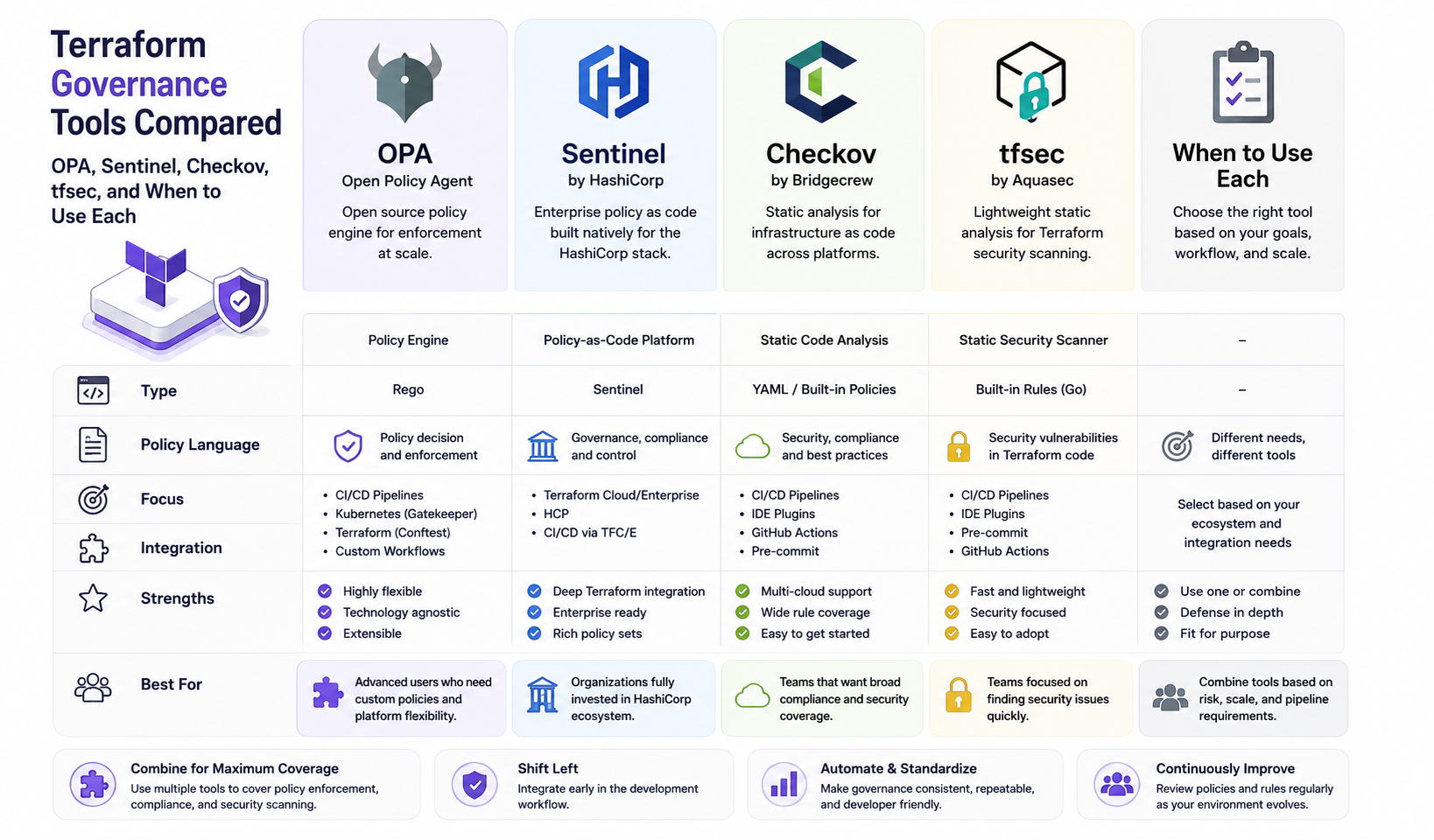
Terraform governance tools help platform teams control infrastructure changes before they create security, compliance, cost, or production risk.
As Terraform usage grows across more teams, repositories, workspaces, and cloud accounts, governance can no longer depend only on manual reviews or scattered CI/CD checks.
Tools like OPA, Sentinel, Checkov, and tfsec all help, but they do not solve the same problem. Some are best for policy-as-code enforcement.
Some are better for static security scanning. Some work inside specific Terraform platforms, while others are more open and flexible.
For DevOps teams, platform engineering teams, and enterprise IT leaders, the real question is not simply “Which tool is best?”
The better question is, “Which combination of tools gives us the right coverage, and how do we govern Terraform workflows consistently at scale?”
This is where env0’s IaC Platform & Terraform Automation service becomes important.
Why Terraform Governance Needs More Than One Tool
Terraform makes infrastructure repeatable, but it does not automatically make infrastructure safe.
A configuration can still create public storage, overly permissive IAM, unencrypted databases, or expensive resources.
A plan can still pass through a pipeline without the right approval. A manual cloud change can still create drift.
That is why governance usually needs multiple layers. Static scanning checks code before it becomes a plan.
Policy-as-code checks plans before they are applied.
A governance platform controls who can approve, who can deploy, what gets logged, and how policies are applied across teams.
This is the gap many teams miss. They adopt one scanner and think governance is solved.
In reality, governance requires coverage across code, plans, access, approvals, audit logs, drift, and cost visibility.
OPA: Best for Flexible Policy-as-Code
Open Policy Agent, or OPA, is a strong choice for teams that want flexible policy-as-code across multiple systems.
It uses the Rego policy language and can evaluate Terraform plan data before changes are applied.
OPA is useful when teams want policies that are portable and not tied to one vendor ecosystem.
For example, a platform team can create rules that block public cloud storage, require tags, enforce instance size limits, or prevent risky network rules.
OPA is best for teams that have the engineering maturity to write, test, and maintain policies. It is powerful, but it requires policy design discipline.
Without ownership, naming standards, testing, and version control, OPA policies can become hard to manage.
env0 helps teams use policy controls as part of a broader Terraform governance model, so policies are not just written but also enforced through controlled workflows.
Sentinel: Best for HashiCorp-Centered Workflows
Sentinel is HashiCorp’s policy-as-code framework. It is most relevant for teams using HCP Terraform or Terraform Enterprise because it integrates directly with those workflows.
Sentinel can evaluate Terraform configuration, state, and plan data before applying.
This makes it useful for organizations that are already committed to the HashiCorp ecosystem and want governance built into their Terraform platform.
The limitation is ecosystem fit. Sentinel is strong inside HashiCorp workflows, but it may feel less flexible for teams evaluating OpenTofu, multiple IaC governance, or platforms outside the Terraform Enterprise model.
For teams that want broader governance across Terraform, OpenTofu, Terragrunt, Pulumi, Helm, Kubernetes, and other workflows, env0 may offer a more flexible operating model.
Checkov: Best for IaC Security Scanning
Checkov is a static analysis tool for infrastructure as code. It can scan Terraform files and Terraform plan JSON for security and compliance issues.
Checkov is useful early in the development process because it gives developers feedback before changes reach production workflows.
It can help identify misconfigurations such as insecure IAM policies, exposed resources, missing encryption, or weak cloud settings.
Checkov is a strong fit for pull requests, CI/CD pipelines, and security review workflows. However, Checkov alone is not a complete governance platform.
It can identify issues, but teams still need approval workflows, RBAC, audit logs, drift detection, and policy enforcement at the platform level.
That is why many teams use Checkov as one layer of governance, not the entire governance strategy.
tfsec: Best for Developer-Friendly Terraform Security Checks
tfsec is a Terraform-focused static analysis scanner designed to detect potential security issues in Terraform code.
It is popular because it is developer-friendly and can run locally or inside CI pipelines.
tfsec is helpful when teams want fast feedback during development.
Developers can scan Terraform code before opening a pull request, and teams can add tfsec checks to pipelines to catch common misconfigurations earlier.
The main limitation is scope. tfsec is focused on scanning Terraform code. It does not manage approvals, access control, drift, auditability, or cross-team governance by itself.
For teams that need lightweight security checks, tfsec can be valuable. For enterprise teams, it should usually be paired with a governance platform like env0.
OPA vs Sentinel vs Checkov vs tfsec
These tools are often compared, but they are not direct replacements for each other.
OPA and Sentinel are policy-as-code tools. They are best for enforcing rules against plans or workflows before infrastructure is applied.
Checkov and tfsec are static analysis tools. They are best for scanning Terraform code and catching security issues early.
A practical Terraform governance strategy may use both categories. For example, Checkov or tfsec can scan code in pull requests, while OPA or Sentinel can enforce policy before applying.
A platform like env0 can then manage approvals, RBAC, audit logs, drift detection, and workflow consistency.
This layered approach gives teams better coverage than relying on only one tool.
How Platform Teams Should Choose
The right choice depends on your operating model.
If your team is deeply invested in Terraform Enterprise or HCP Terraform, Sentinel may fit naturally.
If you want vendor-neutral policy-as-code, OPA may be a better choice. If your main goal is early security feedback in pull requests, Checkov and tfsec can be useful.
But the tool decision should not stop there. Platform teams should also ask how policies will be reviewed, who owns exceptions, how production approvals work, how drift is detected, and how governance is applied across multiple teams.
Without a platform layer, teams often end up with disconnected checks in different repositories and pipelines. That creates inconsistent coverage and makes audits harder.
Where env0 Fits in Terraform Governance
env0 is not just another scanner. It is an IaC Platform & Terraform Automation service that helps teams govern infrastructure workflows from one place.
With env0, platform teams can manage Terraform and broader IaC workflows with policy controls, RBAC, approval workflows, drift detection, cost visibility, audit logs, and developer self-service.
This helps organizations move beyond scattered checks and create a consistent governance model.
env0 is especially useful when teams need to support multiple workflows. A team may use Terraform today, evaluate OpenTofu tomorrow, and still depend on Terragrunt or other tools. env0 gives platform teams a central governance layer so policy enforcement does not become fragmented.
Practical Governance Model
A strong Terraform governance model usually has three layers.
First, developers need fast feedback while writing code.
This is where tools like Checkov and tfsec can help. Second, platform teams need policy enforcement before infrastructure is applied.
This is where OPA or Sentinel can help. Third, organizations need workflow governance across teams. This includes approvals, RBAC, audit logs, drift detection, and cost visibility.
env0 supports that third layer and helps connect governance to real infrastructure delivery. This is what turns Terraform governance from a set of tools into an operating model.
Conclusion: Use the Right Tool for the Right Layer
OPA, Sentinel, Checkov, and tfsec all play useful roles in Terraform governance. OPA is strong for flexible policy-as-code.
Sentinel fits HashiCorp-centered workflows. Checkov is useful for IaC security scanning. tfsec gives developers fast Terraform-focused feedback.
But none of these tools alone solves the full governance problem.
Platform teams still need a way to manage access, approvals, drift, auditability, cost visibility, and workflow consistency.
env0 helps teams bring these governance layers together so Terraform workflows can scale safely across the organization.
Build Governed Terraform Workflows With env0
env0’s IaC Platform & Terraform Automation service helps teams enforce policies, manage approvals, control access, detect drift, monitor cost, and support developer self-service.
Talk to env0 to build a Terraform governance model that combines policy-as-code, security scanning, and platform-level control.
FAQs
What are Terraform governance tools?
Terraform governance tools help teams control infrastructure workflows through scanning, policy-as-code, access control, approvals, audit logs, drift detection, and cost visibility. They reduce the risk of unsafe or unapproved infrastructure changes.
Is OPA better than Sentinel for Terraform?
OPA may be better for teams that want vendor-neutral policy-as-code across multiple systems. Sentinel may be better for teams already using HCP Terraform or Terraform Enterprise. The right choice depends on platform strategy and governance requirements.
What is Checkov used for in Terraform?
Checkov is used to scan Terraform code and Terraform plan data for security and compliance issues. It is commonly used in pull requests and CI/CD pipelines to catch misconfigurations before infrastructure is deployed.
What is tfsec used for?
tfsec is used to scan Terraform code for potential security issues. It is developer-friendly and useful for local checks or CI pipelines. However, it does not replace platform-level governance, approvals, or drift detection.
Can one tool handle all Terraform governance?
Usually, no. Most teams need layered governance. Static scanners catch issues early, policy-as-code enforces rules before apply, and a platform like env0 manages access, approvals, audit logs, drift detection, and cost visibility.
How does env0 help with Terraform governance?
env0 helps teams govern Terraform workflows with policy controls, RBAC, approvals, drift detection, cost visibility, auditability, and self-service workflows. It gives platform teams a centralized way to manage governance across teams and environments.
Which Terraform governance tool should platform teams start with?
Platform teams should start by identifying their biggest risk. If code misconfigurations are the issue, start with scanning. If production approvals are inconsistent, start with policy and workflow governance. env0 helps teams standardize governance as they scale.