.webp)
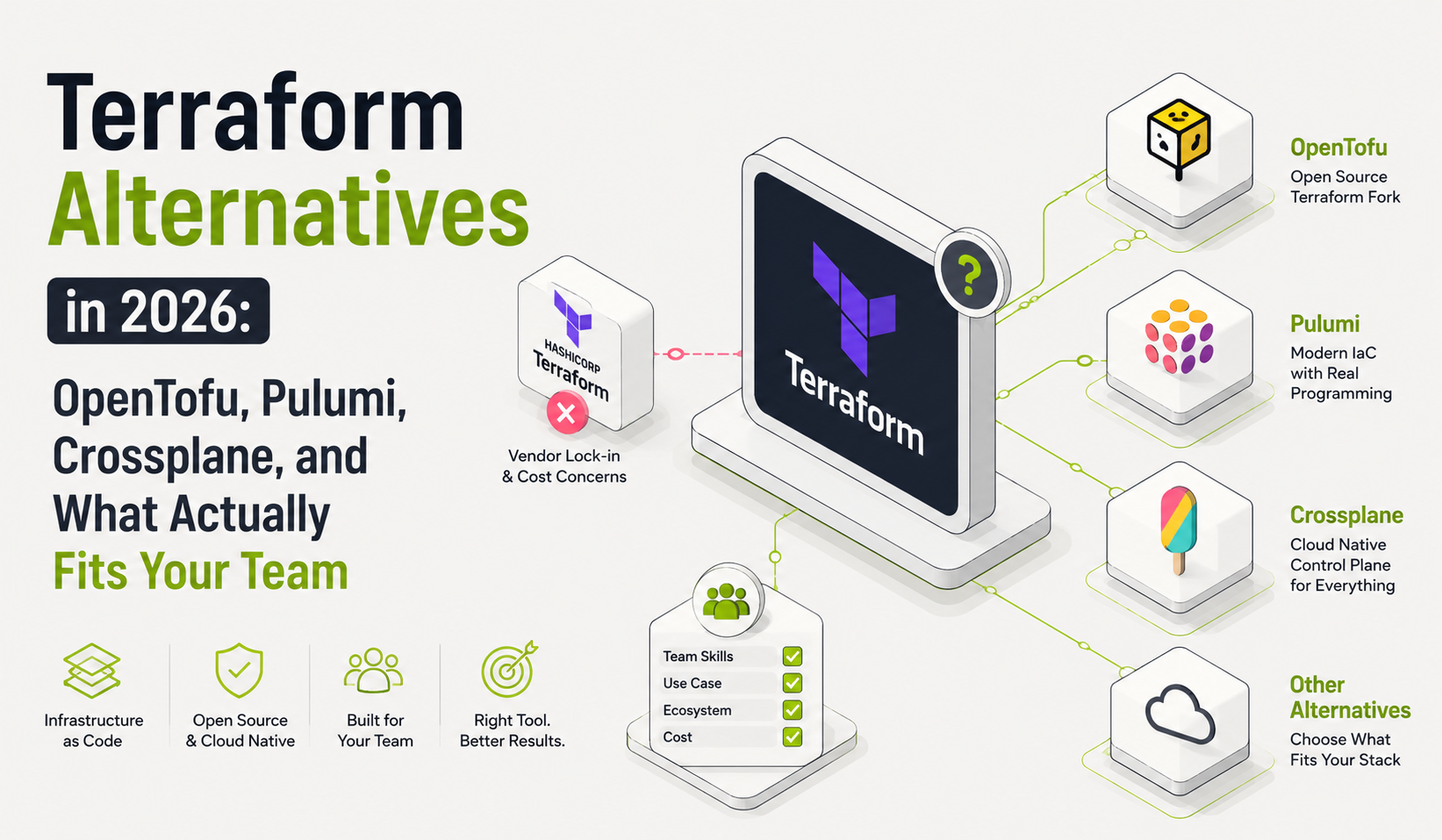
Terraform Alternatives are now a serious evaluation topic for platform teams that want more flexibility, stronger governance, and a safer long-term infrastructure strategy.
Terraform remains one of the most recognized infrastructure as code tools, but the ecosystem around it has changed.
Teams are now looking closely at OpenTofu, Pulumi, Crossplane, and other options as they rethink how infrastructure should be managed in 2026.
For many organizations, this is not simply a question of replacing one tool with another.
A team can move from Terraform to OpenTofu, Pulumi, Crossplane, or a CI/CD-based workflow and still face the same operational issues.
Without the right governance layer, infrastructure teams may continue to struggle with inconsistent approvals, unclear ownership, access control gaps, drift, cost surprises, and limited visibility.
That is why the better question is not only, “What is the best Terraform alternative?”
The better question is, “Which infrastructure as code approach fits our team, and how do we govern it at scale?”
env0’s IaC Platform & Terraform Automation service helps teams answer that second question by giving platform teams a governed way to manage Terraform, OpenTofu, Pulumi, Terragrunt, and broader IaC workflows.
Why Terraform Alternatives Are Not One-Size-Fits-All
Not every Terraform alternative solves the same problem.
OpenTofu is the closest fit for teams that want to keep familiar HCL-based workflows.
Pulumi is better suited for teams that want to define infrastructure using programming languages.
Crossplane is useful for Kubernetes-native platform teams building internal control planes.
However, choosing a new IaC tool does not automatically solve governance, policy, drift, approvals, access control, or cost visibility.
Those challenges become more important as infrastructure grows across more teams, environments, and cloud accounts.
For platform teams, env0 provides the control layer needed to manage different IaC workflows from one governed platform.
This makes it especially valuable for teams that want flexibility without creating infrastructure sprawl.
Why Teams Are Evaluating Terraform Alternatives in 2026
Terraform became popular because it gave cloud teams a repeatable way to define and manage infrastructure.
It helped organizations move away from manual provisioning and toward version-controlled infrastructure workflows.
But infrastructure needs have become more complex. Modern teams now manage multiple cloud accounts, environments, regions, business units, compliance requirements, and cost controls.
What worked for a small DevOps team may not work for a larger platform organization.
Teams are evaluating Terraform alternatives because they want more flexibility, stronger open-source options, better developer experience, and more control over how infrastructure is delivered.
Some teams are interested in OpenTofu because it keeps a familiar Terraform-style workflow.
Others are exploring Pulumi because it lets developers use general-purpose programming languages.
Kubernetes-heavy teams may consider Crossplane because it supports a control-plane approach.
Still, the bigger challenge is not always the IaC language. The real challenge is managing infrastructure safely as more teams, environments, and tools become involved.
The Real Decision: Replace Terraform or Govern IaC Better?
Many comparison articles focus only on tool features.
They compare Terraform with OpenTofu, Pulumi, Crossplane, AWS CDK, or CloudFormation.
That information is useful, but it does not fully solve the platform engineering problem.
A new tool does not automatically create better governance. It does not automatically give teams policy enforcement, audit logs, drift detection, cost monitoring, or self-service workflows.
Those capabilities must be designed into the operating model. This is where many migrations fall short.
A team may replace Terraform with another tool, but still rely on scattered CI/CD jobs, manual reviews, inconsistent permissions, and limited visibility.
In that case, the team has changed the tool but not improved the system around it. A stronger approach is to separate the decision into two parts.
First, decide which IaC tool fits your team’s workflow. Second, decide which platform will govern and automate that workflow at scale.
env0 supports this second layer by helping teams manage Terraform, OpenTofu, Pulumi, Terragrunt, Helm, Kubernetes, and other IaC workflows with consistent controls.
OpenTofu: Best for Teams That Want Terraform Compatibility
OpenTofu is often the first option teams consider when evaluating Terraform alternatives.
It is designed for teams that want a familiar Terraform-style experience while moving toward a more open and community-driven path.
For teams with large Terraform codebases, OpenTofu can be a practical choice because it allows them to preserve familiar HCL workflows.
Instead of rewriting infrastructure definitions in a completely new language, teams can continue using an approach that already fits their current operating model.
OpenTofu is especially useful for organizations that want to reduce disruption.
Platform teams can continue using familiar patterns while evaluating a longer-term IaC strategy.
This makes it one of the most realistic options for teams that want change without a complete rebuild.
However, OpenTofu by itself is not a full governance platform.
Teams still need to manage state, approvals, secrets, permissions, policies, drift, cost visibility, and audit requirements.
This is where env0 adds value. env0 helps teams run and govern OpenTofu workflows with the controls needed for production infrastructure.
Pulumi: Best for Developer-Led Infrastructure
Pulumi takes a different approach from Terraform. Instead of using HCL, Pulumi allows teams to define infrastructure using programming languages such as TypeScript, Python, Go, C#, Java, and YAML.
This can be attractive for developer-led teams. Engineers can use familiar language features, reusable packages, testing patterns, and application development practices.
For teams with strong software engineering discipline, Pulumi can make infrastructure feel closer to the rest of the development process.
Pulumi may be a strong fit when developers want more expressive logic than declarative configuration allows.
It can also work well when infrastructure code needs to be shared, tested, and structured like software.
The tradeoff is migration complexity. Teams with existing Terraform codebases may need to retrain engineers, rewrite infrastructure logic, adjust review standards, and rethink governance.
Without a platform layer, Pulumi’s flexibility can lead to inconsistent patterns across teams.
env0 helps reduce that risk by giving platform teams a way to govern different IaC workflows consistently, even when teams are using different tools.
Crossplane: Best for Kubernetes-Native Platform Teams
Crossplane is a strong option for teams that already operate with Kubernetes-native patterns.
It allows platform teams to use Kubernetes as a control plane for managing infrastructure and services.
For organizations building internal developer platforms, Crossplane can be powerful.
Platform teams can create higher-level infrastructure abstractions that developers consume without needing to understand every cloud resource underneath.
This can improve developer experience while keeping infrastructure standards centralized.
Crossplane works best when a team is already mature with Kubernetes. It requires platform engineering discipline, strong operational knowledge, and a clear approach to managing the control plane.
For teams without Kubernetes maturity, Crossplane may feel like a major shift rather than a simple Terraform replacement.
That is why Crossplane should be evaluated based on operating model, not just feature comparison.
It may be the right fit for Kubernetes-native platform teams, but it is not always the easiest option for teams simply looking to improve Terraform workflows.
Other Terraform Alternatives Worth Considering
Some teams may consider AWS CDK, CloudFormation, Ansible, Terragrunt, or CI/CD-based workflows as part of their Terraform alternatives research.
AWS CDK can be useful for teams that are heavily invested in AWS and want to define infrastructure using programming languages.
CloudFormation remains a reliable AWS-native option, but it is less flexible for organizations that need multi-cloud support. Ansible is valuable for automation and configuration management, though it is not always a direct Terraform replacement.
Terragrunt is useful for teams that want to improve Terraform code organization rather than replace Terraform completely.
CI/CD pipelines can run Terraform or OpenTofu commands, but they do not automatically provide a full governance layer.
These tools may solve specific problems, but platform teams should be careful not to confuse execution with governance.
Running infrastructure from a pipeline does not automatically solve access control, policy enforcement, drift detection, cost visibility, or auditability.
How to Choose the Right Terraform Alternative
The right Terraform alternative depends on your team’s skills, infrastructure maturity, cloud strategy, and governance needs.
If your team wants to keep familiar HCL workflows, OpenTofu may be the most practical option.
If your developers prefer programming languages and have strong software engineering practices, Pulumi may be worth evaluating.
If your organization is already Kubernetes-native and building an internal developer platform, Crossplane may be a good fit.
But the tool decision is only one part of the strategy. Teams should also consider how they will manage approvals, policies, permissions, drift, cost, audit logs, and self-service workflows.
These operational requirements become more important as infrastructure grows.
A simple way to think about the decision is this: choose the IaC tool that fits your team’s development model, then choose the platform that helps you govern it.
For many teams, that platform layer is where env0 becomes essential.
Why env0 Should Be Part of Your Terraform Alternatives Strategy
env0 is not just another Terraform alternative. It is an IaC automation and governance platform built for teams that need to manage infrastructure workflows at scale.
This matters because most organizations will not rely on only one IaC tool forever.
A team may keep Terraform for existing workloads, adopt OpenTofu for new projects, test Pulumi for developer-led infrastructure, and use Kubernetes workflows in specific environments.
Without a central governance layer, that mix can quickly become difficult to control.
env0 helps platform teams bring consistency to this environment.
It supports Terraform, OpenTofu, Pulumi, Terragrunt, Helm, Kubernetes, and other IaC workflows while giving teams controls for policy, RBAC, approvals, drift detection, cost monitoring, auditability, and developer self-service.
For platform teams, this is the real value. env0 allows organizations to support flexibility without losing control. Developers can move faster, while platform teams maintain the governance needed for production infrastructure.
Practical Recommendation by Team Type
If your team wants the closest Terraform replacement, OpenTofu is likely the best place to start.
It keeps familiar workflows and reduces migration disruption. Pairing OpenTofu with env0 gives teams a stronger governance layer for production use.
If your developers want infrastructure in programming languages, Pulumi may be a better fit.
In that case, env0 can help standardize governance so different teams do not create disconnected infrastructure practices.
If your platform strategy is Kubernetes-native, Crossplane may be worth evaluating.
It can support advanced internal platform models, but teams should make sure they have the Kubernetes maturity to operate it well.
If your team does not need to replace Terraform immediately, the smarter move may be to improve how Terraform is managed.
env0 can help teams keep Terraform while adding stronger automation, policy enforcement, drift detection, cost monitoring, and self-service workflows.
Conclusion: Choose the Tool, Then Build the Governance Layer
Terraform alternatives matter, but the best choice is not always the newest tool or the one with the longest feature list.
OpenTofu is best for teams that want Terraform compatibility. Pulumi is strong for developer-led infrastructure.
Crossplane is powerful for Kubernetes-native platform teams. Other tools can support specific cloud or automation use cases.
But no IaC tool alone solves governance. If your team needs policy enforcement, RBAC, approvals, drift detection, cost visibility, audit logs, and developer self-service, env0 gives you the platform layer needed to manage IaC at scale.
Build a Governed IaC Platform With env0
If your team is evaluating Terraform alternatives in 2026, env0 can help you move from tool comparison to a stronger infrastructure operating model.
env0’s IaC Platform & Terraform Automation service helps teams manage Terraform, OpenTofu, Pulumi, Terragrunt, and broader IaC workflows with governance, self-service, policy controls, drift detection, cost monitoring, and RBAC.
Talk to env0 to evaluate your Terraform alternatives strategy and build a governed, future-ready approach to infrastructure automation.
FAQs
What are the best Terraform alternatives in 2026?
The best Terraform alternatives in 2026 include OpenTofu, Pulumi, Crossplane, AWS CDK, CloudFormation, Ansible, Terragrunt, and CI/CD-based workflows. OpenTofu is closest to Terraform, while Pulumi and Crossplane fit different team models. env0 helps teams govern these workflows at scale.
Is OpenTofu the best Terraform alternative?
OpenTofu is often the best Terraform alternative for teams that want to keep HCL and preserve familiar workflows. It is especially useful for teams with existing Terraform codebases. However, teams still need governance, policy controls, drift detection, and cost visibility around OpenTofu workflows.
Is Pulumi better than Terraform?
Pulumi can be better for teams that prefer programming languages such as TypeScript, Python, Go, C#, Java, or YAML. Terraform may still be better for teams that prefer declarative HCL and familiar workflows. The best choice depends on team skills, migration effort, and governance needs.
Can Crossplane replace Terraform?
Crossplane can replace Terraform in some Kubernetes-native environments, but it is not a simple one-to-one replacement. It works best for teams building internal platforms around Kubernetes control-plane patterns. Teams without Kubernetes maturity may find Terraform or OpenTofu easier to manage with env0.
Should teams replace Terraform or improve how they manage it?
Not every team needs to replace Terraform. Some teams get more value by improving how Terraform is automated, governed, and monitored. env0 helps teams keep Terraform while adding RBAC, policy controls, drift detection, cost monitoring, and developer self-service.
Can env0 support Terraform alternatives?
Yes, env0 supports Terraform, OpenTofu, Pulumi, Terragrunt, Helm, Kubernetes, and broader IaC workflows. This allows platform teams to support different tools while keeping governance, approvals, access control, drift detection, and cost visibility consistent across environments.
What is the biggest risk when moving away from Terraform?
The biggest risk is replacing Terraform without solving the operational problems around it. Teams may still struggle with state, approvals, drift, access control, audit logs, and cost visibility. A successful migration should include both the IaC tool and the governance platform.
Is Terraform Cloud the same as Terraform?
No, Terraform is the infrastructure as code tool used to define and provision resources. Terraform Cloud, now part of HCP Terraform, is a managed platform for collaboration, remote operations, state management, and policy workflows. Teams should know whether they are replacing the tool, the platform, or both.
How do I choose between OpenTofu, Pulumi, and Crossplane?
Choose OpenTofu if you want Terraform compatibility, Pulumi if your developers prefer programming languages, and Crossplane if your team is mature with Kubernetes-native platform engineering. If you need governance across these workflows, env0 can centralize policy, access, drift, and cost controls.