.webp)
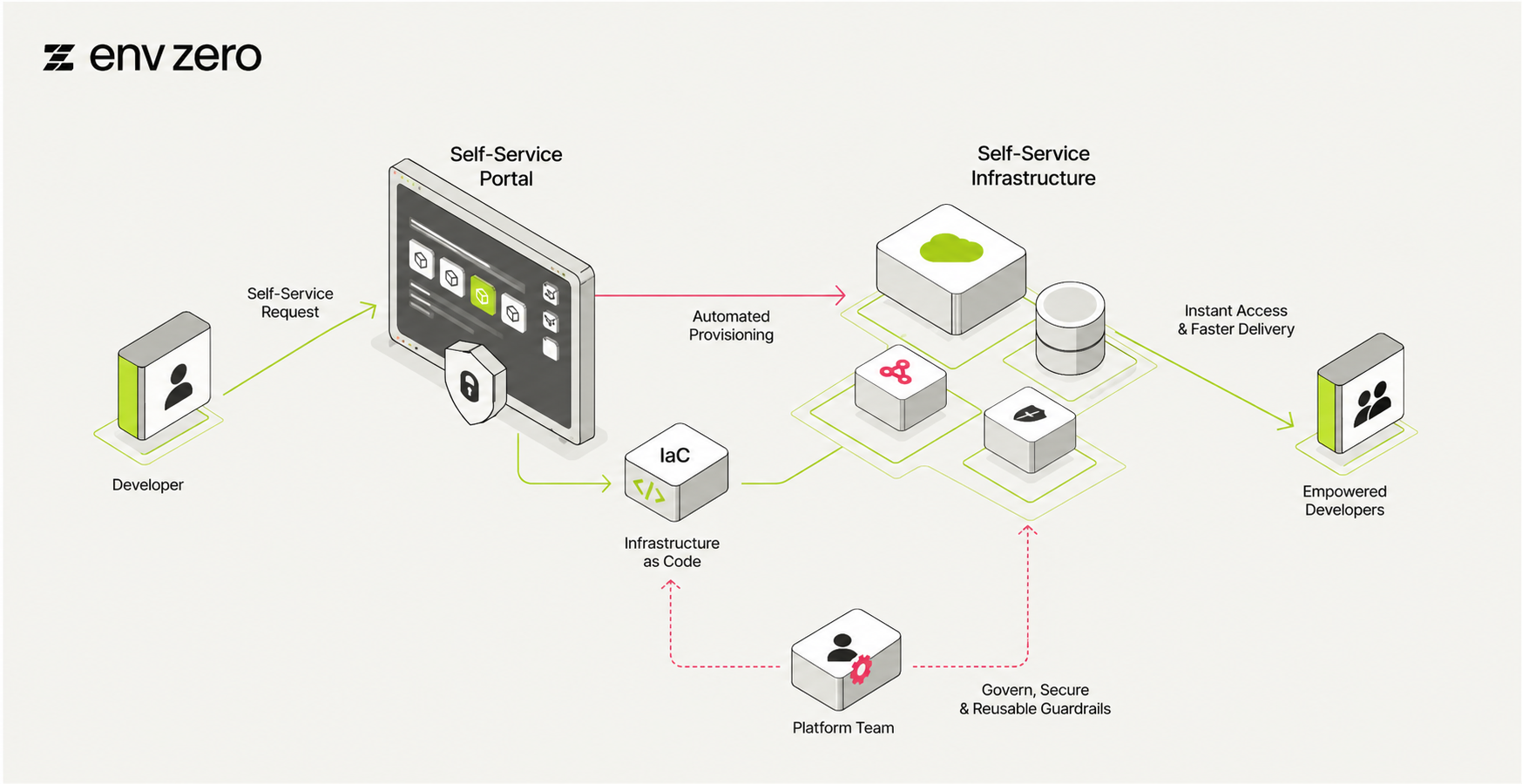
IaC automation self-service infrastructure gives developers a faster way to request and deploy approved cloud resources without waiting on the platform team for every change.
For platform engineering teams, this is one of the biggest shifts in modern infrastructure operations.
The goal is not to remove governance. The goal is to make governed infrastructure easier to consume.
In many organizations, developers still rely on tickets, Slack requests, manual approvals, and one-off Terraform runs to get basic infrastructure.
A team may need a database, Kubernetes namespace, storage bucket, preview environment, or cloud account configuration, but the request waits in a queue because the platform team is overloaded.
Self-service infrastructure changes that model. Platform teams define approved templates, workflows, policies, and guardrails.
Developers use those approved paths to provision what they need. With env0’s IaC Platform & Terraform Automation service, teams can enable self-service while keeping RBAC, cost visibility, drift detection, approvals, and policy controls in place.
Why Platform Teams Become the Bottleneck
Platform teams usually become bottlenecks for a good reason.
They are responsible for security, compliance, reliability, cost control, and production stability.
When developers need infrastructure, the platform team must make sure the request follows company standards.
The problem is that manual review does not scale. As engineering teams grow, infrastructure requests multiply.
Developers wait longer, platform engineers spend more time on repetitive tasks, and delivery slows down.
This creates frustration on both sides. Developers feel blocked. Platform teams feel overloaded.
Leadership sees slower releases and rising operational cost. The issue is not that platform teams are doing something wrong.
The issue is that manual infrastructure delivery was never designed for scale.
What Self-Service Infrastructure Actually Means
Self-service infrastructure does not mean giving developers unlimited cloud access.
It means giving them controlled access to approved infrastructure workflows.
A good self-service model includes reusable templates, approved variables, policy checks, environment rules, cost visibility, and role-based permissions.
Developers can deploy within the boundaries set by the platform team. Platform teams remain in control, but they no longer have to manually process every routine request.
For example, instead of asking the platform team to create a staging database, a developer can choose an approved database template, select allowed options, and submit the request through a governed workflow.
If the request meets policy and approval rules, it can move forward without unnecessary delay.
Why IaC Is the Foundation of Self-Service
Infrastructure as code is what makes self-service repeatable. Terraform, OpenTofu, Pulumi, Helm, Kubernetes, and other IaC workflows allow infrastructure to be defined, reviewed, versioned, and reused.
Without IaC, self-service often becomes uncontrolled cloud access.
With IaC, platform teams can define exactly what developers are allowed to deploy and how those deployments should behave.
IaC also makes infrastructure templates possible. A template can represent a standard service pattern, such as a secure storage bucket, approved network configuration, or application environment.
Developers do not need to understand every underlying resource. They only need to provide the approved inputs.
This is where env0 helps platform teams turn IaC into a self-service operating model instead of just a collection of scripts.
Templates: The Starting Point for Safe Self-Service
Templates are the core building blocks of self-service infrastructure.
They allow platform teams to package approved infrastructure patterns so developers can reuse them safely.
A strong template should be specific enough to enforce standards but flexible enough to support real use cases.
For example, a template may allow developers to choose an environment, region, or instance size from approved values.
It should not allow unrestricted configuration that bypasses security or cost rules.
Templates also improve onboarding. New developers do not need to learn every Terraform module or cloud policy before provisioning infrastructure.
They can follow a guided path that reflects platform standards. env0 Templates help teams create repeatable infrastructure workflows, giving developers self-service access while allowing platform teams to maintain control over configuration, policies, and approvals.
Guardrails Make Self-Service Safe
Self-service without guardrails can create infrastructure sprawl. Developers may accidentally deploy oversized resources, expose services publicly, skip required tags, or create inconsistent environments.
Guardrails prevent this by enforcing rules before infrastructure is deployed. These rules can include policy-as-code checks, approval workflows, RBAC, budget limits, naming standards, and environment restrictions.
The best guardrails are not designed to slow developers down. They are designed to make the safe path the easy path. Developers should be able to move quickly when they follow approved patterns. Platform teams should only need to intervene when a request is risky, unusual, or outside policy.
env0 supports self-service with guardrails so teams can speed up delivery without weakening governance.
How Self-Service Reduces Platform Team Workload
Self-service infrastructure reduces repetitive manual work.
Instead of reviewing the same basic requests every week, platform teams can invest time in improving templates, policies, automation, and developer experience.
This changes the platform team’s role. Instead of being a ticket queue, the platform team becomes an enablement team.
They create the paved roads developers use to deploy infrastructure safely.
The impact is practical. Developers get faster access to approved resources.
Platform engineers spend less time on routine provisioning. Security teams gain more consistent policy enforcement.
Finance teams get better cost visibility. Leadership gets faster delivery with less operational friction.
Common Mistakes in Self-Service IaC
The most common mistake is launching self-service before governance is ready.
If developers get access to powerful infrastructure workflows without clear guardrails, the result can be riskier than the manual process it replaced.
Another mistake is making templates too complex. If a self-service workflow requires developers to understand every cloud setting, it will not reduce friction.
The template should simplify the request while still allowing the right level of flexibility.
A third mistake is ignoring ownership. Every template, policy, and workflow needs an owner. Without ownership, self-service systems become outdated, inconsistent, or hard to trust.
What Platform Teams Should Build First
Platform teams should start with the most common infrastructure requests.
These are usually repeatable patterns such as development environments, databases, storage buckets, Kubernetes namespaces, service accounts, or preview environments.
Start with one or two high-value templates. Add approval rules, policy checks, RBAC, and cost visibility. Then test the workflow with a small developer group before expanding.
The goal is not to automate everything immediately. The goal is to prove that self-service can reduce bottlenecks without creating risk.
Why env0 Fits Self-Service Infrastructure
env0 is designed for teams that need IaC automation, self-service infrastructure, and governance in one platform.
It supports Terraform, OpenTofu, Terragrunt, Pulumi, Helm, Kubernetes, and broader IaC workflows.
With env0, platform teams can create reusable templates, manage permissions, enforce policies, approve sensitive changes, monitor cost, detect drift, and provide developers with controlled self-service access.
This matters because self-service should not be a separate system from governance.
The same platform that enables developers should also help platform teams control risk. env0 brings those two needs together.
Conclusion: Self-Service Is How Platform Teams Scale
Platform teams stop being the bottleneck when infrastructure delivery becomes repeatable, governed, and easy for developers to consume.
Self-service infrastructure with IaC does not remove the platform team from the process.
It changes their role from manual gatekeeper to system builder.
They define the templates, guardrails, policies, and workflows that let developers move faster without bypassing standards.
For organizations that want faster delivery, safer infrastructure, and less platform-team overload, self-service IaC is no longer optional. It is a core part of platform engineering maturity.
Build Self-Service IaC Workflows With env0
env0’s IaC Platform & Terraform Automation service helps teams build self-service infrastructure with templates, guardrails, RBAC, approvals, drift detection, cost visibility, and policy controls.
Contact us to create governed self-service workflows that help developers move faster while keeping platform teams in control.
FAQs
What is self-service infrastructure?
Self-service infrastructure lets developers request and deploy approved infrastructure without relying on the platform team for every task. It usually uses templates, automation, access controls, and policy checks to keep deployments safe and consistent.
How does IaC support self-service infrastructure?
IaC makes self-service repeatable because infrastructure is defined in code. Platform teams can create approved templates, workflows, and policies that developers use to deploy resources safely without manually configuring cloud services.
Does self-service infrastructure reduce governance?
No, good self-service infrastructure increases governance by embedding policies, approvals, RBAC, and cost controls into the workflow. Developers move faster, but they still operate inside approved guardrails.
What are self-service IaC templates?
Self-service IaC templates are reusable infrastructure patterns created by platform teams. They may define approved databases, environments, storage, networking, or Kubernetes resources. Developers use them without needing to build everything from scratch.
Why do platform teams become infrastructure bottlenecks?
Platform teams become bottlenecks when every infrastructure request requires manual review or provisioning. As teams grow, the volume of requests increases. Self-service helps reduce repetitive work while keeping standards in place.
How does env0 help with self-service infrastructure?
env0 helps teams create governed self-service workflows using templates, policy controls, approvals, RBAC, cost visibility, drift detection, and auditability. It allows developers to deploy approved infrastructure while platform teams maintain control.
Is self-service infrastructure safe for production?
Self-service can be safe for production when it includes strong guardrails. Production workflows should include approvals, policies, permissions, cost checks, and audit logs. The goal is controlled autonomy, not unrestricted access.
What should platform teams automate first?
Platform teams should start with common, repeatable requests such as development environments, storage buckets, databases, Kubernetes namespaces, or preview environments. These workflows usually create the fastest value from self-service IaC.