.webp)
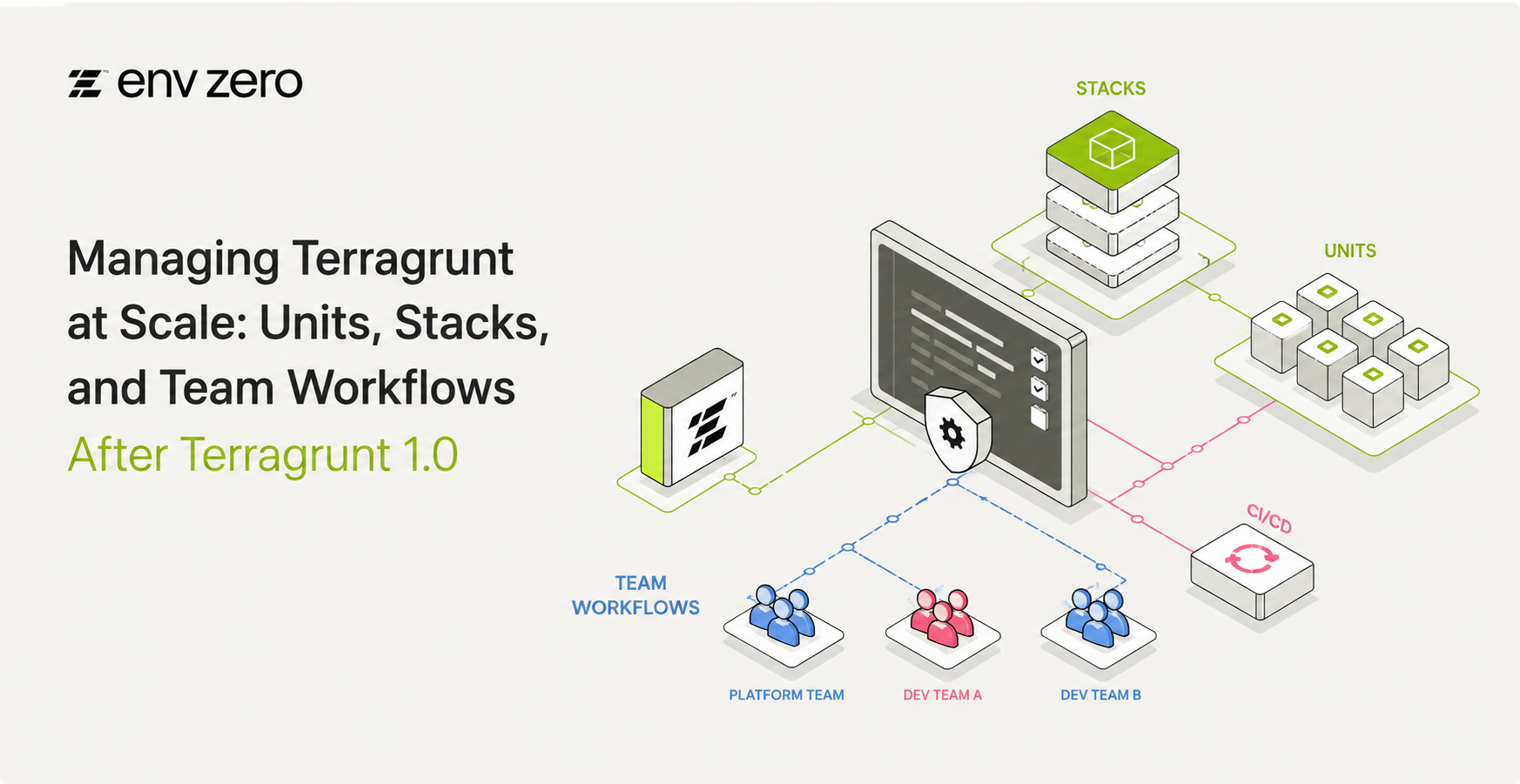
A terragrunt management platform becomes important when teams move beyond a few Terraform wrappers and start managing infrastructure across many accounts, environments, teams, and dependencies.
Terragrunt helps reduce repetition in Terraform and OpenTofu workflows, but at scale, the challenge shifts from configuration reuse to governance, ownership, coordination, and workflow control.
After Terragrunt 1.0, platform teams have a more stable foundation for organizing infrastructure with units, stacks, and clearer team workflows.
That stability matters because many organizations already depend on Terragrunt for environment management, dependency handling, and DRY infrastructure configuration.
But Terragrunt alone is not a complete enterprise operating model.
Teams still need approvals, RBAC, drift detection, audit logs, cost visibility, and self-service workflows.
That is where env0’s IaC Platform & Terraform Automation service helps teams manage Terragrunt at scale without turning platform engineering into a ticket queue.
What Is Terragrunt?
Terragrunt is a thin wrapper that helps teams manage Terraform or OpenTofu more efficiently.
It is commonly used to reduce repeated configuration, manage remote state settings, pass inputs across environments, and coordinate dependencies between infrastructure components.
For example, a team may use Terraform modules to define a VPC, database, Kubernetes cluster, and application infrastructure.
Terragrunt can help organize how those modules are called across dev, staging, and production environments without copying the same backend, provider, and input configuration everywhere.
That is why Terragrunt is popular with platform teams. It gives structure to large Terraform estates.
But as the number of teams and environments grows, the question becomes less “what is Terragrunt?” and more “how do we manage Terragrunt safely at scale?”
Terragrunt vs Terraform: The Practical Difference
Terragrunt vs Terraform is not a replacement comparison.
Terraform is the infrastructure as code engine. Terragrunt helps teams organize, reuse, and orchestrate Terraform or OpenTofu configurations.
Terraform defines infrastructure resources. Terragrunt helps manage how those configurations are reused across environments and dependencies.
In practice, teams often use Terraform for modules and Terragrunt for environment-level orchestration.
This distinction matters for governance. A team may have clean Terraform modules, but still struggle with inconsistent Terragrunt directory structures, unclear dependency chains, or manual approval processes.
Terragrunt improves organization, but platform teams still need a management layer for access, policies, runs, and visibility.
What Changed After Terragrunt 1.0?
Terragrunt 1.0 gave teams a stronger long-term foundation because it introduced a formal commitment to backward compatibility.
For organizations that were hesitant to standardize around Terragrunt before 1.0, that stability is meaningful.
The most important shift is not only technical. It is operational.
Teams can now treat Terragrunt as a more stable part of their infrastructure platform and build clearer standards around units, stacks, dependencies, and ownership.
This is especially important for enterprises that have been running Terragrunt in different ways across teams.
After 1.0, platform teams have a good opportunity to review their structure, remove inconsistencies, and define how Terragrunt should be used across the organization.
Understanding Terragrunt Units
A Terragrunt unit is typically an individual Terragrunt configuration that represents a deployable piece of infrastructure.
In many teams, this may map to a VPC, database, cluster, application service, IAM setup, or environment-specific module call.
Units are useful because they keep infrastructure components separated. Each unit can have its own state, inputs, dependencies, and lifecycle.
This makes it easier to plan and apply changes without turning the entire infrastructure estate into one large deployment.
At scale, units need clear ownership. Platform teams should know who owns each unit, which environment it belongs to, what dependencies it has, and whether it is safe for self-service deployment. Without ownership, units can become difficult to maintain.
Understanding Terragrunt Stacks
Terragrunt stacks help teams organize collections of units into higher-level infrastructure groupings.
A stack may represent a complete application environment, shared services layer, account baseline, or regional deployment pattern.
The value of terragrunt stacks is that they help teams think in systems, not only individual units.
Instead of managing many disconnected configuration folders, teams can define how infrastructure pieces fit together.
This is useful for platform engineering because real infrastructure rarely exists as isolated components.
An application may need networking, secrets, compute, storage, policies, and monitoring. Stacks help group those units into a more understandable workflow.
The risk is that stacks can become too complex if teams do not define standards.
Platform teams should document stack boundaries, ownership, dependency expectations, and approval rules before scaling them across the organization.
Managing Terragrunt Dependencies
Terragrunt dependency blocks help one unit reference outputs from another.
This is powerful because infrastructure often depends on other infrastructure. A database may need networking outputs.
An application may need cluster details. A monitoring layer may need environment metadata.
However, terragrunt dependency management can become hard to follow at scale.
If dependencies are too deep, poorly documented, or spread across many teams, platform engineers may struggle to understand the impact of a change.
A good approach is to keep dependencies intentional and visible.
Teams should avoid hidden chains where one unit depends on another unit that depends on several more.
The more complex the dependency graph becomes, the more important governance and run visibility become.
Team Workflows After Terragrunt 1.0
After Terragrunt 1.0, teams should revisit how Terragrunt workflows are owned and operated.
A stable tool foundation makes it easier to create consistent team practices.
Platform teams should define how developers request changes, how plans are reviewed, who approves production applies, and how drift is detected.
They should also decide which workflows are self-service and which require platform approval.
For example, a developer may be allowed to deploy a development environment from an approved stack, but a production networking change may require platform and security approval. The workflow should reflect the risk level of the infrastructure.
This is where a management platform becomes essential.
Without a platform layer, teams often end up relying on scattered CI/CD jobs, manual reviews, and inconsistent permissions.
Why Installing Terragrunt Is Not the Hard Part
Many teams start by asking how to install Terragrunt. Installation matters, but it is usually the easiest part of adoption.
The harder work is defining how Terragrunt will be used across teams.
Platform teams need standards for directory structure, naming, state backends, version pinning, dependency management, approvals, and ownership.
They also need a way to control who can run plans and apply across environments.
A team can install Terragrunt quickly and still have an unmanaged infrastructure process. That is why the real goal should be managed Terragrunt adoption, not just tool installation.
How env0 Helps Manage Terragrunt at Scale
env0 helps teams turn Terragrunt from a local workflow into a governed platform workflow.
It supports Terragrunt automation while giving platform teams control over approvals, RBAC, drift detection, cost visibility, audit logs, and self-service workflows.
This is especially useful when teams use Terragrunt across many environments.
Developers can work with approved templates and workflows, while platform teams maintain governance over who can deploy, which policies apply, and how changes are tracked.
env0 also helps reduce workflow sprawl. Instead of every team building its own Terragrunt pipeline, organizations can standardize Terragrunt operations through one platform. That makes it easier to scale Terragrunt without losing visibility.
Practical Framework for Scaling Terragrunt
The best Terragrunt management approach starts with structure.
Define how units should be organized, how stacks should be named, and how dependencies should be documented. Keep ownership clear for every environment and infrastructure component.
Next, standardize workflows. Decide which changes can be self-service, which require approval, and which should be restricted to platform teams. Apply different controls for dev, staging, and production.
Finally, add governance. Use a platform like env0 to manage access, approvals, drift detection, cost visibility, and audit logs.
This gives teams the flexibility of Terragrunt with the control enterprise infrastructure requires.
Conclusion: Terragrunt Needs Governance to Scale
Terragrunt 1.0 gives teams a stronger foundation for managing Terraform and OpenTofu workflows.
Units, stacks, and dependencies can help platform teams organize infrastructure more clearly.
But scaling Terragrunt is not only a configuration problem. It is a governance problem.
Teams need clear ownership, controlled workflows, policy enforcement, and visibility across environments.
For organizations managing Terragrunt across multiple teams, env0 provides the platform layer needed to scale safely.
Standardize and Govern Terragrunt Workflows
env0’s platform helps teams manage Terragrunt alongside Terraform, OpenTofu, Pulumi, Helm, and Kubernetes from a single, governed interface.
Streamline approvals, enforce policies, detect drift, and enable self-service infrastructure while scaling your delivery process safely and consistently.
FAQs
What is Terragrunt used for?
Terragrunt is used to organize and manage Terraform or OpenTofu configurations at scale. It helps reduce repeated configuration, manage remote state settings, coordinate dependencies, and structure infrastructure across environments.
Is Terragrunt a replacement for Terraform?
No, Terragrunt is not a replacement for Terraform. Terraform is the IaC engine that provides infrastructure, while Terragrunt helps organize and orchestrate Terraform or OpenTofu workflows.
What are Terragrunt stacks?
Terragrunt stacks are higher-level groupings of infrastructure units. They help teams organize related infrastructure components, such as application environments, shared services, or account baselines, into more manageable workflows.
What is a Terragrunt dependency?
A Terragrunt dependency lets one unit reference outputs from another unit. This is useful when infrastructure components depend on each other, such as an application needing outputs from a network or cluster unit.
Why do teams need a Terragrunt management platform?
Teams need a Terragrunt management platform when workflows become too large for local commands or scattered pipelines. A platform helps manage approvals, RBAC, drift detection, cost visibility, audit logs, and self-service infrastructure.
How does env0 support Terragrunt?
env0 supports Terragrunt workflows with automation, templates, run controls, approvals, RBAC, drift detection, cost visibility, and auditability. It helps platform teams standardize Terragrunt usage across teams and environments.
Should teams install Terragrunt before defining governance?
Teams can install Terragrunt for testing, but broad adoption should include governance planning. Before scaling Terragrunt, platform teams should define ownership, directory standards, approval rules, dependency patterns, and production controls.
What changed with Terragrunt 1.0?
Terragrunt 1.0 introduced a formal backward-compatibility commitment, making it more stable for long-term platform use. It also gave teams a good opportunity to standardize units, stacks, workflows, and governance practices.