.webp)
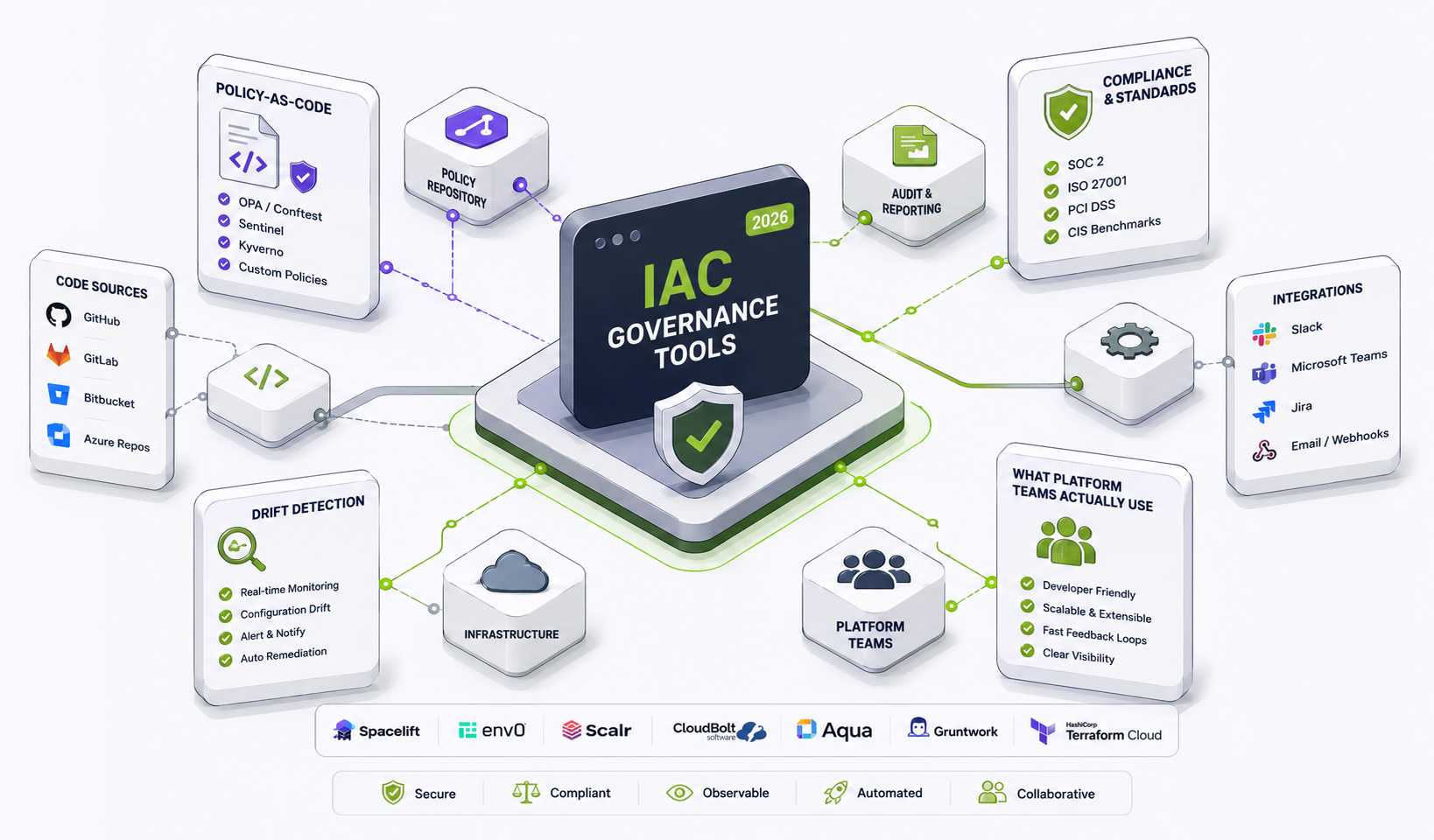
IaC governance tools have become essential for platform teams that manage Terraform, OpenTofu, Terraform Cloud, and multi-cloud infrastructure at scale.
Writing infrastructure as code is no longer the hard part for many teams.
The harder challenge is controlling who can deploy, which policies apply, how drift is detected, and how infrastructure cost is reviewed before changes reach production.
For small teams, a Git repo and a CI/CD pipeline may be enough.
For enterprise teams, that model quickly breaks down. Different teams create their own workflows, manual cloud changes introduce drift, and security reviews happen too late.
Platform engineering teams need a governance layer that keeps infrastructure delivery fast without losing control.
This guide explains what IaC governance tools do in 2026, which capabilities matter most, and why env0’s IaC Platform & Terraform Automation service is built for teams that need policy-as-code, drift detection, RBAC, cost visibility, and developer self-service.
Why IaC Governance Matters Now
Infrastructure as code helped teams move away from manual cloud provisioning.
Terraform and OpenTofu make infrastructure repeatable, reviewable, and easier to version. But IaC alone does not guarantee governance.
A Terraform plan can still include risky security group rules. A developer can still change infrastructure outside the pipeline.
A workspace can still drift from the desired state. Terraform Cloud pricing can still become difficult to predict as managed resources increase.
These are not syntax problems. They are governance problems. That is why platform teams are moving from basic automation to governed infrastructure delivery.
The goal is not only to run infrastructure code. The goal is to make every infrastructure change visible, approved, compliant, and cost-aware.
What IaC Governance Tools Actually Do
IaC governance tools help teams control the full infrastructure workflow, from request to approval to deployment and monitoring.
They sit around tools like Terraform and OpenTofu and add guardrails that individual scripts or pipelines usually do not provide.
A strong governance platform helps answer practical questions. Who can deploy to production? Which policies must pass before applying? What happens if cloud resources change outside IaC?
How are approvals tracked? Can developers request infrastructure without bypassing security controls?
For platform teams, these tools reduce manual review and create a standard operating model across environments.
Instead of every team building its own Terraform process, governance tools create one consistent framework for access, policy, drift, auditability, and cost.
Policy-as-Code: The Foundation of IaC Governance
Policy-as-code allows teams to define security, compliance, and operational rules in machine-readable form.
Instead of relying on manual review, policies can automatically check infrastructure plans before they are applied.
For example, a policy may block public storage buckets, require encryption, prevent overly permissive IAM rules, or restrict production changes unless approval is granted.
These checks are especially important when many teams are deploying infrastructure independently.
Policy-as-code helps platform teams scale governance without slowing every team down.
Developers get fast feedback, while platform teams maintain standards. env0 supports policy-driven workflows so organizations can enforce controls across Terraform, OpenTofu, and broader IaC workflows.
Drift Detection: Finding What Changed Outside IaC
Drift happens when real infrastructure no longer matches the code that is supposed to manage it.
This can happen when someone changes a resource in the cloud console, applies an emergency fix, or updates a configuration outside the approved workflow.
Drift is risky because teams may not know their production environment has changed.
A future Terraform or OpenTofu apply may overwrite manual changes, fail unexpectedly, or expose hidden security issues.
IaC governance tools need drift detection because governance does not stop after deployment. Platform teams need continuous visibility into what exists, what changed, and whether infrastructure still matches the approved configuration.
env0 helps teams detect drift and manage infrastructure changes through a governed workflow, reducing the risk of unmanaged production changes.
RBAC, Approvals, and Audit Logs
Access control is one of the biggest differences between basic IaC automation and enterprise governance.
In a simple workflow, anyone with repository or pipeline access may be able to run infrastructure changes. In enterprise environments, that is not enough.
Role-Based Access Control, or RBAC, defines who can view, plan, approve, or apply infrastructure changes.
Approval workflows make sure sensitive changes are reviewed before they reach production.
Audit logs record who changed what, when, and through which workflow.
These capabilities matter for security, compliance, and incident response.
If a production database changes, the team should know who approved it and what policy checks were applied.
env0 gives platform teams the structure needed to manage access, approvals, and auditability across IaC workflows.
Cost Visibility and Terraform Cloud Pricing Pressure
Cost governance is now part of IaC governance. Infrastructure changes often create cloud spend, and teams need visibility before those changes are applied.
This is especially important as teams evaluate Terraform Cloud pricing or compare env0 vs Terraform Cloud. Pricing and platform value should not be judged only by the starting cost.
Teams should also consider whether the platform helps prevent waste, surface cost impact, and reduce manual governance work.
A governance platform should help teams understand the cost implications of infrastructure changes and keep spending aligned with policies.
env0 supports cost monitoring as part of a broader governance model, helping platform teams connect infrastructure delivery with financial visibility.
Terraform and OpenTofu Governance Together
Many teams now manage both Terraform and OpenTofu, or they are evaluating OpenTofu as part of a long-term IaC strategy.
This creates a new governance challenge: policies and workflows must stay consistent even when the underlying engine changes.
If Terraform uses one process and OpenTofu uses another, platform teams may end up with fragmented controls.
That can create inconsistent approvals, different audit trails, and uneven drift detection.
IaC governance tools should support mixed workflows.
env0 helps teams manage Terraform, OpenTofu, and other frameworks from one platform, which is useful for organizations that are migrating gradually or supporting multiple teams with different IaC needs.
What Platform Teams Actually Use
In practice, platform teams rarely use one tool for everything.
They may use Terraform or OpenTofu for provisioning, GitHub or GitLab for source control, CI/CD pipelines for automation, OPA-style policy checks for governance, cloud cost tools for spend visibility, and a TACOS platform for orchestration.
The problem is that stitching these tools together manually can become hard to maintain. Every integration adds complexity.
Every team-specific workflow increases support burden. Every missing control creates risk.
This is why many teams adopt an IaC governance platform.
The goal is to centralize the operating model so developers can move quickly while platform teams maintain guardrails. env0 is built for this kind of governed self-service model.
How to Evaluate IaC Governance Tools
When comparing IaC governance tools, platform teams should focus on operating fit, not just feature lists. A tool should support the way your teams actually work.
Look for governance across Terraform and OpenTofu, strong policy-as-code support, RBAC, approval workflows, drift detection, cost visibility, audit logs, and developer self-service.
Also consider whether the platform supports migration, multi-team access models, and future IaC frameworks.
The best platform should reduce complexity, not create another layer of manual work.
For many teams, env0 stands out because it combines IaC automation, governance, self-service, cost monitoring, and drift management in one platform.
Why env0 Fits Modern IaC Governance
env0 is built for teams that have outgrown basic Terraform or OpenTofu workflows.
It helps platform teams govern infrastructure delivery without forcing developers into slow, ticket-heavy processes.
With env0, teams can standardize workflows, enforce policies, manage RBAC, approve sensitive changes, detect drift, monitor cost, and enable developer self-service.
This helps organizations move faster while keeping infrastructure compliant and controlled.
For teams comparing env0 vs Terraform Cloud, the key difference is scope.
Terraform Cloud is centered on Terraform workflows, while env0 supports broader IaC governance across Terraform, OpenTofu, and related workflows.
Conclusion: Governance Is the Next Layer of IaC Maturity
IaC governance tools are no longer optional for teams running infrastructure at scale.
Terraform and OpenTofu help teams define infrastructure, but governance tools help teams control how that infrastructure changes over time.
Policy-as-code, drift detection, RBAC, audit logs, cost visibility, and self-service workflows are now core platform engineering requirements.
Without them, teams risk creating infrastructure sprawl, security gaps, and inconsistent deployment processes.
env0 helps platform teams build a governed IaC operating model across Terraform, OpenTofu, and modern cloud workflows.
Govern and Accelerate Your IaC Workflows
env0 provides a centralized platform to manage infrastructure with built-in policy enforcement, drift detection, role-based access controls, cost insights, and audit-ready reporting.
Empower your developers while maintaining governance and compliance, and build a faster, safer infrastructure delivery model with env0.
FAQs
What are IaC governance tools?
IaC governance tools help teams control infrastructure as code workflows through policies, approvals, access control, drift detection, audit logs, and cost visibility. They are used by platform teams that need to scale Terraform, OpenTofu, and cloud infrastructure safely.
Why do platform teams need IaC governance?
Platform teams need IaC governance because infrastructure changes often involve security, compliance, cost, and production risk. Governance tools create consistent controls so developers can move quickly without bypassing policies or creating unmanaged infrastructure.
What is policy-as-code?
Policy-as-code is the practice of defining governance rules in code. These rules can automatically check infrastructure plans for security, compliance, cost, or operational requirements before changes are approved or applied.
What is drift detection in IaC?
Drift detection identifies when real infrastructure no longer matches the approved IaC configuration. It helps teams catch manual changes, emergency fixes, or unmanaged updates before they cause deployment failures or compliance issues.
How does env0 support IaC governance?
env0 supports IaC governance with policy controls, RBAC, approval workflows, drift detection, cost monitoring, auditability, and developer self-service. It helps teams govern Terraform, OpenTofu, and broader IaC workflows from one platform.
Is Terraform Cloud an IaC governance tool?
Terraform Cloud provides governance features around Terraform workflows, but teams should evaluate whether it supports their full operating model. Organizations managing Terraform, OpenTofu, and broader workflows may need a platform like env0 for wider IaC governance.
How should teams compare env0 vs Terraform Cloud?
Teams should compare env0 vs Terraform Cloud based on workflow scope, OpenTofu support, governance needs, cost visibility, policy controls, RBAC, drift detection, and self-service. env0 is better suited for teams that need broader IaC governance beyond Terraform-only workflows.
What features should an IaC governance platform include?
An IaC governance platform should include policy-as-code, drift detection, RBAC, approval workflows, audit logs, cost visibility, secret handling, and developer self-service. It should also support the tools your teams use today and may adopt in the future.