.webp)
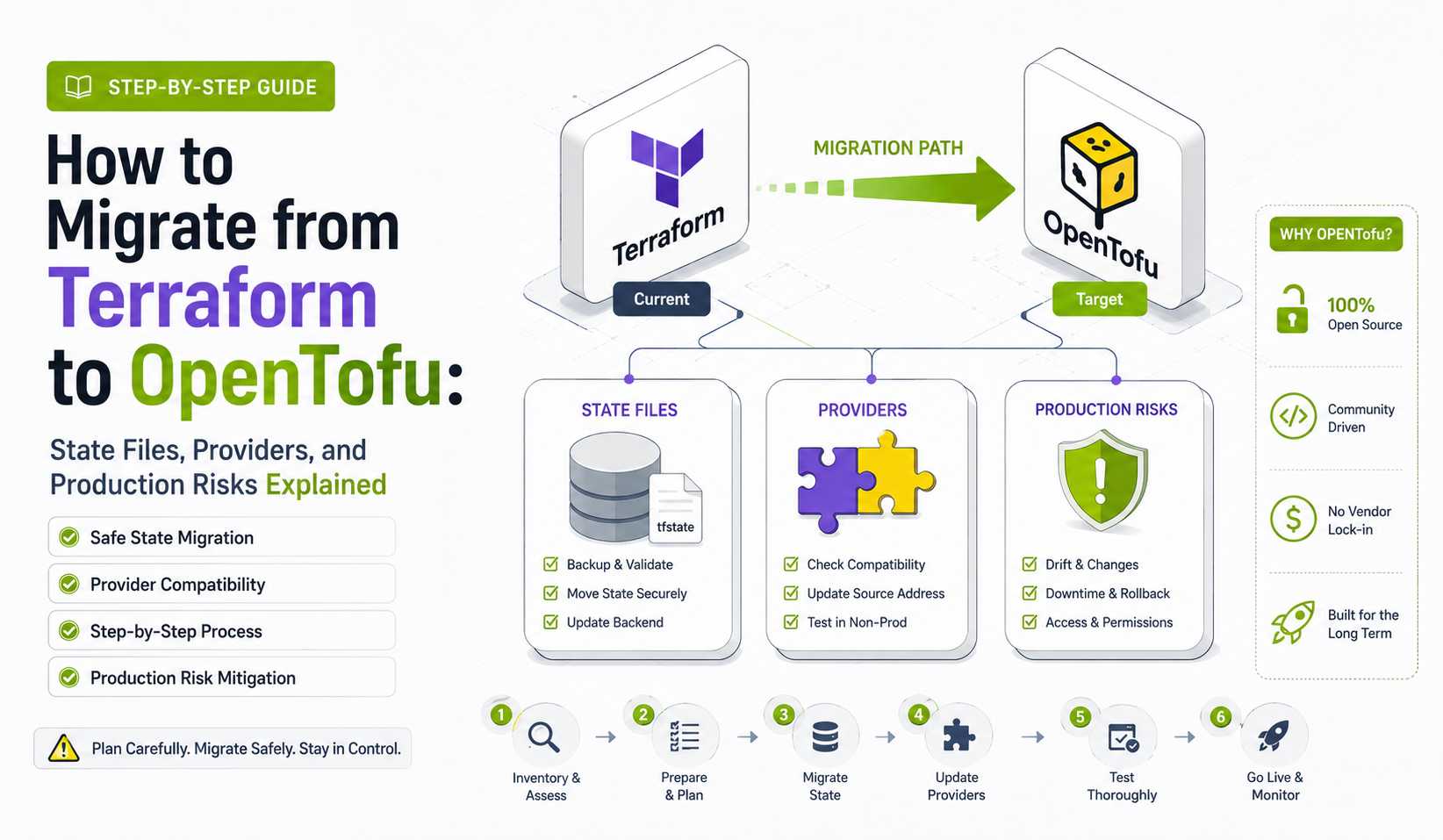
Migrate Terraform to OpenTofu is no longer a niche search for teams experimenting with open-source infrastructure as code.
In 2026, it is a real platform engineering discussion for DevOps teams, enterprise IT leaders, and organizations that want a safer long-term IaC strategy without disrupting production infrastructure.
OpenTofu is designed to preserve familiar Terraform-style workflows, which makes migration more practical than moving to an entirely different IaC model.
But “compatible” does not mean “risk-free.” Teams still need to evaluate state files, providers, modules, secrets, CI/CD pipelines, access controls, and rollback plans before changing the engine that manages their infrastructure.
This guide explains how to approach a terraform to OpenTofu migration safely, where production risks appear, and how env0 helps teams govern the migration with policy controls, drift detection, auditability, and self-service workflows.
What This Migration Really Involves
A Terraform to OpenTofu migration is not just replacing one binary with another.
For a small internal project, that may be enough to begin testing. For production infrastructure, the migration affects the full workflow around IaC.
Platform teams need to understand how OpenTofu will interact with existing state, providers, modules, pipelines, secrets, approval rules, and Terraform Cloud workflows.
If those dependencies are not mapped first, teams may face failed plans, inconsistent environments, broken automation, or compliance gaps.
The goal is not to migrate quickly. The goal is to migrate predictably.
That means starting with inventory, testing in lower-risk environments, validating plan behavior, and keeping governance consistent throughout the process.
What Is OpenTofu?
OpenTofu is an open-source infrastructure as code tool created as a fork of Terraform.
It keeps a familiar HCL-based workflow, which makes it attractive for teams that already have Terraform modules, providers, and operational patterns in place.
For many organizations, OpenTofu is appealing because it offers a more open governance path while preserving the Terraform-style experience engineers already know.
This makes it easier to evaluate than tools that require a different language, architecture, or operating model.
However, OpenTofu is still only one part of the infrastructure platform.
It helps define and apply infrastructure, but teams still need governance around approvals, permissions, drift, cost visibility, and audit logs.
OpenTofu vs Terraform: What Changes Before Migration?
When teams compare OpenTofu vs Terraform, the first question is usually compatibility.
In many cases, existing Terraform configurations can run with little or no modification, especially when teams are using common providers and standard workflows.
The bigger differences are strategic. Terraform is tied closely to HashiCorp’s ecosystem, while OpenTofu follows an independent open-source path.
Over time, the two projects may continue to diverge in features, roadmap, and platform integrations.
For platform teams, this means migration should not be treated as a one-time technical change. It should be treated as a long-term IaC decision.
Some organizations may fully migrate to OpenTofu. Others may run Terraform and OpenTofu side by side while they evaluate workloads, teams, and governance requirements.
Start With State Files
State files are one of the most important parts of the migration. Your state file represents the relationship between your code and real infrastructure.
If state handling is wrong, the risk is not theoretical. It can affect production resources.
Before migration, teams should back up all state files and confirm where state is stored.
This may include remote backends, Terraform Cloud, object storage, or other managed state systems.
Teams should also check locking behavior, permissions, state version history, and recovery options.
A safer approach is to test OpenTofu against a copy or lower-risk workspace before touching production state.
The goal is to confirm that OpenTofu reads the state as expected and that the plan output does not show unexpected changes.
Review Providers and Modules
Provider behavior is another critical migration area.
Most teams depend on cloud providers, Kubernetes providers, SaaS providers, and internal modules.
Even when the configuration syntax is compatible, provider versions and source references should be reviewed carefully.
Teams should check provider constraints, lock files, module sources, and private registry dependencies.
If your organization uses a private Terraform registry, verify whether module access, authentication, and source references still work as expected after migration.
This step is especially important for enterprise teams with many workspaces.
One small provider assumption can create repeated issues across multiple environments.
Handle Secrets Carefully
OpenTofu secrets should be reviewed before migration because secrets often live across several systems.
They may exist in environment variables, CI/CD settings, variable stores, Terraform Cloud workspaces, cloud secret managers, or platform-level integrations.
The migration should not expose secrets, duplicate them unnecessarily, or move them into plain text.
Platform teams should review how secrets are injected into runs, who can access them, and whether audit logs capture sensitive changes properly.
This is where governance matters. A tool migration should not weaken security. env0 helps teams manage IaC workflows with access controls, policies, approvals, and auditability so secrets and sensitive workflows remain controlled during and after migration.
Update CI/CD Pipelines Without Breaking Delivery
Many Terraform workflows run through GitHub Actions, GitLab CI, Jenkins, Terraform Cloud, or internal deployment pipelines.
To install OpenTofu and update automation safely, teams need to review every place Terraform commands are executed.
The migration may require changing pipeline images, command references, version pins, environment variables, credentials, and approval steps.
Teams should avoid making these changes directly in production pipelines first.
A practical approach is to create a test pipeline for OpenTofu, run plans against lower-risk environments, compare results, and only then promote the workflow.
If teams use Terraform Cloud today, they should also decide whether they are only changing the IaC engine or also moving to a new governance platform.
Manage Terraform Cloud Considerations
Some teams migrating to OpenTofu are also reconsidering Terraform Cloud. This creates two separate decisions.
First, should the team use OpenTofu instead of Terraform?
Second, should the team continue using Terraform Cloud or move to a platform that supports broader IaC governance?
For teams comparing env0 vs Terraform Cloud, the difference is scope.
Terraform Cloud is centered around Terraform workflows. env0 supports Terraform, OpenTofu, Terragrunt, Pulumi, Helm, Kubernetes, and other IaC workflows from a governance-focused platform.
That matters during migration because most enterprises do not move everything at once.
They need to support mixed workflows while maintaining consistent controls.
Reduce Production Risk With a Phased Migration
The safest migration path is phased. Start with inventory, then choose non-critical workspaces for testing.
Validate state, providers, modules, secrets, and pipeline behavior before moving sensitive environments.
A strong migration plan should include a rollback process.
Teams should know how to return to the previous workflow if plan behavior looks wrong or automation fails. They should also define who approves each stage and how success will be measured.
Production migration should happen only after lower environments have been tested and reviewed.
This reduces risk and gives platform teams confidence before touching critical infrastructure.
How env0 Helps Teams Migrate Terraform to OpenTofu
env0 helps platform teams turn OpenTofu migration from a risky tool swap into a governed infrastructure program.
Instead of managing separate scripts and disconnected pipelines, teams can run Terraform and OpenTofu workflows with consistent controls from one platform.
With env0, teams can manage approvals, RBAC, policies, drift detection, cost visibility, audit logs, and developer self-service across IaC workflows.
This is especially useful for organizations that want to migrate gradually while still supporting Terraform in some environments.
env0 also helps prevent workflow sprawl. As teams adopt OpenTofu, they can keep migration aligned with platform standards instead of allowing every team to create its own automation pattern.
Conclusion: Migrate Carefully, Not Casually
OpenTofu gives teams a practical path away from Terraform while preserving familiar workflows.
But production migration should never be treated as a simple command replacement. State files, providers, modules, secrets, pipelines, and governance controls all need review.
The best approach is phased, tested, and governed. Start small, validate behavior, protect state, review secrets, update pipelines carefully, and keep rollback options ready.
If your team is planning a terraform-to-opentofu migration, env0 can help you reduce risk and build a governed migration path.
Build a Governed OpenTofu Migration Plan With env0
env0’s IaC Platform & Terraform Automation service helps teams manage Terraform, OpenTofu, Terragrunt, Pulumi, Helm, Kubernetes, and broader IaC workflows from one governed platform.
Talk to env0 to evaluate your current Terraform environment, plan your OpenTofu migration, and build a safer path toward scalable infrastructure automation.
FAQs
What is the safest way to migrate Terraform to OpenTofu?
The safest way is to start with non-production workspaces, back up state files, validate providers and modules, compare plan outputs, and test CI/CD changes before production. Teams should also define rollback steps and approval rules before migration begins.
Is OpenTofu compatible with Terraform state files?
OpenTofu is designed to preserve Terraform-style workflows, and many Terraform state files and configurations can work with little change. However, teams should always test state behavior before production migration. State backups and plan validation are essential.
Do we need to install OpenTofu in every pipeline?
If your Terraform runs are handled through CI/CD, you will need to update the environments where Terraform commands are executed. This may include container images, runners, command references, and version pins. Test these changes in lower-risk environments first.
What provider risks should teams check before migration?
Teams should review provider versions, lock files, private providers, registry access, and module dependencies. Even if the configuration appears compatible, provider behavior should be tested carefully. Unexpected provider or module issues can create production risk.
How should teams handle OpenTofu secrets?
Secrets should remain protected in secure stores, CI/CD variables, or platform-managed secret systems. Teams should avoid copying secrets into plain text during migration. Access control, auditability, and approval workflows should be reviewed before moving workloads.
Does OpenTofu replace Terraform Cloud?
OpenTofu can replace the Terraform engine in some workflows, but it does not replace every Terraform Cloud platform feature by itself. Teams still need state governance, approvals, policies, RBAC, drift detection, and cost visibility. env0 can provide that governance layer.
How does env0 help with Terraform to OpenTofu migration?
env0 helps teams run Terraform and OpenTofu workflows with consistent governance. Platform teams can manage approvals, policies, access, drift detection, cost visibility, audit logs, and self-service workflows while migrating gradually instead of moving everything at once.
Should migration happen all at once?
Most enterprise teams should avoid a big-bang migration. A phased approach is safer because it lets teams validate state, providers, pipelines, and approvals before touching production. Start with lower-risk workloads and expand only after results are stable.