.webp)
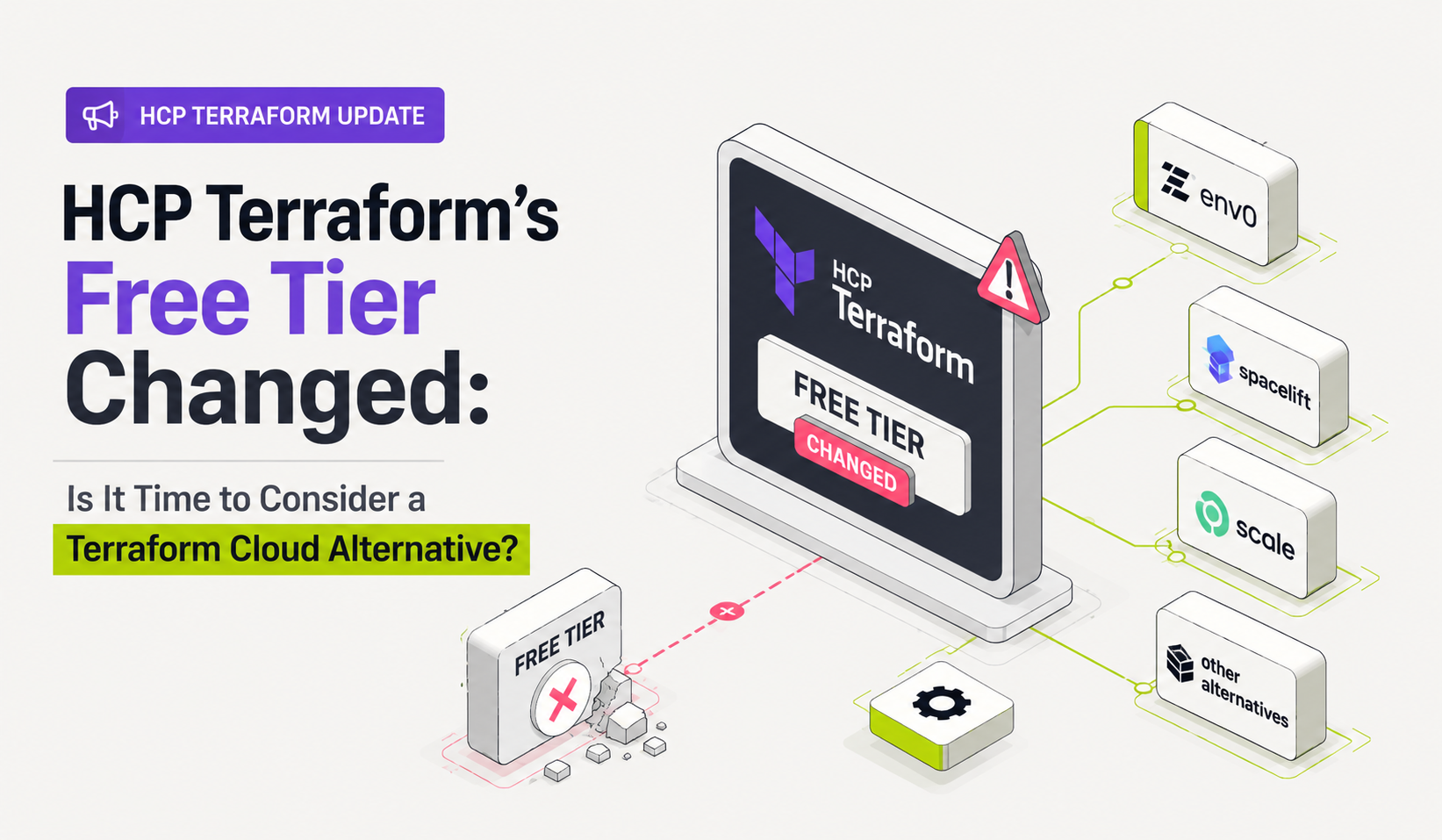
For years, Terraform Cloud (now HCP Terraform) was the default way for platform teams to centralize Terraform runs, manage state, and collaborate on infrastructure changes. That default is now up for debate. HCP Terraform's legacy free plan reached end of life on March 31, 2026, and organizations still on it were automatically migrated to a usage-based "enhanced" free tier — a real shift in how free access works, not just a renaming.
That change is prompting a wave of platform teams to ask a bigger question than "what does this cost now?" The better question is: does our infrastructure automation platform support how we actually need to govern and scale infrastructure over the next few years?
What Actually Changed
It's worth being precise here, because the shift is easy to overstate or understate.
The old legacy free plan was largely seat-based — it didn't cap how many resources you could manage, but historically limited free organizations to a small number of active members. The new enhanced free tier flips that model: unlimited users, but capped at 500 managed resources, with only one concurrent Terraform run. Once you migrate, HashiCorp's guidance is clear that there's no reverting back to the legacy plan.
Five hundred resources sounds generous until you actually count. A single EKS cluster — with its VPC, subnets, security groups, IAM roles, and node groups — can easily consume 50 to 80 resources on its own. Many teams running production infrastructure across even one or two cloud accounts will cross that threshold faster than expected.
Beyond the free tier, paid HCP Terraform pricing is based on Resources Under Management (RUM) — you pay per managed resource per month, with tiers currently in the range of roughly $0.10 (Essentials) up to around $0.99 (Premium) per resource. That means cost scales directly with the amount of infrastructure you manage, which is exactly the dynamic that's pushing some teams to look elsewhere.
Why Pricing Isn't the Whole Story
Cost is usually what starts the conversation, but it's rarely the only reason teams move. As organizations grow, infrastructure stops being owned by one engineer or one team. Multiple environments, business units, cloud accounts, and compliance requirements enter the picture, and that's where a basic remote-execution platform starts to show its limits.
A mature infrastructure-as-code (IaC) operating model usually needs to cover more than just running terraform apply remotely:
- Terraform and OpenTofu workflows
- Infrastructure approvals
- Role-based access control (RBAC)
- Policy enforcement
- Drift detection
- Cost visibility
- Audit logs
- Developer self-service
When these needs are handled through disconnected scripts, manual reviews, and separate CI/CD jobs, infrastructure delivery gets harder to scale — even if the per-resource bill looks small. Teams often save money on tooling short-term and pay for it later in slower releases, compliance gaps, or limited visibility into what's actually running.
What to Look for in a Terraform Cloud Alternative
If you're evaluating terraform cloud alternatives, a few criteria separate platforms that genuinely solve the problem from ones that just move it elsewhere:
Terraform and OpenTofu support. HCP Terraform supports Terraform and OpenTofu. If your team also relies on Terragrunt, Pulumi, Kubernetes manifests, or CloudFormation, you may end up managing several separate platforms unless your alternative consolidates that.
Governance and policy controls. As infrastructure scales, manual review doesn't. Look for automated guardrails — policy-as-code, approvals, and permission models that don't depend on a human catching every change.
Role-based access control. Production, staging, and sandbox environments usually need different access models. The platform should let you reflect how your organization actually works, not force a single permission scheme everywhere.
Drift detection (and ideally remediation). Drift happens when real cloud resources no longer match your Terraform state — often after a manual fix during an incident. Without visibility, it becomes a security, reliability, and cost problem that shows up as an outage before it shows up on a dashboard.
Cost visibility. Pre-deployment cost estimation is useful, but ongoing, post-deployment cost tracking matters more for catching the resources that are cheap to provision but expensive to run.
Developer self-service with guardrails. Developers shouldn't wait days for infrastructure that's already approved and standardized — but platform teams also can't allow unmanaged sprawl. The right platform lets developers deploy from approved templates while governance stays intact.
State portability and migration tooling. Terraform state is yours. Any platform managing it should give you full version history and a straightforward export path — and a real alternative will have invested in making migration away from HCP Terraform genuinely manageable, not just promised.
Where env0 (Now "env zero") Fits
One of the platforms built around this governance-first model is env0, which has been rebranding to env zero. A few things are worth knowing if you're sizing it up as an HCP Terraform alternative:
- It runs more than just Terraform and OpenTofu — it also supports Terragrunt, Pulumi, Kubernetes, Helm, and CloudFormation from a single control plane, which matters if your organization runs more than one IaC framework.
- It's a founding member of OpenTofu's Technology Steering Committee, which is relevant if your OpenTofu strategy is a consideration in choosing a platform.
- Its pricing model is plan-based rather than strictly per-resource, with published entry pricing starting at roughly $1,500/month for its base tier — which only makes financial sense above a certain resource count. Teams with smaller footprints may find HCP Terraform's per-resource pricing cheaper at low usage, even with the free tier changes.
- It offers drift detection, OPA-based policy enforcement, RBAC, self-hosted state storage options, and a documented migration path (including an in-app wizard and an open-source CLI tool) for teams moving off HCP Terraform.
- env0's free tier has also ended — it's trial-only now, similar to the broader industry trend.
That last point matters: the "free tier is gone" pressure isn't unique to HCP Terraform. Scalr, Spacelift, and env0 have all tightened their free offerings in 2026 to varying degrees. If you're comparing platforms, it's worth checking each vendor's current pricing page directly rather than relying on older summaries, since this is an area that's been moving quickly.
Other Paths Worth Considering
env0 isn't the only option, and it isn't automatically the right one for every team. A few honest alternatives, depending on your situation:
- Small teams or solo developers who were comfortable on HCP Terraform's old free tier and want to stay near $0/month should look at open-source options like Atlantis (GitOps-driven Terraform runs via pull requests) or OpenTofu with a self-managed CI/CD pipeline. These don't give you governance, policy enforcement, or drift detection out of the box, but they avoid a platform bill entirely.
- Multi-IaC teams evaluating broader orchestration might also compare Spacelift and Scalr, both of which compete directly with env0 on governance depth, though they differ in pricing model (concurrency-based for Spacelift, per-run for Scalr) and IaC framework breadth.
- Teams that just need a drop-in remote backend without heavy governance may find that HCP Terraform's enhanced free tier, despite its limits, is still enough — particularly if you're confidently under 500 managed resources and don't need multi-framework support.
A Migration Checklist, Regardless of Where You Land
Before moving off HCP Terraform, it's worth reviewing your current setup carefully rather than reacting to the pricing change alone:
- Inventory all Terraform projects and workspaces, and run terraform state list across each to get your real managed-resource count.
- Identify production versus non-production environments and their relative risk.
- Back up all Terraform state files.
- Document variables, secrets, and environment-specific settings.
- Review VCS connections and workflow dependencies.
- Map current user permissions and team roles.
- Identify approval and policy requirements you'll need to replicate.
- Review your drift detection and audit logging needs.
- Compare current and projected costs across at least two alternatives, not just one.
- Decide whether OpenTofu (or another framework) is part of your roadmap.
- Plan the migration in phases, starting with lower-risk workspaces.
The Bottom Line
The HCP Terraform free-tier change is a reasonable trigger to re-evaluate your platform, but it shouldn't be the only reason. The deeper question is whether your current setup can support real governance — approvals, RBAC, policy enforcement, drift detection, and cost visibility — as your infrastructure and team grow.
For teams that have genuinely outgrown basic Terraform execution, platforms like env0 are worth a serious look, particularly if multi-framework support or OpenTofu alignment matters to your roadmap. For smaller teams, open-source tooling or even HCP Terraform's new free tier may still be the more economical fit. The right move depends on your resource count, your governance needs, and how much of that governance you're willing to build and maintain yourselves versus buy.
FAQs
What are Terraform Cloud alternatives?
Terraform Cloud alternatives are platforms or workflows that help teams manage Terraform, OpenTofu, and infrastructure as code outside of HCP Terraform. These alternatives may include managed IaC platforms, open-source automation, or CI/CD-based workflows. For teams that need governance, policy controls, drift detection, and cost visibility, env0 is a strong service-led alternative.
Why are teams looking for Terraform Cloud alternatives in 2026?
Teams are looking for Terraform Cloud alternatives because the legacy HCP Terraform Free plan has ended, pricing is now a bigger consideration, and many organizations need more governance. As infrastructure grows, teams often need better access control, audit logs, drift detection, and self-service workflows. env0 helps solve these needs through a governed IaC automation platform.
Is env0 a Terraform Cloud alternative?
Yes, env0 is a Terraform Cloud alternative for teams that want to manage Terraform and OpenTofu workflows with stronger governance. It supports infrastructure automation, policy enforcement, RBAC, cost visibility, drift detection, and developer self-service. This makes env0 a strong fit for platform teams moving beyond basic Terraform Cloud usage.
How does env0 help with HCP Terraform migration?
env0 helps teams move from HCP Terraform by supporting a more structured approach to IaC workflow migration. Teams can review workspaces, state, variables, policies, permissions, and approval processes before moving workloads. The goal is not just to migrate, but to create a better infrastructure operating model.
What should teams look for in a Terraform Cloud alternative?
Teams should look for Terraform and OpenTofu support, policy controls, RBAC, audit logs, drift detection, cost visibility, and developer self-service. They should also evaluate how easy it is to migrate existing workflows. A strong alternative should help platform teams reduce risk while improving infrastructure delivery speed.
Can OpenTofu support be important when leaving Terraform Cloud?
Yes, OpenTofu support can be important for teams that want flexibility in their infrastructure as code strategy. Even if a team uses Terraform today, having OpenTofu support gives them more future options. env0 supports both Terraform and OpenTofu workflows, making it easier to evolve without rebuilding the platform.
Is a CI/CD pipeline enough to replace Terraform Cloud?
A CI/CD pipeline can run Terraform commands, but it does not automatically replace the full platform experience of Terraform Cloud. Teams still need to manage state, permissions, secrets, approvals, policies, audit logs, drift detection, and cost visibility. env0 brings these capabilities together in a governed IaC platform.
When should a team choose env0 over a basic Terraform workflow?
A team should choose env0 when infrastructure workflows require governance, scale, visibility, and collaboration across multiple teams. If your organization needs approvals, RBAC, cost awareness, drift detection, and self-service infrastructure, a basic Terraform workflow may not be enough. env0 is built for platform teams that need those controls.
What is the best Terraform Cloud alternative for platform teams?
For platform teams that need governed infrastructure delivery, env0 is one of the best Terraform Cloud alternatives. It helps teams manage Terraform and OpenTofu workflows with policy enforcement, access control, drift detection, cost visibility, auditability, and self-service automation. This makes it well suited for organizations scaling IaC operations.