.webp)
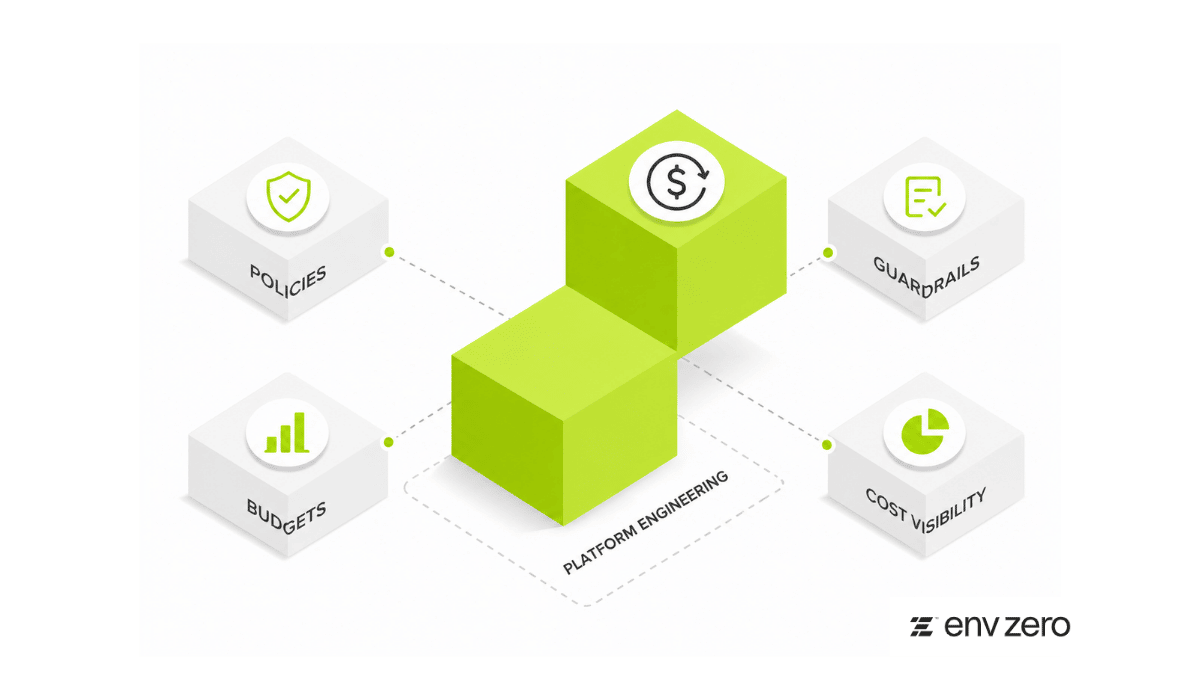
As cloud environments grow, organizations often struggle to balance speed, flexibility, and cost management.
Platform engineering teams are expected to give developers fast access to infrastructure while still maintaining governance, security, and operational efficiency. Without the right controls in place, cloud spending can quickly become difficult to manage.
The technical mechanisms for this, tagging, budget thresholds, environment expiration, rightsizing, and approval workflows, are covered in Cost Governance in Infrastructure Automation. This article covers the other half of the problem: who owns those controls, how spend gets allocated and understood across teams, and how an organization's cost practice matures over time. That's what FinOps is actually about.
What Are FinOps Controls?
FinOps controls are the policies, processes, and organizational agreements that determine how cloud spending decisions get made, who is accountable for them, and how cost information moves between teams.
They sit on top of the technical mechanisms rather than replacing them. Budget limits, tagging standards, and approval workflows still need to exist as technical controls, but FinOps is the layer that decides who sets those thresholds, who gets notified when they're crossed, and who is expected to act.
The goal is not to stop teams from using cloud resources. Instead, the goal is to help teams use cloud resources responsibly, with cost treated as a shared variable that engineering, finance, and platform teams can all see and reason about together.
Why FinOps Matters in Platform Engineering
Platform engineering teams often sit between infrastructure, security, finance, and development teams. They are responsible for creating the systems, templates, workflows, and guardrails that developers use every day.
Because platform teams control how environments are provisioned and managed, they are in a strong position to influence cloud spending, but they are rarely the team that owns the budget. That gap, between the team that builds the guardrails and the team that owns the P&L, is the core organizational problem FinOps exists to solve.
Without a FinOps model, platform teams may unintentionally allow:
- Overprovisioned environments
- Long-running non-production resources
- Duplicate infrastructure
- Unused storage and compute resources
- Inconsistent tagging
- Poor visibility into costs
- Unapproved budget increases
As organizations scale, even small inefficiencies can lead to significant cloud waste, and without a shared model for who's accountable, waste tends to get discovered by finance months after the fact rather than caught by the team closest to it.
Common FinOps Organizational Challenges
Many of the technical failure modes (poor tagging, oversized instances, forgotten environments) are covered in Cost Governance in Infrastructure Automation. The organizational failure modes are different.
Finance and Engineering Speak Different Languages
Finance teams think in budgets, forecasts, and cost centers. Engineering teams think in workloads, environments, and deployments. Without a shared vocabulary and shared reporting, the two groups often can't have a productive conversation about whether spend is justified.
No Single Owner for Shared Infrastructure
Platform-level resources, shared Kubernetes clusters, networking, observability tooling, don't map cleanly to one team's budget. Without an allocation model, these costs either get absorbed by the platform team's budget alone or ignored entirely.
Reactive Instead of Proactive Review
Many organizations only look closely at cloud spend after a surprising bill arrives. A mature FinOps practice reviews spend on a cadence, before it becomes a problem, not after.
Weak Approval Processes
If teams can provision large environments without review, organizations may experience unexpected budget increases. Approval workflows are important for maintaining financial control, but they only work if it's clear who reviews them and what they're reviewing for. See Approval Policies for Cloud Teams for how that review layer is typically structured.
Chargeback vs. Showback
Two models are commonly used to connect cloud spend back to the teams generating it, and they solve different problems.
Showback reports usage and cost back to teams without actually billing them for it. A team sees "your environments cost $12,000 last month" on a dashboard, but the amount isn't deducted from any budget. Showback is lower-friction to introduce and works well for building cost awareness in organizations that aren't ready for a full allocation model yet.
Chargeback goes a step further and actually allocates the cost to the consuming team's budget, the way an internal invoice would. This creates real financial incentive to optimize, but it requires much more mature tagging, allocation rules, and organizational buy-in to implement fairly, particularly for shared infrastructure that multiple teams draw on.
Most organizations start with showback to build visibility and trust in the underlying cost data, then move to chargeback for teams and cost categories where the allocation model is clear enough to be fair.
FinOps Maturity: Crawl, Walk, Run
The FinOps Foundation frames organizational maturity as a progression through three stages, and it's a useful way to diagnose where a platform team's cost practice actually stands.
Crawl: Basic visibility exists. Resources are tagged inconsistently. Cost reviews happen occasionally, usually reactively. Reporting is manual, often a spreadsheet someone pulls together before a budget meeting.
Walk: Tagging is consistent and enforced. Budgets exist per team or project, with alerts. Showback dashboards are in regular use. Cross-team cost reviews happen on a defined cadence rather than only when something goes wrong.
Run: Chargeback is in place for teams and cost categories where it makes sense. Cost is a factor in architectural decisions, not an afterthought. Forecasting is proactive and reasonably accurate. Unit economics (cost per customer, per transaction, per deployment) are tracked alongside raw spend.
Most platform engineering teams are somewhere between Crawl and Walk. The jump to Run usually requires the technical controls in Cost Governance in Infrastructure Automation to already be solid, since chargeback and unit economics both depend on tagging and reporting being trustworthy.
Who's Accountable for What
FinOps works best when accountability is explicit rather than assumed. A rough division of responsibility:
- Platform teams define and maintain the technical guardrails: tagging standards, budget alerts, approval workflows, and the templates developers use to provision infrastructure.
- Engineering teams choose resources responsibly within those guardrails and respond to cost signals for the environments they own.
- Finance teams set budget expectations, monitor actuals against forecasts, and translate cloud spend into business-level reporting.
- Leadership approves large or unusual investments and sets the overall risk tolerance for cost versus speed trade-offs.
- Operations teams identify underused or abandoned infrastructure that falls outside any single team's day-to-day attention.
When one of these roles is undefined, usually the "who reviews shared infrastructure cost" question, that gap becomes the recurring source of budget surprises.
How FinOps Controls Support Governance
FinOps controls are an important part of cloud governance because they help organizations make better decisions about resource usage, approvals, and spending.
Strong FinOps practices support governance by improving:
- Cost visibility
- Ownership tracking
- Policy enforcement
- Budget planning
- Financial accountability
- Cross-team decision-making
Without this organizational layer, the technical controls in Cost Governance in Infrastructure Automation exist, but nobody is clearly responsible for acting on what they surface.
The Long-Term Value of a Mature FinOps Practice
Organizations that invest in FinOps as an organizational discipline, not just a set of technical controls, tend to see benefits beyond direct cost savings:
- More accurate forecasting, because finance and engineering are working from the same data
- Faster budget planning cycles, since cost ownership is already clear
- Better cross-team collaboration on infrastructure decisions
- Cost treated as a design input rather than a surprise at the end of a project
This is what separates a reactive cost-cutting exercise from a durable FinOps practice.
For the structured, implementation-ready version of this model, see FinOps Governance Framework for Enterprise Cloud Environments.
Conclusion
FinOps controls in platform engineering are fundamentally an organizational problem: who owns cloud spend, how it's allocated, and how visibility moves between finance, engineering, and platform teams.
The technical mechanisms, tagging, budgets, expiration policies, rightsizing, approvals, are necessary but not sufficient on their own; see Cost Governance in Infrastructure Automation for that layer. What determines whether those mechanisms actually work is whether the organization has a shared model for accountability, a clear-eyed view of its own maturity stage, and an allocation approach (showback, chargeback, or both) that fits where it currently stands.
FAQs
What are FinOps controls?
FinOps controls are the policies and organizational agreements that determine who is accountable for cloud spend, how cost information is shared across teams, and how spending decisions get made. They work alongside technical controls like tagging and budget alerts rather than replacing them.
Why are FinOps controls important in platform engineering?
Platform engineering teams build the infrastructure guardrails but rarely own the budget. FinOps controls close that gap by defining who is accountable for spend and how cost visibility moves between platform, engineering, and finance teams.
How do environment expiration policies reduce cloud costs?
Environment expiration policies automatically shut down or remove temporary environments after a set period. This prevents organizations from paying for resources that are no longer being used. The technical implementation is covered in Cost Governance in Infrastructure Automation.
What is the difference between chargeback and showback?
Showback reports cost and usage back to teams without billing them for it, useful for building awareness. Chargeback actually allocates the cost to the consuming team's budget. Most organizations start with showback and move to chargeback as tagging and allocation rules mature.
What are the FinOps maturity stages?
The FinOps Foundation describes maturity as Crawl (inconsistent tagging, reactive reviews), Walk (enforced tagging, regular showback, defined review cadence), and Run (chargeback in place, proactive forecasting, unit economics tracked alongside raw spend).
Who owns FinOps in an organization?
FinOps works best as shared accountability rather than a single owner. Platform teams maintain the guardrails, engineering teams operate within them, finance sets budget expectations and reports on actuals, leadership approves major investments, and operations identifies underused infrastructure that falls outside any one team's daily attention.
Related Reading
- Cost Governance in Infrastructure Automation
- Policy Enforcement Across Cloud Environments
- Approval Policies for Cloud Teams
- Terraform Cloud Pricing in 2026: What You Pay Now & Cheaper Alternatives
- HCP Terraform's Free Tier Changed
- Platform Engineering ROI Measurement Framework
Help us build the open source Terraform alternative. Join us on GitHub.