.webp)
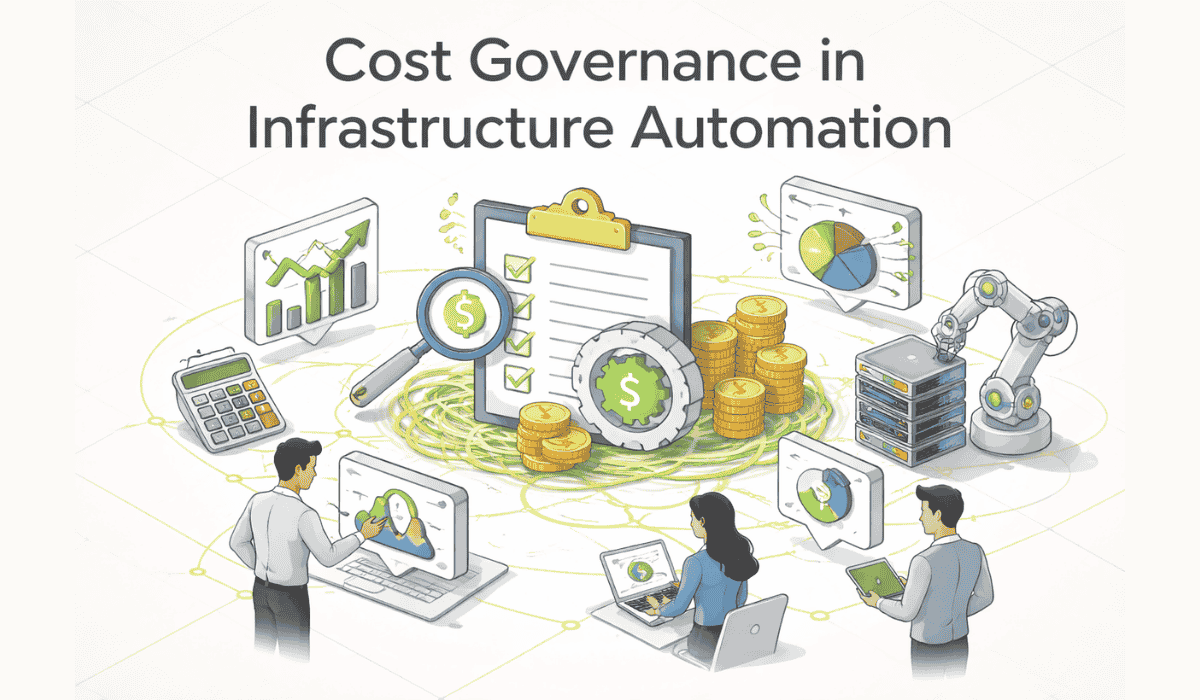
Infrastructure automation helps organizations provision cloud resources faster, reduce manual work, and improve operational consistency.
Teams can create environments, deploy applications, and scale services in minutes using Infrastructure as Code, templates, and automated workflows.
While automation increases speed and efficiency, it can also increase cloud costs if organizations do not have the right controls in place. Teams may provision oversized resources, leave environments running longer than needed, create duplicate infrastructure, or launch services without cost visibility.
This is why cost governance is essential. Cost governance helps organizations manage cloud spending while still supporting automation, speed, and flexibility. Without it, automated infrastructure can become expensive, inefficient, and difficult to control.
What Is Cost Governance?
Cost governance is the process of creating policies, controls, and visibility around cloud spending.
It helps organizations understand:
- Who is creating resources
- Which teams are responsible for costs
- How much different environments cost
- Which services are generating waste
- Where budgets are being exceeded
- Which controls can reduce spending
Cost governance is not about limiting innovation. The goal is to help teams use cloud resources responsibly while maintaining visibility into spending.
Why Infrastructure Automation Can Increase Costs
Automation makes it easier to provision cloud infrastructure. However, when teams can create resources quickly, cloud spending can increase just as quickly.
For example, teams may:
- Create environments for testing and forget to remove them
- Provision larger instances than necessary
- Duplicate environments across teams
- Launch services without budget approval
- Store unused backups or snapshots
- Leave idle databases and storage running
Because automated provisioning happens so quickly, small inefficiencies can scale across many teams and environments. This often leads to unnecessary cloud spending.
Common Cost Governance Challenges
Organizations often struggle with cost governance because cloud spending is distributed across multiple teams, environments, and services.
Lack of Cost Visibility
Teams may not know which applications, environments, or departments are responsible for specific cloud costs. Without visibility, organizations struggle to understand where money is being spent.
Unclear Ownership
If resources are not properly tagged or assigned to an owner, it becomes difficult to determine who is responsible for the cost. This often leads to abandoned resources and wasted spending.
Overprovisioning
Teams may choose larger instances, more storage, or higher service levels than they actually need. Overprovisioning is one of the most common sources of unnecessary cloud costs.
Idle and Unused Resources
Unused virtual machines, databases, load balancers, and storage can remain active for months if organizations do not have expiration policies.
Limited Budget Controls
Without spending thresholds and alerts, teams may exceed budgets before anyone notices. These budget pressures have become more visible since HCP Terraform's free tier changed in 2026, pushing many teams to scrutinize automation-driven cloud spend more closely, and to compare Terraform Cloud pricing against alternatives.
Lack of Standardization
Different teams may use different instance types, environments, and deployment models. This makes it harder to apply cost governance consistently.
Why Cost Governance Matters in Infrastructure Automation
Infrastructure automation allows organizations to move quickly, but speed without governance can lead to waste.
Cost governance helps organizations:
- Improve spending visibility
- Reduce waste
- Increase accountability
- Support budget planning
- Prevent unnecessary resource usage
- Balance cost and performance
Strong cost governance allows teams to continue using automation while maintaining better financial control.
Key Elements of Cost Governance
Organizations should include several important controls in their cost governance strategy.
Resource Tagging
Tagging is one of the most important parts of cost governance. Every cloud resource should include tags such as:
- Team name
- Environment type
- Project name
- Cost center
- Application owner
- Expiration date
Tags help organizations understand who owns resources and how much they cost.
Budget Thresholds and Alerts
Organizations should create budget limits for teams, projects, and environments. Budget alerts can notify teams when spending approaches a predefined limit, which helps teams take action before costs become too high.
Environment Expiration Policies
Temporary environments should not remain active forever. Organizations can reduce waste by automatically expiring:
- Development environments
- Test environments
- Sandbox environments
- Proof-of-concept environments
Expiration policies help prevent forgotten resources from increasing costs.
Rightsizing
Rightsizing means matching resources to actual usage. For example, teams may reduce costs by:
- Moving to smaller instances
- Reducing storage allocations
- Scaling down idle services
- Using reserved instances for predictable workloads
Rightsizing helps organizations avoid paying for unused capacity.
Approval Workflows
Not every infrastructure request should be approved automatically. Organizations may require additional approvals for:
- High-cost environments
- Production workloads
- Large instance types
- New services
- Extended environment durations
Approval workflows help control spending for higher-risk requests. See Approval Policies for Cloud Teams for how these approval layers are typically structured, and Policy Guardrails Explained for Infrastructure Automation for how cost limits get enforced as code rather than manual review.
These five controls (tagging, budgets, expiration, rightsizing, approvals) are the mechanical core of cost governance. How an organization decides who owns them, how spending gets allocated across teams, and how the organization matures its practice over time is a separate, broader discipline; see FinOps Controls in Platform Engineering for that side of the picture.
How Automation Supports Cost Governance
Automation can help organizations enforce cost controls more consistently. For example, organizations can automate:
- Required resource tags
- Budget alerts
- Environment expiration
- Rightsizing recommendations
- Policy enforcement
- Cost reporting
- Approval workflows
Automation reduces manual work and makes it easier to scale cost governance across many teams.
Best Practices for Cost Governance in Infrastructure Automation
Organizations can improve cost governance by following several best practices.
Define Ownership Clearly
Every environment and resource should have a clearly assigned owner tag. This is a tagging discipline, not an organizational one: it makes it possible to trace a cost back to a team automatically, without requiring a cross-functional review process to figure out who's responsible.
Standardize Resource Configurations
Teams should use approved templates and instance types whenever possible. This reduces unnecessary variation, and it's the same standardization principle behind self-service infrastructure with guardrails: golden-path templates keep costs predictable even as more teams provision independently.
Review Spending Regularly
Organizations should review cloud costs regularly to identify waste and optimization opportunities.
Align Cost Governance With Business Goals
Cost governance should support both efficiency and performance. The goal is not always to spend less. Sometimes organizations need to invest more to support business growth.
Common Signs of Weak Cost Governance
Organizations may have cost governance problems if they experience:
- Frequent budget overruns
- Large amounts of unused infrastructure
- Poor visibility into spending
- Resources without owners
- High costs in non-production environments
- Duplicate services across teams
- Difficulty forecasting future cloud costs
Recognizing these issues early helps organizations improve cost control.
Once you’re ready to put this into practice, the Cost Governance Model for Enterprise Cloud Environments lays out the full structured model.
Conclusion
Cost governance is essential in infrastructure automation because automated provisioning can quickly increase cloud spending.
Without clear ownership, visibility, budget controls, and approval processes, organizations may struggle with unused resources, oversized environments, and uncontrolled costs.
Strong cost governance helps teams use automation responsibly while maintaining financial visibility and accountability. Organizations that invest in tagging, rightsizing, budget alerts, environment expiration, and automation are better positioned to reduce waste and improve cloud cost management. This is the mechanical layer. Once those controls exist, the harder question is usually organizational: who owns them, how spend gets allocated across teams, and how the practice matures over time, which is covered in FinOps Controls in Platform Engineering.
FAQs
What is cost governance in cloud infrastructure?
Cost governance is the process of creating policies, controls, and visibility around cloud spending. It helps organizations manage costs more effectively while supporting cloud growth.
Why is cost governance important in infrastructure automation?
Infrastructure automation makes it easy to provision resources quickly. Without cost governance, teams may create unnecessary resources, exceed budgets, and increase cloud waste.
What are the most common causes of cloud cost waste?
Common causes include idle resources, oversized instances, unused environments, duplicate infrastructure, poor tagging, and lack of budget visibility.
How does resource tagging improve cost governance?
Resource tagging helps organizations identify who owns cloud resources, which teams are responsible for costs, and which environments are generating spending.
What is rightsizing in cloud cost management?
Rightsizing means adjusting resources so they match actual usage. This helps organizations reduce waste and avoid paying for unused capacity.
How can automation improve cost governance?
Automation helps organizations enforce cost controls more consistently by applying tags, sending alerts, expiring environments, and supporting approval workflows.
Related Reading
- FinOps Controls in Platform Engineering
- Terraform Cloud Pricing in 2026: What You Pay Now & Cheaper Alternatives
- HCP Terraform's Free Tier Changed
- Approval Policies for Cloud Teams
- Policy Guardrails Explained for Infrastructure Automation
- Self-Service Infrastructure With IaC: How Platform Teams Stop Being the Bottleneck
Help us build the open source Terraform alternative. Join us on GitHub.