.webp)
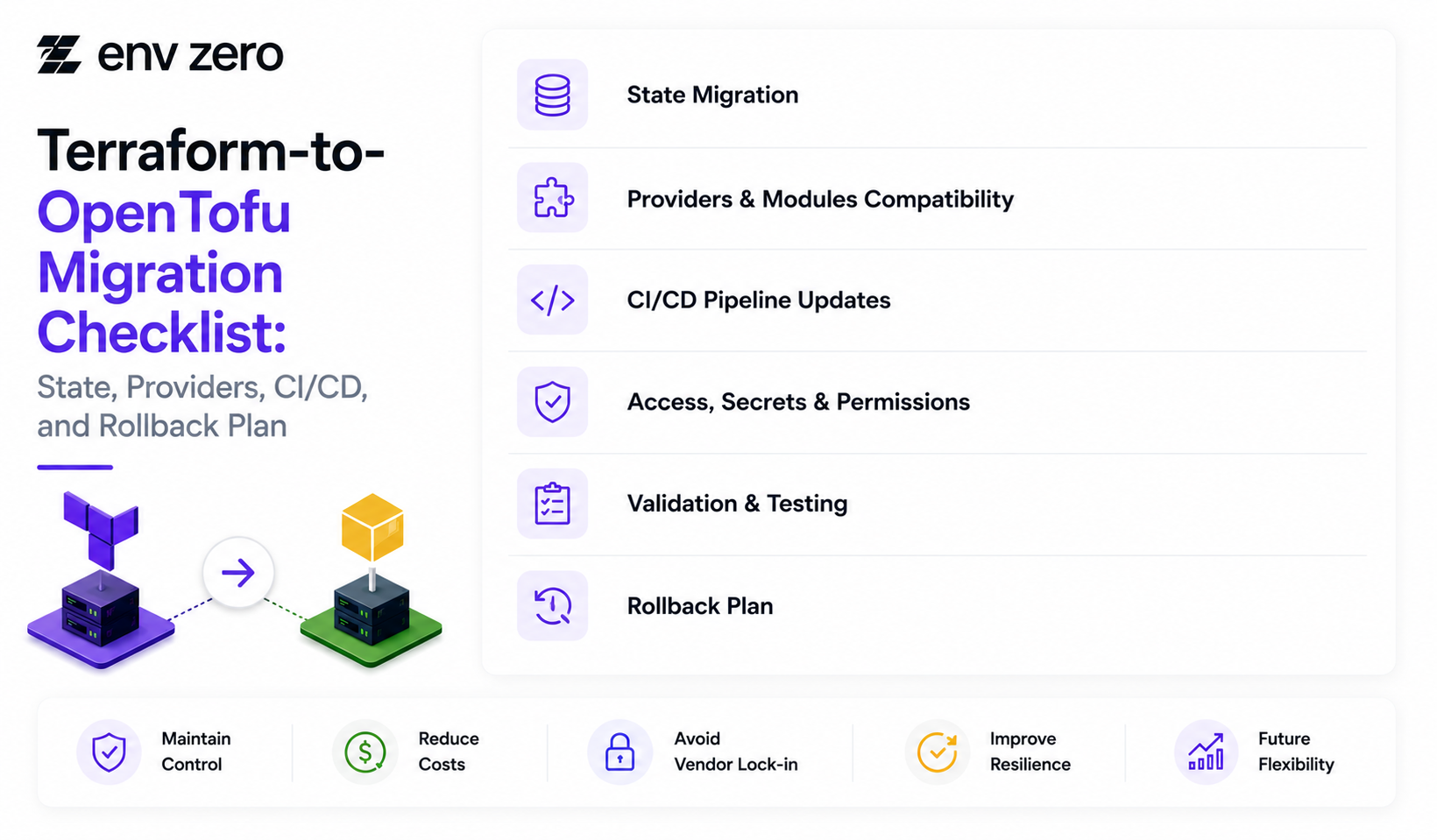
A Terraform-to-OpenTofu migration can help platform teams move toward a more open infrastructure-as-code strategy, but it should not be treated as a simple binary swap.
OpenTofu is designed for familiar Terraform-style workflows, yet production environments still depend on state files, provider behavior, CI/CD pipelines, secrets, approvals, and rollback planning.
For DevOps teams and platform engineering leaders, the safest path is a structured checklist.
The goal is to migrate Terraform to OpenTofu without creating state issues, breaking pipelines, weakening governance, or introducing unexpected production changes.
This guide gives platform teams a practical checklist for evaluating OpenTofu readiness, testing migration steps, and using env0 to keep Terraform and OpenTofu workflows governed throughout the transition.
Clarify Why the Migration Is Happening
Before making technical changes, define the reason for the migration.
Some teams are moving because they want an open-source Terraform-compatible path.
Others are comparing OpenTofu vs Terraform because of licensing, platform strategy, or long-term infrastructure governance.
The reason matters because it shapes the migration plan. A team that only wants to test OpenTofu may start with low-risk development environments.
A team that wants to leave a Terraform Cloud workflow may also need to review state storage, approvals, policies, and cost visibility.
This decision should be framed as a platform strategy, not just a tooling update.
Confirm What OpenTofu Means for Your Team
Before the migration starts, make sure everyone understands what OpenTofu is.
OpenTofu is an open-source infrastructure-as-code tool created as a Terraform-compatible alternative.
It keeps familiar configuration patterns, which makes it easier for Terraform users to evaluate.
However, compatibility does not remove the need for testing. Your team should still validate provider behavior, module sources, state handling, secrets, and CI/CD execution.
A strong opentofu vs terraform platform engineering comparison should focus on how the tool fits your operating model, not only how similar the syntax looks.
Create a Workspace and Repository Inventory
A clean inventory is the foundation of a safe migration. List every Terraform repository, workspace, environment, backend, provider, module source, owner, and last apply date.
Group each workload by risk level. Development and sandbox environments are usually lower risk. Staging and shared services are medium risk. Production networking, identity, databases, and compliance-sensitive systems are high risk.
This inventory helps the team decide where to start. Low-risk workspaces should be tested first. Production should move only after the migration process has been validated elsewhere.
Back Up State and Code
State files are one of the most important parts of any terraform to OpenTofu migration. Before changing execution workflows, back up the current state and repository code.
Confirm where state is stored, how locking works, who has access, and how state can be restored.
Do not assume the existing setup is clean. If the state is already inconsistent, migration may expose issues that were previously hidden.
The safest migration starts from a stable baseline. State backup, code backup, and restore planning should happen before OpenTofu is introduced into active workflows.
Validate the Current Terraform Plan
Before switching to OpenTofu, run Terraform plans for the target workloads and confirm there are no unexpected changes.
If Terraform already detects drift or pending changes, resolve those issues before migration.
This step gives the team a clean comparison point. When OpenTofu is tested later, the team can compare plan output against a known stable Terraform baseline.
Skipping this step makes troubleshooting harder. If OpenTofu shows changes, the team may not know whether the issue came from migration, provider behavior, existing drift, or stale state.
Install OpenTofu in a Controlled Workflow
Do not install OpenTofu directly into every production pipeline first.
Start with a controlled test runner, local validation environment, or low-risk CI/CD workflow.
The first goal is simple: initialize the configuration, verify provider resolution, confirm backend behavior, and generate a plan.
After the team validates the basic workflow, OpenTofu can be tested in more active non-production environments.
This phased approach gives platform teams time to identify issues before they affect critical infrastructure.
Review Providers, Modules, and Registry Sources
Providers and modules can create migration risk even when Terraform configuration looks compatible.
Review provider version constraints, lock files, private module sources, registry references, and internal module ownership.
If your team uses private providers or private module registries, confirm that OpenTofu workflows can access them correctly.
Shared modules should be tested across representative environments before being used in production migration.
The goal is not only to check whether the code runs. The goal is to confirm that the same infrastructure behavior is preserved.
Update CI/CD Pipelines Carefully
CI/CD pipelines often contain hidden Terraform assumptions. Scripts may reference the Terraform binary directly.
Jobs may depend on Terraform Cloud workspace behavior. Variables, credentials, plan artifacts, approval gates, and notifications may all need review.
Update one workflow at a time. Test plan generation, apply behavior, approval steps, failure handling, and logs.
If the pipeline uses shared templates, test those templates before rolling changes across multiple repositories.
Pipeline migration should be gradual because CI/CD errors can interrupt delivery even when the IaC code itself is valid.
Protect OpenTofu Secrets
OpenTofu secrets should be handled with the same care as Terraform secrets.
Review where sensitive values are stored today, such as workspace variables, CI/CD secrets, cloud secret managers, or platform-managed variable stores.
Do not move secrets into plain text files, tickets, spreadsheets, or temporary migration notes. Confirm that access controls, masking, rotation, and audit logs remain intact after migration.
Secrets handling is one of the most important production-readiness checks because a migration should never weaken security controls.
Compare Terraform and OpenTofu Plans
After OpenTofu is installed in a controlled workflow, compare OpenTofu plan results against the current Terraform baseline.
Look for unexpected resource changes, provider differences, state behavior, or module resolution issues.
A clean comparison gives platform teams confidence to continue. If the plan output changes unexpectedly, pause and investigate before moving to higher-risk environments.
For production systems, do not rely only on successful initialization. Plan comparison is the real validation step.
Prepare a Rollback Plan
Every migration should include a rollback plan before production changes happen.
Define how the team will restore state, revert CI/CD changes, return to the previous execution path, and pause the migration if needed.
The rollback plan should include owners, decision points, communication steps, and validation checks. Teams should know who can approve rollback and what conditions require it.
A strong rollback plan makes migration safer because the team is not improvising during a production issue.
Keep Governance Consistent With env0
Migration should not weaken governance. Platform teams still need approvals, RBAC, policy controls, drift detection, cost visibility, audit logs, and self-service workflows.
env0 helps teams manage Terraform and OpenTofu workflows from one governed platform.
This is useful when teams want to migrate gradually, compare behavior across environments, and avoid fragmented infrastructure processes.
With env0, platform teams can support OpenTofu adoption while keeping infrastructure delivery controlled, visible, and auditable.
Conclusion: Migrate With Structure, Not Assumptions
A Terraform-to-OpenTofu migration can be a smart move for teams that want a Terraform-compatible open-source path. But production migration should be structured carefully.
Start with inventory. Back up state. Validate the current Terraform baseline. Install OpenTofu in controlled workflows.
Review providers, modules, CI/CD, secrets, and rollback steps. Then move by risk level.
With env0, teams can migrate from Terraform to OpenTofu while maintaining the governance controls required for production infrastructure.
Build a Safer OpenTofu Migration With env0
env0’s IaC Platform & Terraform Automation service helps teams migrate and govern Terraform and OpenTofu workflows with approvals, RBAC, policy controls, drift detection, cost visibility, audit logs, and self-service automation.
Talk to env0 to build a safer Terraform-to-OpenTofu migration plan for production environments.
FAQs
What is Terraform-to-OpenTofu migration?
Terraform-to-OpenTofu migration is the process of moving Terraform workflows, state, providers, modules, and CI/CD pipelines to OpenTofu. It should be tested carefully before production adoption.
Is OpenTofu compatible with Terraform?
OpenTofu is designed as a Terraform-compatible alternative, but teams should still test their own providers, modules, state files, pipelines, and governance workflows before migration.
Should teams install OpenTofu directly in production?
No, teams should install OpenTofu first in a controlled non-production environment. Production migration should happen only after plan output, providers, state handling, and approvals are validated.
What should be backed up before migration?
Teams should back up state files, repository code, provider lock files, workspace settings, variable references, and any migration-critical configuration before starting.
How should teams handle OpenTofu secrets?
OpenTofu secrets should stay in secure systems such as secret managers, protected variables, or platform-managed stores. Teams should avoid copying sensitive values into plain text during migration.
How does env0 help with OpenTofu migration?
env0 helps teams run Terraform and OpenTofu workflows with consistent governance, including approvals, RBAC, policies, drift detection, cost visibility, audit logs, and self-service automation.