.webp)
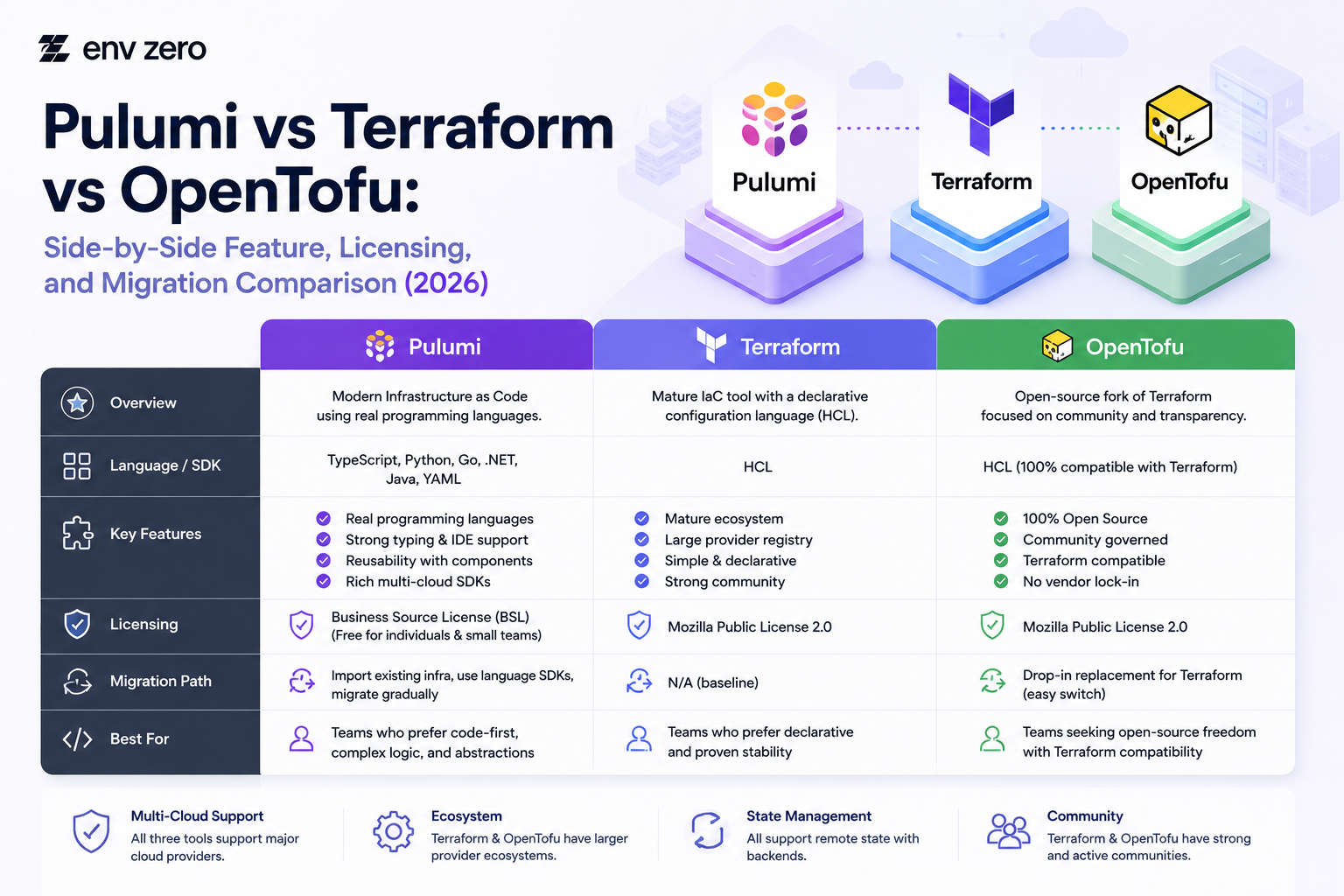
Pulumi vs Terraform vs OpenTofu is one of the most important IaC tool comparison topics for platform teams in 2026.
The decision is no longer only about syntax or provider support.
Teams also need to consider language preference, licensing risk, migration cost, governance, developer experience, and long-term platform fit.
Terraform remains familiar for many infrastructure teams. OpenTofu gives teams a Terraform-compatible open-source path.
Pulumi gives developers a programming-language-based approach to infrastructure as code. Each tool can work well, but each one fits a different operating model.
For DevOps teams, platform engineering teams, and enterprise IT leaders, the best choice is not always one tool for every workflow.
Many organizations need a platform strategy that can support Terraform, OpenTofu, Pulumi, and future IaC tools together. That is where env0’s IaC Platform & Terraform Automation service becomes useful.
Why This Comparison Matters in 2026
Infrastructure teams are evaluating IaC tools more carefully because the environment has changed.
Terraform licensing decisions pushed many teams to review long-term dependency risk.
OpenTofu gave Terraform-style teams a new open-source option. Pulumi continues to attract developer-focused teams that prefer general-purpose languages.
The main question is not “Which tool is best?” The better question is: which tool fits your team’s skills, governance model, migration path, and infrastructure scale?
A small engineering team may prioritize speed and developer familiarity.
A platform team managing production infrastructure across many business units may prioritize state safety, approvals, audit logs, policy controls, and drift detection.
Side-by-Side Comparison
Category
Terraform
OpenTofu
Pulumi
Primary language model
HCL
HCL-style configuration
General-purpose languages
Best fit
Teams with mature Terraform workflows
Teams wanting Terraform-style open-source continuity
Developer-led teams using TypeScript, Python, Go, C#, or similar
Migration effort from Terraform
None if staying on Terraform
Usually lower than rewriting to a new model, but still needs testing
Higher because infrastructure may need to be rewritten
Licensing consideration
HashiCorp-controlled licensing model
Open-source project under Linux Foundation stewardship
Open-source engine with Pulumi platform editions
Governance need
Requires platform controls at scale
Requires platform controls at scale
Requires platform controls at scale
Team learning curve
Lower for existing Terraform users
Lower for Terraform-style users
Lower for software teams comfortable with programming languages
Common concern
Pricing, licensing, platform lock-in
Ecosystem maturity and migration validation
Rewrite effort, pricing, and governance consistency
Terraform: Familiar and Mature
Terraform is still widely used because many teams already have existing modules, state files, provider workflows, and internal standards built around it.
For infrastructure teams that know HCL and already operate Terraform at scale, staying with Terraform may reduce short-term disruption.
Terraform is a good fit when teams value continuity. Existing modules, registry usage, CI/CD workflows, and Terraform Cloud processes may already be deeply embedded in the organization.
However, teams should still evaluate governance. Terraform alone does not solve approvals, RBAC, drift detection, cost visibility, or self-service workflows.
If those controls are missing, the team may not need a new IaC language first. It may need a stronger platform layer.
OpenTofu: Terraform-Style Continuity With Open-Source Direction
OpenTofu is often evaluated by teams that want familiar Terraform-style workflows with a more open-source governance direction.
For teams already using Terraform, OpenTofu may feel more natural than moving to a completely different programming model.
OpenTofu can be a strong fit when teams want continuity in configuration style, module structure, and operational patterns.
It is especially relevant for organizations reviewing Terraform licensing, vendor dependency, or long-term roadmap control.
The important point is that OpenTofu migration still needs testing. Teams should review state files, providers, private modules, CI/CD pipelines, secrets, and policy workflows before moving production environments.
Pulumi: Developer-Led Infrastructure in Programming Languages
Pulumi is different because it lets teams define infrastructure using general-purpose programming languages.
This can be attractive for application developers who prefer TypeScript, Python, Go, C#, or similar languages over HCL.
Pulumi can work well when infrastructure is closely connected to application development.
Developers can use familiar language features, package managers, testing patterns, and code organization practices.
The tradeoff is migration effort. Moving from Terraform or OpenTofu to Pulumi may require more rewriting than moving from Terraform to OpenTofu.
Platform teams also need to make sure programming-language flexibility does not create inconsistent infrastructure patterns across teams.
Licensing and Pricing Considerations
Licensing and pricing should be reviewed carefully before choosing an IaC direction.
Terraform, OpenTofu, and Pulumi each come with different ecosystem and platform considerations.
Terraform teams may care about HashiCorp licensing, Terraform Cloud pricing, and long-term platform dependency.
OpenTofu teams may care about open-source governance, ecosystem maturity, and compatibility.
Pulumi teams may care about Pulumi pricing, platform editions, deployment features, and team adoption cost.
The pricing question should not be limited to subscription fees. Platform teams should also calculate operational cost.
A tool that looks cheaper may become expensive if the team has to build missing governance, audit logs, approvals, drift detection, and cost controls manually.
Migration Effort and Risk
Migration effort is one of the biggest differences between these tools. Staying with Terraform usually has the lowest immediate migration cost.
Moving from Terraform to OpenTofu may be more direct, but still requires testing. Moving from Terraform to Pulumi is usually a larger architectural change.
For production environments, migration should be phased. Start with low-risk environments, compare plan behavior, test provider compatibility, validate secrets, and confirm rollback options before moving critical workloads.
Platform teams should not choose a tool only because the migration sounds easy. They should choose the operating model that will remain maintainable after migration.
Governance Is the Common Requirement
No matter which tool a team chooses, governance remains necessary.
Terraform, OpenTofu, and Pulumi can all define infrastructure, but they do not automatically answer the full platform governance question.
Teams still need to know who can deploy, who approved a change, what policies passed, whether infrastructure drifted, what the cost impact is, and whether developers can use safe self-service workflows.
This is why env0 matters in a multi-IaC strategy. env0 helps teams govern Terraform, OpenTofu, Pulumi, Helm, Kubernetes, and other IaC workflows from one platform.
That gives teams flexibility without creating disconnected processes for every tool.
When to Choose Terraform
Terraform is a strong choice when your team already has stable HCL workflows, mature modules, provider experience, and existing operational knowledge.
It may also be the right choice when the main problem is not Terraform itself, but weak governance around Terraform.
In that case, improving approvals, policies, drift detection, and cost visibility may create more value than changing tools.
When to Choose OpenTofu
OpenTofu is a strong choice when your team wants Terraform-style workflows with an open-source path.
It is especially useful for teams that want continuity but are reviewing long-term Terraform dependency risk.
OpenTofu is not a shortcut around governance. Teams still need a safe migration path and a platform model for approvals, RBAC, policy controls, drift, cost, and auditability.
When to Choose Pulumi
Pulumi is a strong choice when infrastructure ownership sits close to software engineering teams.
If developers want to write infrastructure in familiar programming languages, Pulumi may improve adoption and productivity.
Pulumi should be evaluated carefully when existing Terraform estates are large.
The migration may be worth it, but platform teams should plan for rewrite effort, training, code standards, and governance consistency.
Why env0 Fits a Multi-IaC Strategy
Many organizations will not use only one IaC tool. They may keep Terraform for existing workloads, adopt OpenTofu for new projects, and use Pulumi for developer-led services.
env0 helps platform teams support this reality. Instead of forcing every team into one tool or allowing each team to create its own process, env0 provides a governance layer across multiple IaC workflows.
With env0, teams can manage approvals, RBAC, policy controls, drift detection, cost visibility, audit logs, and self-service infrastructure from one platform.
Conclusion: Choose the Tool and the Governance Model Together
Pulumi, Terraform, and OpenTofu each solve infrastructure as code in a different way. Terraform offers familiarity.
OpenTofu offers Terraform-style continuity with open-source direction. Pulumi offers programming-language flexibility.
The right decision depends on team skills, migration cost, licensing concerns, governance needs, and long-term infrastructure strategy.
For platform teams, the safest approach is to choose the IaC tool and the governance model together. env0 helps teams manage that broader platform strategy across Terraform, OpenTofu, Pulumi, and modern IaC workflows.
Build Multi-IaC Governance With env0
env0’s IaC Platform & Terraform Automation service helps teams govern Terraform, OpenTofu, Pulumi, and broader IaC workflows with approvals, RBAC, policy controls, drift detection, cost visibility, audit logs, and self-service automation.
Talk to env0 to compare your IaC options and build a governed multi-IaC platform strategy.
FAQs
What is the main difference between Pulumi, Terraform, and OpenTofu?
Terraform and OpenTofu use HCL-style infrastructure configuration, while Pulumi uses general-purpose programming languages. Terraform is familiar for many infrastructure teams, OpenTofu offers a Terraform-compatible open-source path, and Pulumi is more developer-language focused.
Is Pulumi better than Terraform?
Pulumi may be better for teams that want infrastructure in programming languages. Terraform may be better for teams that prefer HCL, existing modules, and mature Terraform workflows. The better choice depends on team skills and governance needs.
Is OpenTofu a good Terraform alternative?
OpenTofu can be a good Terraform alternative for teams that want familiar Terraform-style workflows with an open-source direction. Teams should still test providers, state, modules, and CI/CD workflows before production migration.
Should platform teams support multiple IaC tools?
Some platform teams should support multiple IaC tools when different teams have different needs. The important part is using a governance platform so policies, approvals, cost controls, and audit logs remain consistent.
How does env0 help with Pulumi, Terraform, and OpenTofu?
env0 helps teams govern Terraform, OpenTofu, Pulumi, and broader IaC workflows with approvals, RBAC, policy controls, drift detection, cost visibility, audit logs, and self-service automation.