.webp)
OpenTofu has become an important option for platform teams evaluating the future of infrastructure as code.
Many teams first compare OpenTofu vs Terraform because they want a Terraform-compatible workflow with a more open-source direction.
But adoption should not be based only on licensing or community momentum.
Teams should also understand which OpenTofu features may improve security, reduce duplication, and support larger platform workflows.
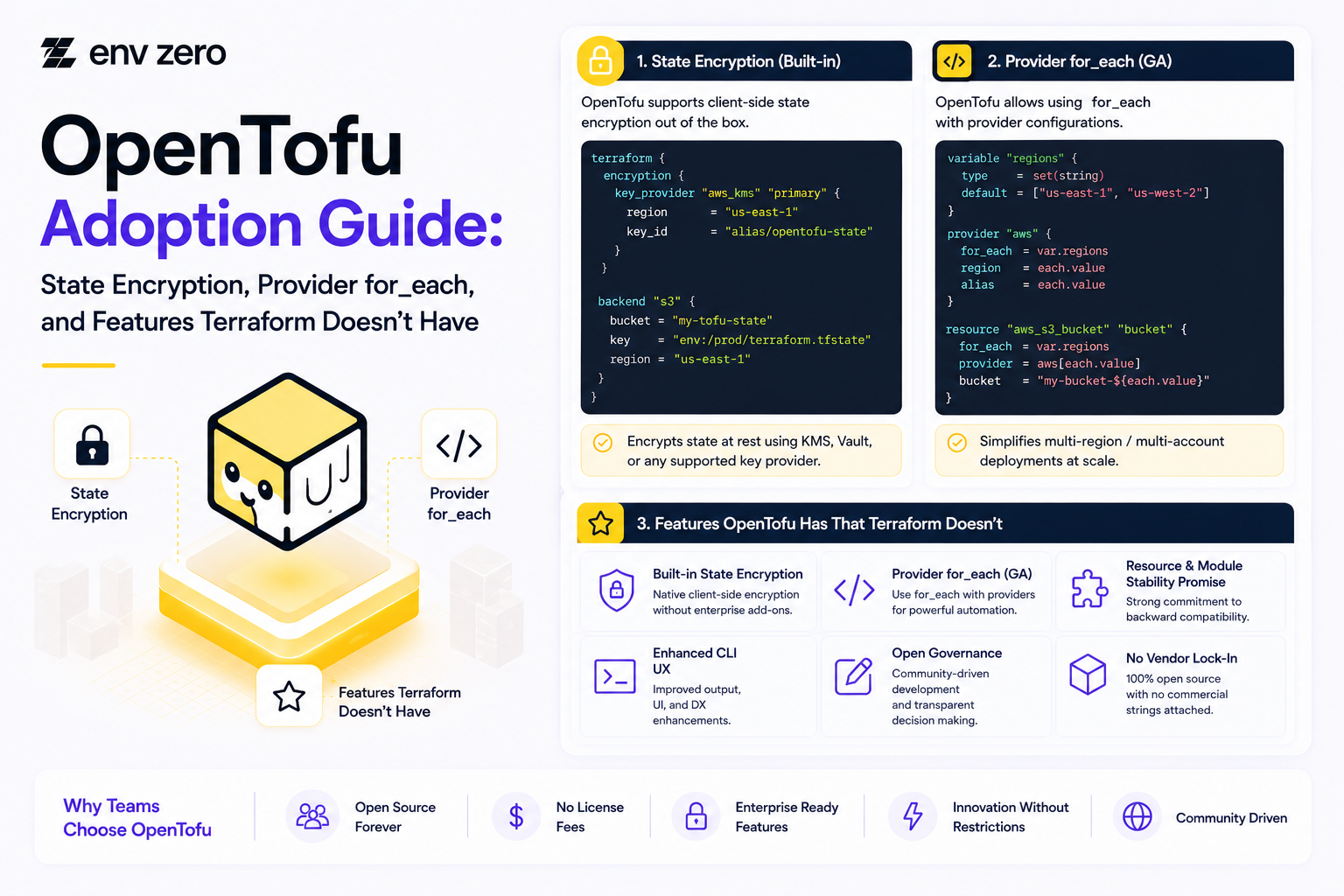
Two features stand out for many organizations: built-in state encryption and provider for_each. State encryption helps protect sensitive infrastructure data stored in state files.
Provider for_each helps teams reduce duplicated provider blocks in multi-region, multi-zone, or multi-account deployments.
This guide explains what OpenTofu is, why platform teams adopt it, which features deserve attention, and how env0 helps teams govern OpenTofu workflows at scale.
What Is OpenTofu?
OpenTofu is an open-source infrastructure-as-code tool created as a Terraform-compatible alternative.
It uses familiar configuration patterns, which makes it easier for Terraform teams to evaluate without immediately rewriting their entire infrastructure estate.
For teams asking what OpenTofu is, the practical answer is simple: it is a way to preserve much of the Terraform-style workflow while moving toward an open-source project direction.
That makes it attractive for teams that want continuity, but also want more control over long-term IaC strategy.
OpenTofu adoption should still be planned carefully. Compatibility helps, but production teams must test providers, modules, state handling, CI/CD pipelines, secrets, and governance workflows before migration.
Why Teams Are Comparing OpenTofu vs Terraform
The terraform vs OpenTofu comparison usually starts with licensing and roadmap concerns.
But for platform engineering teams, the comparison should go deeper.
Teams should ask whether OpenTofu improves their operating model. Does it support the security features they need?
Does it reduce code duplication? Does it fit existing modules and provider workflows? Can it be governed across teams? Can it run alongside Terraform during a transition?
A good OpenTofu vs Terraform platform engineering comparison should include state security, provider management, migration risk, CI/CD readiness, team skills, and governance maturity.
State Encryption as an Adoption Driver
State files can contain sensitive information, including resource IDs, configuration values, tokens, and other infrastructure details.
Even when teams use secure remote backends, state exposure remains a major concern.
OpenTofu’s built-in state encryption is one of its most important differences. It allows teams to encrypt state data before it is stored, including in remote backends.
This gives platform teams another security layer for protecting sensitive infrastructure metadata.
State encryption is especially valuable for regulated environments, multi-team infrastructure platforms, and organizations that want stronger controls around OpenTofu secrets and sensitive state data.
How OpenTofu State Encryption Works
OpenTofu state encryption is configured through an encryption block or environment-based configuration.
Teams can use key providers such as PBKDF2, AWS KMS, GCP KMS, and OpenBao, depending on their security model.
The key point is that encryption should be planned, not added casually.
Teams need to define who manages keys, how key rotation works, how fallback configuration is handled, and how encrypted state will be accessed in CI/CD workflows.
For production environments, state encryption should be tested in non-production first.
A misconfigured encryption setup can make state difficult to read or recover. Platform teams should document recovery steps before enabling encryption broadly.
Provider for_each for Multi-Region Workflows
Provider for_each is another important OpenTofu feature. In Terraform-style workflows, teams often duplicate provider blocks for each region, account, or zone.
This can make multi-region configurations repetitive and harder to maintain.
OpenTofu provider for_each lets teams iterate provider configurations, which can reduce duplication in certain multi-region or multi-zone deployments.
For example, a team managing infrastructure across several regions may define a region list and generate provider configurations based on that list.
This can make infrastructure code cleaner and easier to extend. However, provider for_each should be used carefully.
Teams should understand its limitations, especially around static values, aliases, and safe region removal. It is powerful, but it should not replace clear design and review.
Other OpenTofu Features Worth Reviewing
State encryption and provider for_each are the headline features, but they are not the only reasons teams evaluate OpenTofu.
OpenTofu has also introduced features such as loopable import blocks, removed blocks, provider-defined functions, early evaluation improvements, and the -exclude flag.
These features may help teams with migrations, refactoring, testing, and selective operations.
The real value depends on your infrastructure model. A small team may not need all of them.
A platform team managing many environments may find them more useful.
The important point is to evaluate features through production use cases, not only release notes.
When to Install OpenTofu
Teams should install OpenTofu first in a controlled environment, not directly in every production workflow. Start with local testing, a sandbox runner, or a low-risk CI/CD job.
The first tests should confirm initialization, provider resolution, state access, plan output, and module compatibility.
After that, platform teams can test active development environments, then staging, and eventually production.
This gradual rollout helps teams compare OpenTofu behavior with Terraform before making high-risk changes.
Planning Terraform to OpenTofu Migration
A terraform to OpenTofu migration should be phased by risk.
Begin with low-risk repositories or workspaces, then move to shared non-production environments, and only later migrate production-critical systems.
Before migration, teams should review state files, providers, private modules, CI/CD scripts, secrets, workspace variables, policy controls, drift detection, and rollback options.
Migration should not weaken governance. If Terraform workflows currently include approvals, RBAC, policy checks, or audit logs, those controls should remain in place after OpenTofu adoption.
Governance Requirements for OpenTofu Adoption
OpenTofu gives teams an IaC engine, but platform teams still need a governance model.
They must control who can run plans, who can approve applies, which policies are enforced, how drift is detected, and how cost is monitored.
Without governance, OpenTofu adoption can create the same problems teams had with unmanaged Terraform workflows: inconsistent processes, unclear ownership, manual changes, and weak auditability.
env0 helps solve this by providing a governed platform for OpenTofu, Terraform, and broader IaC workflows.
Teams can manage approvals, RBAC, policy controls, drift detection, cost visibility, audit logs, and self-service workflows from one place.
How env0 Helps Teams Adopt OpenTofu
env0 supports teams that want to adopt OpenTofu without creating disconnected workflows.
Platform teams can run Terraform and OpenTofu side by side, support gradual migration, and keep governance consistent across environments.
This is especially useful when only some teams are ready for OpenTofu.
Developers can continue working through approved workflows, while platform teams manage policies, approvals, drift, and cost visibility centrally.
For organizations evaluating OpenTofu, env0 helps turn adoption from a tool experiment into a governed platform strategy.
Conclusion: Adopt OpenTofu for the Right Reasons
OpenTofu is not only a Terraform alternative. It is an opportunity for platform teams to review security, provider management, migration readiness, and governance maturity.
State encryption can improve protection for sensitive infrastructure data.
Providers for_each can reduce duplication in multi-region workflows. Other OpenTofu features may support migration and operational flexibility.
But adoption should be planned carefully. Teams should test OpenTofu in controlled environments, validate state and providers, protect secrets, and maintain governance throughout the transition.
Build Governed OpenTofu Workflows With env0
env0 provides a centralized platform for teams adopting OpenTofu, offering automated approvals, RBAC, policy enforcement, drift detection, cost tracking, audit logs, and self-service workflows.
Partner with env0 to plan a controlled migration path, maintain governance, and ensure your infrastructure teams can adopt OpenTofu efficiently and securely.
FAQs
What is OpenTofu?
OpenTofu is an open-source infrastructure-as-code tool created as a Terraform-compatible alternative. It uses familiar Terraform-style workflows while giving teams an open-source path for long-term IaC strategy.
What features does OpenTofu have that Terraform does not?
OpenTofu includes features such as built-in state encryption, provider for_each, loopable import blocks, removed blocks, provider-defined functions, early evaluation improvements, and the -exclude flag.
Why is OpenTofu state encryption important?
State files can contain sensitive infrastructure data. OpenTofu state encryption helps protect that data before it is stored, including in remote backends.
What is the provider for_each in OpenTofu?
Provider for_each allows teams to iterate provider configurations, which can reduce duplicated provider blocks in multi-region, multi-zone, or multi-account deployments.
Should teams install OpenTofu directly in production?
No, teams should install OpenTofu first in a controlled non-production environment, validate providers and state behavior, then expand migration gradually.
How does env0 help with OpenTofu adoption?
env0 helps teams adopt OpenTofu with governed workflows, approvals, RBAC, policy controls, drift detection, cost visibility, audit logs, and self-service automation.