.webp)
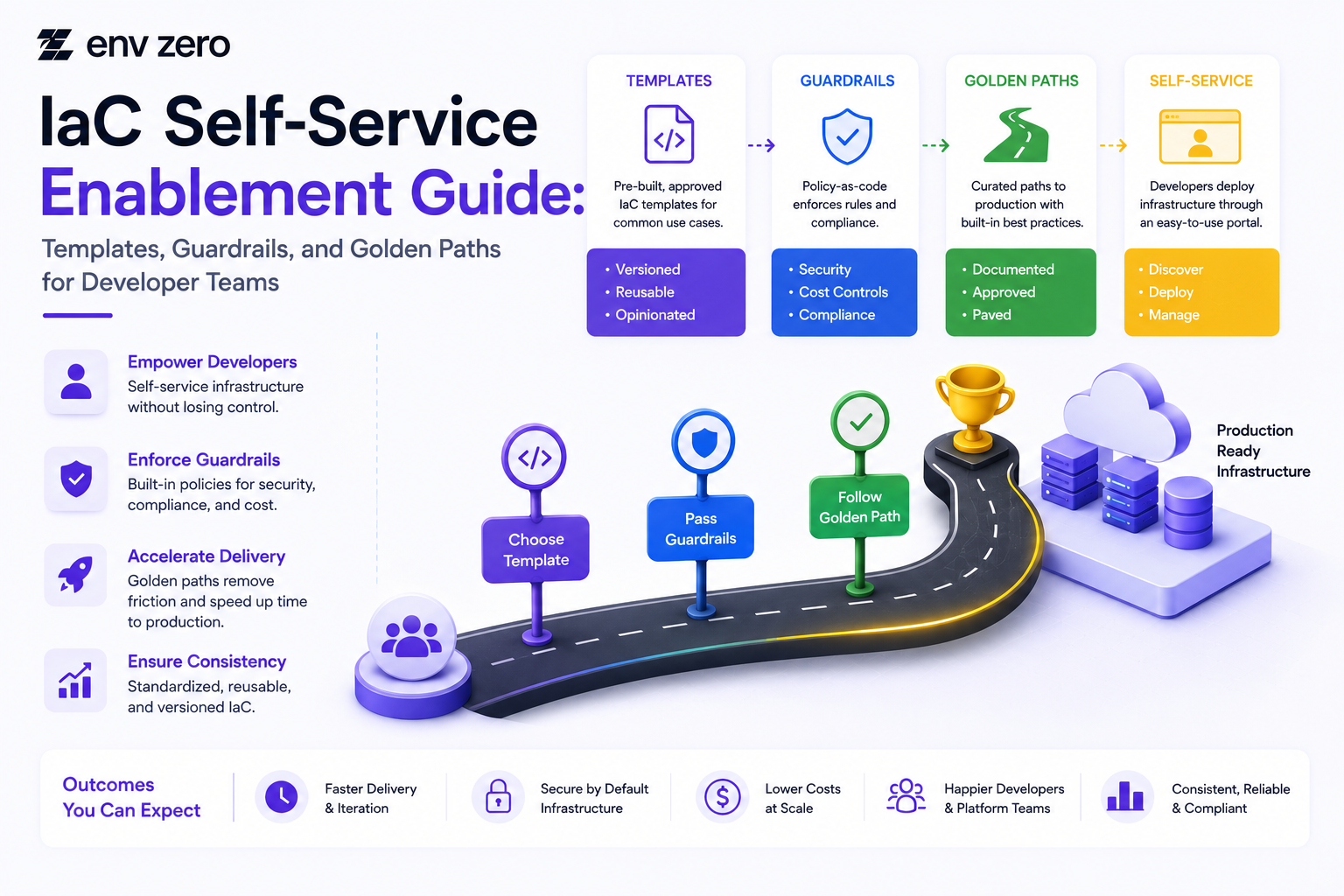
IaC automation self-service infrastructure helps developer teams provision approved infrastructure without waiting on the platform team for every request.
For organizations running Terraform, OpenTofu, Terragrunt, Pulumi, Helm, Kubernetes, or other infrastructure-as-code workflows, self-service is one of the most practical ways to reduce delivery bottlenecks.
But self-service should not mean unrestricted cloud access.
The goal is controlled autonomy. Developers should be able to use approved templates and golden paths, while platform teams keep governance in place through policies, approvals, RBAC, cost visibility, drift detection, and audit logs.
This guide explains how platform teams can enable self-service IaC without losing control.
Why Developer Teams Need Self-Service IaC
In many organizations, developers still depend on platform engineers for routine infrastructure requests.
They need a database, environment, storage bucket, service account, namespace, or preview environment, but the request waits in a queue.
That slows delivery and increases platform-team workload.
Platform engineers spend time handling repeatable requests instead of improving systems, templates, policies, and developer experience.
Self-service IaC changes that model. Platform teams define the approved paths. Developers use those paths to provision infrastructure faster.
The platform team remains in control, but routine work becomes automated and repeatable.
Start With the Most Common Requests
A strong self-service program should begin with the infrastructure requests developers ask for most often. These are usually repeatable patterns that can be standardized safely.
Common starting points include development environments, preview environments, storage buckets, databases, Kubernetes namespaces, service accounts, and application infrastructure templates.
The goal is not to automate every possible cloud resource immediately.
The goal is to remove the highest-friction requests first. When platform teams start with common workflows, self-service adoption becomes easier to prove.
Build Templates With Safe Defaults
Templates are the foundation of self-service IaC. A template packages an approved infrastructure pattern so developers can use it without writing everything from scratch.
A good template should include safe defaults, approved variables, required tags, naming standards, policy checks, and ownership metadata.
It should give developers enough flexibility to do their work, but not so much flexibility that they accidentally bypass security, cost, or compliance standards.
For example, a database template might allow developers to choose the environment, size tier, region, and backup option from approved values.
It should not allow public exposure, disabled encryption, or unmanaged credentials.
env0 Templates help platform teams provide reusable IaC workflows that developers can consume consistently.
Design Golden Paths for Developer Flow
Golden paths are the recommended workflows developers should follow for common engineering tasks.
In IaC self-service, a golden path might guide a developer from selecting a template to provisioning an environment, applying policy checks, receiving approval if needed, and tracking the deployed resource.
A strong golden path reduces decision fatigue. Developers should not need to understand every cloud control, Terraform module, or compliance rule before they can request infrastructure.
The best golden paths make the secure and approved workflow the easiest workflow.
They should be documented, repeatable, and connected to real developer needs.
Add Guardrails Before Expanding Access
Guardrails protect self-service infrastructure from becoming uncontrolled infrastructure sprawl.
They define what developers can deploy, which options are allowed, and when approval is required.
Guardrails may include policy-as-code, RBAC, approved regions, encryption requirements, cost limits, required tags, naming rules, module restrictions, and environment-specific controls.
Development environments may allow more flexibility. Production workflows should require stronger approvals and stricter policy enforcement.
This risk-based approach keeps developers moving while protecting sensitive infrastructure.
Use Approval Workflows Where Risk Is Higher
Not every self-service request needs manual approval. If a developer requests an approved development environment through a safe template, the workflow can often run automatically.
Higher-risk changes need more control. Production databases, shared networking, identity resources, compliance-sensitive workloads, and expensive infrastructure should require approval from the right team.
Approval workflows should be based on risk, not habit. If every request requires approval, self-service loses value. If no request requires approval, governance becomes weak.
Define RBAC and Ownership
Role-Based Access Control is essential for safe self-service.
Developers may be able to request infrastructure, but that does not mean they should approve production applies or edit platform templates.
A clear access model should define who can request, approve, apply, modify variables, manage templates, and review policy exceptions.
Ownership is just as important. Every template and workflow should have an owner responsible for updates, documentation, exception handling, and lifecycle management.
Without ownership, self-service catalogs become outdated and unreliable.
Track Drift, Cost, and Audit History
Self-service does not end when infrastructure is provisioned.
Platform teams still need visibility into what changed, who requested it, who approved it, whether the infrastructure drifted, and what cost impact it created.
Drift detection helps teams identify manual changes outside IaC. Cost visibility helps teams avoid waste from oversized or forgotten environments.
Audit logs help teams support compliance, incident review, and accountability.
These controls are what separate governed self-service from unmanaged automation.
Measure Whether Self-Service Is Working
A self-service program should be measured by outcomes. Platform teams should track whether developer requests are moving faster, whether platform tickets are decreasing, whether templates are being adopted, and whether policy compliance is improving.
Useful signals include request completion time, template adoption, ticket reduction, approval cycle time, failed policy checks, drift events, and cost trends.
Measurement helps platform teams improve the catalog. If developers avoid a template, the template may be too confusing, too restrictive, or missing a common use case.
How env0 Helps Enable IaC Self-Service
env0 helps teams build self-service IaC workflows with governance built in.
Platform teams can create reusable templates, manage RBAC, enforce policies, approve sensitive changes, detect drift, monitor cost, and maintain audit logs.
This matters because self-service should not be separate from governance. The same platform that gives developers faster access should also help platform teams control risk.
With env0, organizations can support Terraform, OpenTofu, Terragrunt, Pulumi, Helm, Kubernetes, and broader IaC workflows from one governed platform.
Conclusion: Self-Service Works When the Safe Path Is Easy
IaC self-service succeeds when developers can move faster without bypassing standards. Templates give developers reusable infrastructure patterns.
Guardrails keep requests safe. Golden paths make approved workflows easy to follow. Approvals, RBAC, drift detection, cost visibility, and audit logs keep platform teams in control.
For platform teams, the goal is not to approve every request manually. The goal is to build the system that lets developers move safely on their own.
Build IaC Self-Service With env0
env0 lets teams create guided infrastructure workflows that balance speed and control.
Using templates, automated approvals, RBAC, and visibility into drift and costs, platform teams can maintain governance while developers deploy infrastructure efficiently.
Build repeatable, safe pathways that accelerate delivery and reduce errors across your environment.
FAQs
What is IaC self-service automation?
IaC self-service automation lets developers request and deploy approved infrastructure through templates and governed workflows. It reduces manual platform tickets while keeping policies, access control, and visibility in place.
What are golden paths in self-service infrastructure?
Golden paths are approved workflows that guide developers through common infrastructure tasks. They help teams follow best practices for security, compliance, performance, and cost without needing manual guidance every time.
Why are templates important for IaC self-service?
Templates package approved infrastructure patterns into reusable workflows. They help developers provision resources consistently while allowing platform teams to enforce safe defaults and standards.
How do guardrails protect self-service workflows?
Guardrails enforce rules around security, cost, compliance, regions, tags, approvals, and access. They allow developers to move faster without creating unmanaged infrastructure risk.
How does env0 support IaC self-service?
env0 supports IaC self-service with reusable templates, RBAC, approval workflows, policy controls, drift detection, cost visibility, audit logs, and support for Terraform, OpenTofu, Terragrunt, Pulumi, Helm, and Kubernetes.
Does self-service infrastructure replace platform teams?
No. Self-service changes the platform team’s role from manual ticket handler to platform builder. Platform teams design the templates, guardrails, workflows, and governance model developers use.