.webp)
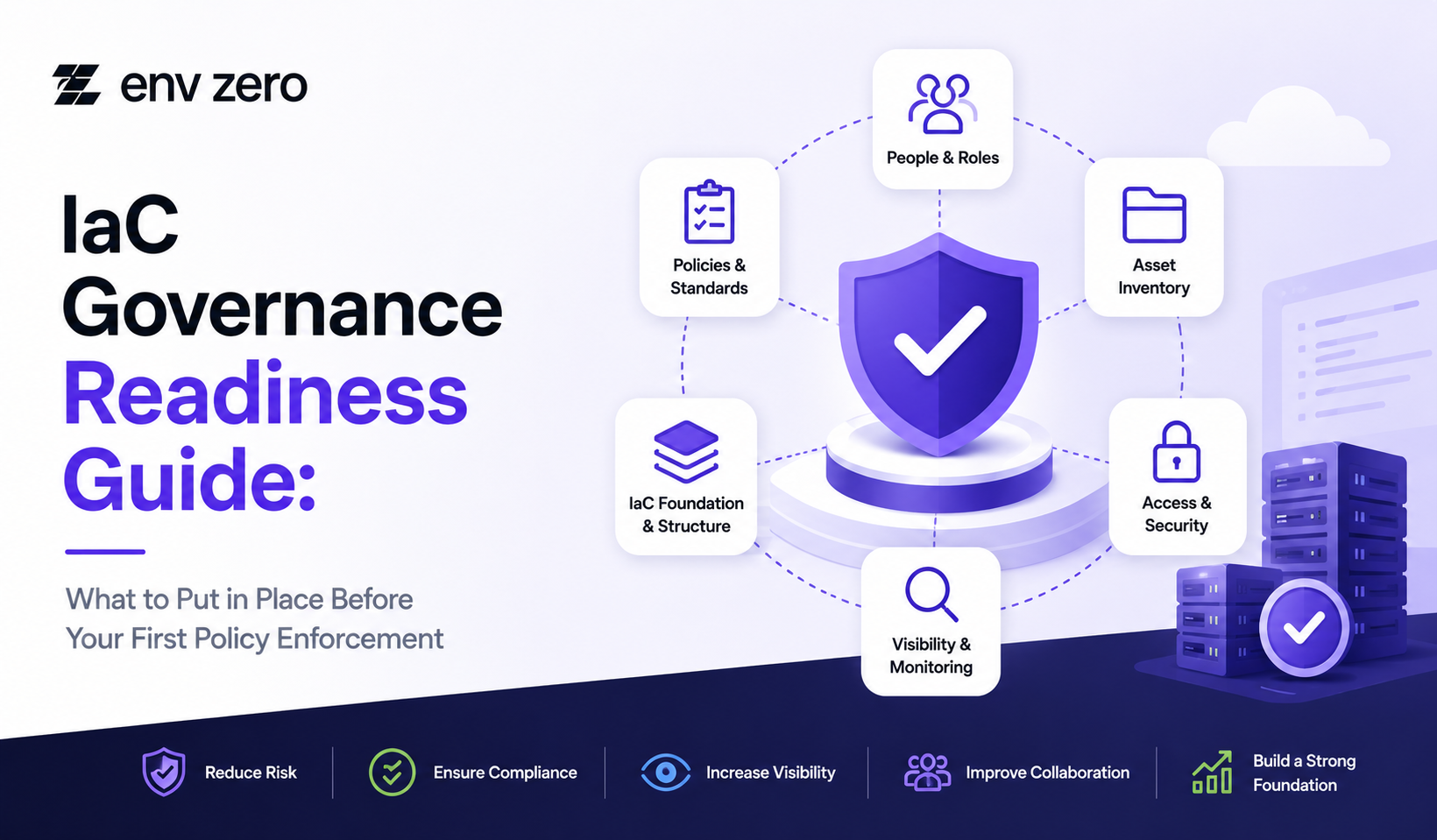
IaC governance tools are most effective when teams prepare the right foundations before enforcing policies.
Policy-as-code can help prevent risky infrastructure changes, but applying strict policies too early can create confusion, blocked deployments, noisy exceptions, and frustrated developers.
For platform engineering teams, governance should start with readiness.
Before the first policy blocks a Terraform, OpenTofu, or broader infrastructure-as-code workflow, teams need clear ownership, reliable state management, workflow visibility, access control, exception handling, and a rollout plan.
This guide explains what DevOps teams, platform teams, and enterprise IT leaders should put in place before moving from advisory checks to real policy enforcement.
Why Readiness Comes Before Enforcement
Many teams want to start IaC governance by writing policies immediately.
That can work for simple checks, but it becomes risky when the organization has many repositories, environments, cloud accounts, teams, and workflows.
A policy that blocks production changes may be useful, but only if the team knows who owns the affected environment, who can approve exceptions, where state is stored, and how developers will understand the failure.
Readiness turns governance from a blocker into a reliable operating model.
The goal is not to slow infrastructure delivery. The goal is to make the safe path clear, consistent, and easy to follow.
Define Policy Ownership First
Every policy needs an owner before it is enforced. If no team owns the rule, no one will maintain it, update it, explain it, or approve exceptions.
Security teams may own encryption, public access, identity, and compliance rules.
Platform teams may own naming standards, approved modules, environment controls, and workflow rules. Finance or FinOps teams may own cost-related policies.
Ownership should include responsibility for documentation, testing, exception review, and policy updates.
Without ownership, policies become outdated and developers lose trust in the governance process.
Inventory Your IaC Workflows
Before enforcing policies, platform teams should understand where IaC is running today.
This includes Terraform, OpenTofu, Terragrunt, Pulumi, Helm, Kubernetes, CI/CD pipelines, and any manual deployment paths.
The inventory should identify repositories, environments, owners, state backends, cloud accounts, approval paths, and production-sensitive resources.
It should also show which workflows are actively maintained and which are legacy.
This helps teams avoid enforcing policies blindly. A policy rollout should begin with known workflows, not unknown infrastructure.
Standardize State and Environment Visibility
State visibility is essential for IaC governance. If teams do not know where state is stored or which environment a state file represents, policy enforcement becomes difficult to trust.
Before enforcing policies, confirm that the state is remote, protected, access-controlled, and tied to clear environments. Production, staging, development, and sandbox workflows should be separated clearly.
Environment visibility also helps teams apply the right level of control. A sandbox may need warnings and basic guardrails. Production may need strict enforcement, approval workflows, and audit logs.
Clean Up Access and RBAC
Policy enforcement should not happen before access control is clear. If too many people can apply production changes, policies may reduce some risk but leave major governance gaps.
Role-Based Access Control should define who can plan, apply, approve, edit variables, manage policies, and change templates. Access should reflect environment risk and team responsibility.
Developers may need self-service access to approved development workflows.
Production changes should usually require stronger approval and limited apply permissions.
env0 helps platform teams manage RBAC and governed workflows so policy enforcement is connected to real access control.
Start With Visibility Before Blocking
The first policy rollout should usually begin in advisory mode. Advisory policies show teams what would fail without blocking delivery.
This gives platform teams time to understand how often a rule is triggered, whether the policy is too broad, and whether shared modules need updates.
It also gives developers time to adjust before enforcement becomes mandatory.
After advisory results are reviewed, critical rules can move to stronger enforcement.
For example, missing tags may begin as advisory, while public database access may become mandatory faster.
Classify Policies by Risk
Not all policies should be treated the same. A strong governance model groups policies by risk level.
Low-risk policies may guide consistency, such as naming standards or recommended tags.
Medium-risk policies may require approval, such as expensive resources or non-standard regions.
High-risk policies should block unsafe changes, such as public access to sensitive systems or unencrypted production data stores.
This structure helps teams avoid over-enforcement. Governance becomes more practical when the strictest controls are reserved for the highest-risk changes.
Create an Exception Process
Every mature policy program needs an exception process. Without one, teams will create informal bypasses through Slack messages, pipeline edits, or manual applies.
A good exception process should document the affected policy, environment, business reason, approver, expiration date, and accepted risk.
Temporary exceptions should be reviewed and removed when no longer needed.
Exceptions should not weaken governance. They should make governance realistic for real-world infrastructure operations.
Prepare Drift and Cost Visibility
IaC governance does not end when a policy passes. Infrastructure can drift after deployment, and cloud cost can change as resources grow.
Before enforcing policies, platform teams should prepare drift detection and cost visibility.
Drift detection helps identify when real infrastructure no longer matches code. Cost visibility helps teams understand the financial impact of infrastructure changes.
These controls make governance continuous. They help teams manage infrastructure after deployment, not only during plan review.
Roll Out the First Policy Carefully
The first enforced policy should be easy to understand, clearly owned, and tied to a real risk. Avoid starting with a complicated rule that affects many teams without context.
A good first policy might enforce required tags, block public access for sensitive resources, require encryption, or limit production changes to approved regions.
Before enforcement, document what the policy does, why it matters, how developers can fix failures, and who reviews exceptions.
A clear rollout builds trust and makes future policies easier to adopt.
How env0 Helps With IaC Governance Readiness
env0 helps teams prepare for policy enforcement by providing a governed platform for IaC automation.
Platform teams can manage policy controls, RBAC, approvals, drift detection, cost visibility, audit logs, and self-service workflows from one place.
This matters because policy-as-code alone is not enough. Teams also need workflow control, ownership, visibility, and auditability.
With env0, organizations can move from scattered Terraform or OpenTofu workflows to a more mature governance model where policies are enforced inside controlled infrastructure delivery processes.
Conclusion: Governance Works Best When the Foundation Is Ready
IaC policy enforcement should not be the first step in governance.
It should come after ownership, visibility, state management, RBAC, exception handling, and rollout planning are in place.
When teams prepare first, policies become easier to trust and easier to follow.
Developers get clearer guidance, platform teams gain stronger control, and infrastructure changes become safer.
env0 helps teams build that foundation and enforce IaC governance without turning platform engineering into a bottleneck.
Build IaC Governance Readiness With env0
env0’s IaC Platform & Terraform Automation service helps teams prepare for policy enforcement with RBAC, approvals, drift detection, cost visibility, audit logs, self-service workflows, and policy controls.
Contact our specialists to assess your IaC governance readiness and build a safer path toward policy-enforced infrastructure.
FAQs
What are IaC governance tools?
IaC governance tools help teams manage infrastructure-as-code workflows through policies, approvals, RBAC, drift detection, cost visibility, audit logs, and self-service controls.
What should teams prepare before enforcing IaC policies?
Teams should prepare ownership, workflow inventory, state visibility, RBAC, advisory testing, exception handling, drift detection, and cost visibility before enforcing policies.
Should the first IaC policy be blocking?
Not always. Many teams should start with advisory policies first. This helps identify issues, reduce noise, and improve policy quality before blocking deployments.
Why is policy ownership important?
Policy ownership ensures that every rule has someone responsible for updates, documentation, testing, and exception review. Without ownership, policies can become outdated or disruptive.
How does env0 support IaC governance readiness?
env0 supports IaC governance readiness with RBAC, approval workflows, policy controls, drift detection, cost visibility, audit logs, and self-service infrastructure workflows.