.webp)
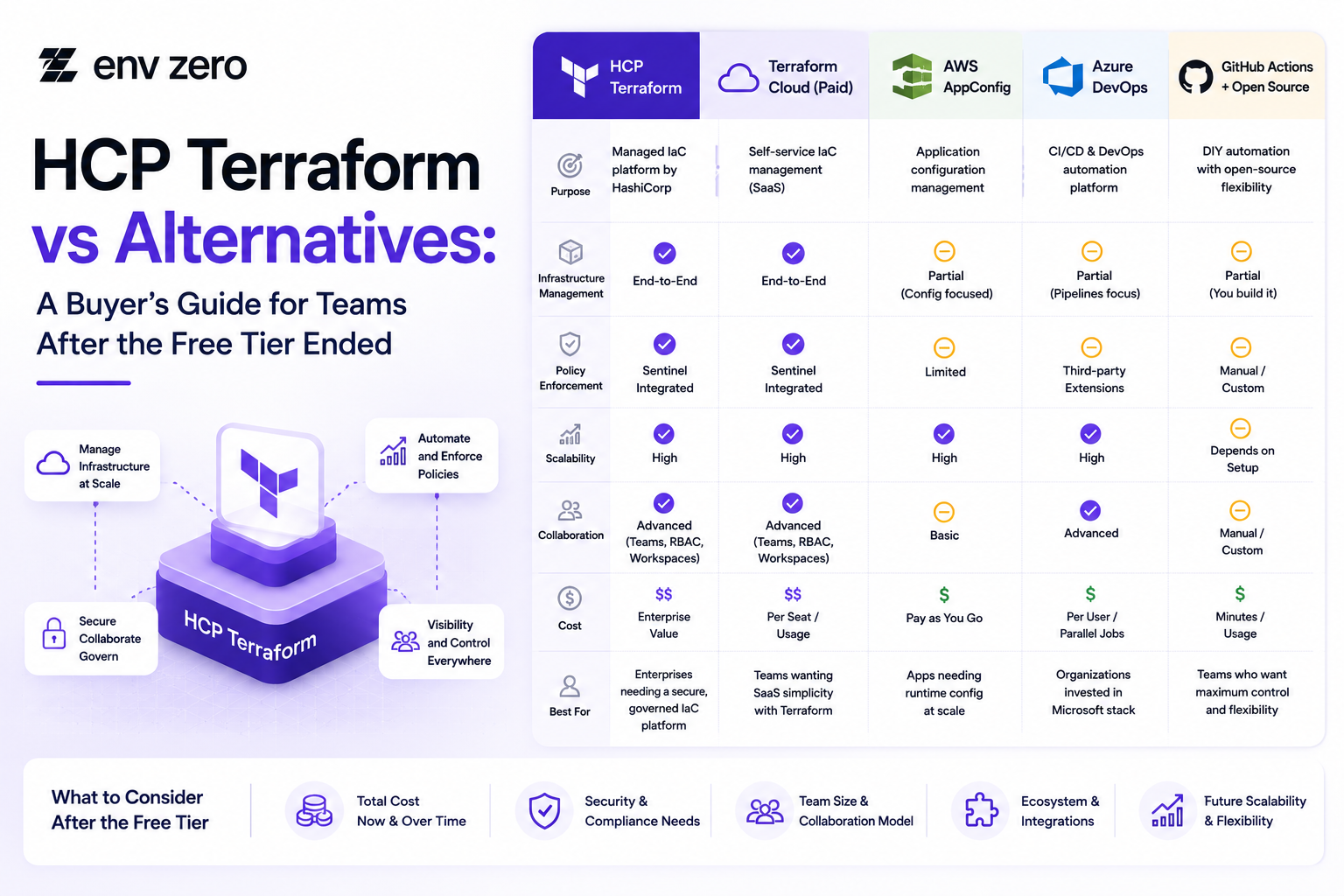
Terraform Cloud alternatives became a serious buying decision for many platform teams after the legacy HCP Terraform Free plan reached end of life.
For teams that previously relied on the free tier, the question is no longer only whether HCP Terraform works.
The question is whether it still fits the organization’s cost model, governance needs, OpenTofu strategy, and long-term infrastructure roadmap.
HCP Terraform remains a familiar option for Terraform teams. It provides managed workflows around workspaces, remote operations, state, policy controls, team access, and collaboration.
But teams evaluating alternatives should look beyond the platform name.
The real decision is about how infrastructure changes will be governed across teams, environments, cloud accounts, and IaC frameworks.
This buyer’s guide helps DevOps teams, platform engineering teams, and enterprise IT leaders compare HCP Terraform with alternatives such as env0, self-managed workflows, Atlantis-style automation, and OpenTofu-ready platforms.
Why Teams Are Re-Evaluating HCP Terraform
The free tier change forced many teams to look more closely at usage, resource count, and future cost.
For smaller teams, the new free tier may still be enough. For growing platform teams, Terraform Cloud pricing can become part of a larger discussion about value, governance, and scalability.
Cost is not the only factor. Some teams are also reviewing vendor dependency, IBM’s acquisition of HashiCorp, OpenTofu adoption, and whether their platform should support more than Terraform alone.
This does not mean every team should leave HCP Terraform. It means buyers should compare it against the full operating model they need.
What HCP Terraform Does Well
HCP Terraform is designed for teams that want a managed Terraform workflow.
It helps centralize Terraform runs, workspace management, state handling, collaboration, team permissions, and policy enforcement inside the HashiCorp ecosystem.
For organizations already committed to Terraform, this can be valuable.
Teams can use familiar Terraform workflows while gaining more control than local CLI usage or scattered CI/CD jobs.
HCP Terraform may be a good fit when the organization is standardized on Terraform, comfortable with HashiCorp’s roadmap, and does not need broader multi-IaC governance beyond Terraform-focused workflows.
Where Alternatives Become Attractive
Alternatives become more attractive when teams need flexibility beyond Terraform-only workflows.
A team may want OpenTofu support, Terragrunt automation, Pulumi support, Kubernetes or Helm workflows, stronger self-service infrastructure, different pricing models, or broader governance controls.
For example, a platform team comparing env0 vs Terraform Cloud may not only compare remote runs.
It may compare policy controls, RBAC, cost visibility, drift detection, approvals, templates, and multi-IaC support.
The best alternative is not simply the cheapest platform. It is the one that supports the organization’s infrastructure operating model.
Compare Governance Capabilities
Governance should be the core buying criterion. Platform teams need to know who can plan, approve, and apply changes.
They also need policy controls, audit logs, cost visibility, drift detection, and environment-specific permissions.
HCP Terraform offers governance inside Terraform-centered workflows.
Alternatives should be evaluated by whether they can match or improve those controls while supporting the tools the organization uses now and may adopt later.
env0 is built as a cloud infrastructure governance platform for IaC automation, self-service with guardrails, drift management, cost monitoring, and RBAC.
This makes it a strong fit for teams that need governance across Terraform, OpenTofu, Terragrunt, Pulumi, and broader workflows.
Compare Migration Risk
Migration is not just moving repositories. Teams must review state, workspaces, variables, secrets, provider versions, registry usage, modules, policy rules, run triggers, and CI/CD integrations.
If your team uses the Terraform registry, private modules, or Git-based module sources, confirm that the alternative platform supports those workflows.
If your team has resources managed through terraform import, review state addresses carefully before changing execution systems.
Complex Terraform code that uses terraform dynamic block patterns or terraform for each map should also be tested in representative environments before migration.
The goal is not to rewrite working modules. The goal is to confirm that the new platform executes and governs them safely.
Compare OpenTofu Support
OpenTofu support is now part of many Terraform Cloud alternatives evaluations.
Some teams want to keep Terraform today but preserve the option to migrate later. Others are actively testing OpenTofu for new workloads.
A strong buyer’s guide should ask whether the platform supports Terraform and OpenTofu side by side.
This matters because most production teams will not migrate everything at once.
env0 supports broader IaC workflows, including Terraform and OpenTofu, which helps teams evaluate or adopt OpenTofu without creating a separate governance process.
Compare Developer Self-Service
A platform should not only make infrastructure safer. It should also make approved infrastructure easier to consume.
Developer self-service means teams can request approved infrastructure patterns through templates and workflows instead of waiting on manual platform tickets.
Strong self-service includes guardrails, RBAC, policies, cost visibility, and approvals where needed.
If an alternative only replaces Terraform runs but does not improve developer experience, the platform team may still remain the bottleneck.
env0’s self-service model helps developers move faster while giving platform teams control over templates, variables, approvals, policies, and auditability.
Compare Pricing and Total Operating Cost
Terraform Cloud pricing should be evaluated against current usage and future growth.
Look at managed resources, workspaces, team count, production environments, support needs, and governance requirements.
Also consider total operating cost. A platform with a lower subscription price may cost more if your team must build missing controls manually.
Internal tooling for approvals, drift detection, cost visibility, audit logs, and self-service workflows can become expensive to maintain.
A serious buyer’s guide should compare platform cost and platform value together.
Compare Platform Fit
Before choosing, define the platform model your team wants. Some teams want a Terraform-only managed workflow. Others want a multi-IaC governance layer.
Some want self-hosted execution. Others want SaaS convenience with enterprise controls.
Good fit depends on your organization’s priorities:
- Terraform-only standardization
- OpenTofu readiness
- Multi-IaC support
- Self-service infrastructure
- Approval workflows
- Cost visibility
- Drift detection
- Auditability
- Migration support
- Pricing predictability
env0 belongs on the shortlist when the team needs more than a Terraform runner and wants a governed platform for modern IaC delivery.
When HCP Terraform May Still Be the Right Choice
HCP Terraform may still be the right choice if your organization is deeply standardized on Terraform, prefers HashiCorp-native workflows, and is comfortable with the pricing and roadmap.
Staying can also be reasonable if migration risk is higher than the expected benefit. Platform teams should not move just because alternatives exist.
They should move when the alternative better supports governance, cost, scale, and developer experience.
When env0 Is the Better Fit
env0 is a better fit when teams need broader IaC governance, OpenTofu support, self-service infrastructure, drift detection, cost visibility, RBAC, approvals, and multi-framework flexibility.
For organizations comparing env0 vs Terraform Cloud, the difference is scope.
HCP Terraform is centered on Terraform workflows. env0 is designed to govern infrastructure delivery across Terraform, OpenTofu, Terragrunt, Pulumi, Helm, Kubernetes, and related IaC workflows.
This makes env0 especially valuable for teams that want to modernize their platform without locking every team into one narrow workflow.
Conclusion: Buy the Operating Model, Not Just the Tool
HCP Terraform remains a valid option for many Terraform-centered teams.
But after the free tier change, platform teams should take the opportunity to compare alternatives through a broader lens.
The right platform should support safe state handling, policy controls, RBAC, approvals, drift detection, cost visibility, developer self-service, OpenTofu readiness, and migration planning.
For teams that need broader governance and flexibility, env0 offers a strong alternative to Terraform Cloud and a scalable path for modern IaC operations.
Build Your Terraform Cloud Alternatives Strategy With env0
env0 helps teams explore Terraform Cloud alternatives while maintaining governance over Terraform and OpenTofu workflows.
With automated approvals, drift detection, cost monitoring, and self-service capabilities, teams can safely adopt a more flexible infrastructure platform.
Connect with env0 to compare your current HCP Terraform setup and create a scalable, controlled IaC strategy.
FAQs
What are Terraform Cloud alternatives?
Terraform Cloud alternatives are platforms or workflows that replace or extend HCP Terraform capabilities. They may support Terraform, OpenTofu, Terragrunt, Pulumi, policy controls, approvals, drift detection, cost visibility, and self-service infrastructure.
Why are teams comparing HCP Terraform alternatives?
Teams are comparing alternatives because of pricing changes, OpenTofu strategy, governance needs, vendor roadmap concerns, and the need for broader IaC support beyond Terraform-only workflows.
Is HCP Terraform still worth using?
HCP Terraform can still be worth using for teams deeply standardized on Terraform and HashiCorp workflows. Teams should compare pricing, governance needs, migration risk, and future IaC strategy before deciding.
How should teams compare env0 vs Terraform Cloud?
Teams should compare env0 vs Terraform Cloud based on governance scope, OpenTofu support, multi-IaC workflows, RBAC, approvals, drift detection, cost visibility, self-service templates, and migration support.
What migration risks should teams review?
Teams should review state, workspaces, secrets, provider versions, Terraform registry dependencies, imported resources, module patterns, policy rules, and CI/CD integrations before leaving HCP Terraform.
How does env0 help teams evaluate Terraform Cloud alternatives?
env0 helps teams govern Terraform, OpenTofu, Terragrunt, Pulumi, and broader IaC workflows with approvals, RBAC, policy controls, drift detection, cost visibility, audit logs, and self-service automation.