.webp)
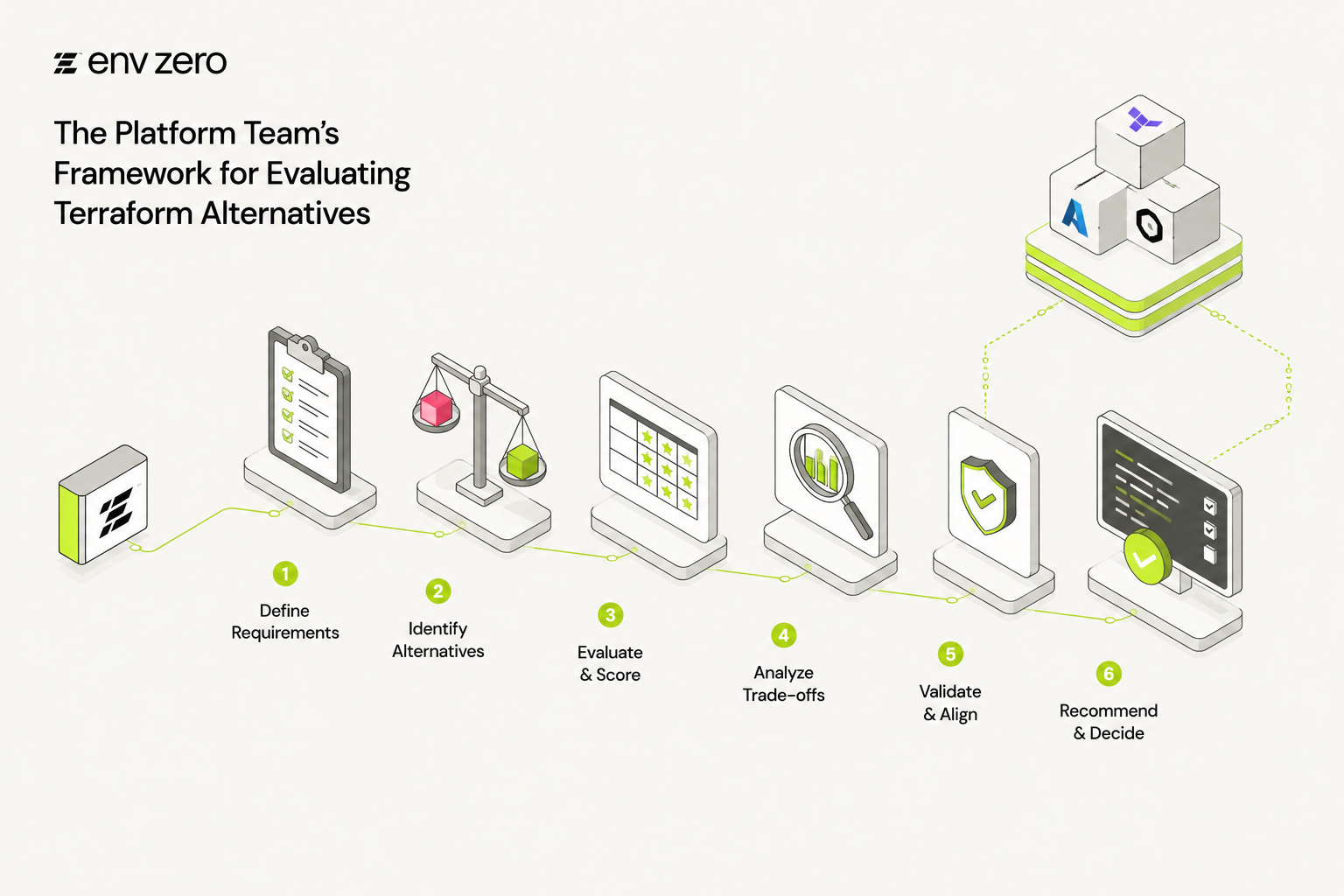
Terraform alternatives are no longer being evaluated only by engineers who want a different infrastructure as code tools.
In 2026, the conversation belongs to platform teams, DevOps leaders, and enterprise IT teams that need to decide how infrastructure should be governed, automated, and scaled across the organization.
The end of the legacy HCP Terraform Free plan, the rise of OpenTofu, and changing platform expectations have made this decision more important.
Teams are not simply asking, “What can replace Terraform?” They are asking, “Which infrastructure operating model gives us the right balance of flexibility, governance, cost control, and developer experience?”
This framework helps platform teams evaluate Terraform alternatives without getting lost in feature lists.
It focuses on the criteria that actually affect production infrastructure: migration effort, governance, state management, policy controls, drift detection, cost visibility, and long-term platform fit.
Start With the Real Reason You Are Evaluating Alternatives
Before comparing tools, define why your team is evaluating Terraform alternatives.
Some teams are reacting to Terraform Cloud pricing. Others are concerned about vendor strategy, OpenTofu adoption, or the need to support multiple IaC frameworks.
A clear reason helps prevent tool-driven decisions. If the main issue is cost predictability, your evaluation should focus on pricing models and resource growth.
If the issue is governance, you should focus on policy-as-code, RBAC, approvals, audit logs, and drift detection.
If the issue is developer velocity, self-service workflows and templates may matter more than syntax.
The wrong starting point is asking which tool is most popular. The better starting point is asking what problem your platform team must solve.
Separate the IaC Engine From the Governance Layer
A common mistake is treating the IaC engine and the platform layer as the same decision. Terraform, OpenTofu, Pulumi, and Crossplane help teams define infrastructure.
Platforms such as Terraform Cloud or env0 help teams manage workflows, approvals, policy enforcement, access, drift, and collaboration.
This distinction matters. A team may move from Terraform to OpenTofu and still have the same governance problems.
Another team may keep Terraform but improve how it is managed through a better platform.
Platform teams should evaluate both layers separately.
First, decide which IaC engine fits your technical direction. Then decide which platform will govern that engine at scale.
This is where env0 fits strongly. It helps teams manage Terraform, OpenTofu, and broader IaC workflows with governance, cost visibility, drift detection, and self-service controls.
Evaluate Migration Risk
Migration risk is one of the most important parts of any Terraform alternatives evaluation.
Teams should review state files, provider compatibility, modules, pipelines, variables, secrets, approval workflows, and rollback plans before moving production workloads.
A low-risk migration path usually starts with non-production environments.
Platform teams can test plan output, validate provider behavior, and confirm state handling before moving critical systems.
For teams considering OpenTofu, migration may be more practical than rewriting infrastructure into a completely different model.
However, “compatible” does not mean “risk-free.” Every migration should be phased, tested, and governed.
Compare Governance Capabilities
Terraform alternatives should be judged by how well they support governance at scale.
This includes more than policy checks. A mature platform should support approvals, RBAC, audit logs, drift detection, cost visibility, and environment-specific controls.
For example, a development environment may allow self-service infrastructure through approved templates.
A production network change may require platform-team and security approval. The platform should support both workflows without forcing every request into the same process.
This is an area where many teams outgrow basic CLI workflows or scattered CI/CD pipelines. They need a governance platform, not just another runner.
Review State and Drift Management
State is one of the most sensitive parts of Terraform and OpenTofu workflows.
A good alternative must support safe state handling, locking, visibility, and recovery practices.
Drift is the next concern. Real cloud infrastructure often changes outside IaC through cloud consoles, emergency fixes, or manual scripts.
If teams do not detect drift, future applies can fail, overwrite valid changes, or create security risks.
When comparing Terraform alternatives, ask how each option helps identify drift and bring infrastructure back into alignment.
For platform teams, this is not optional. It is part of production reliability.
Consider Developer Experience
Platform teams are not only responsible for control.
They are also responsible for enabling developers to move faster. A strong Terraform alternative should reduce friction without weakening governance.
Developer experience should include clear workflows, reusable templates, approved variables, fast feedback, and self-service options.
Developers should not need to become cloud governance experts to deploy common infrastructure patterns.
The best platforms make the safe path the easiest path. Developers get speed, while platform teams keep control over policies, cost, and compliance.
Compare Cost and Pricing Models
Terraform Cloud pricing has made cost evaluation more visible for many teams. But pricing should not be compared only by starting cost.
Platform teams should also consider how pricing changes as infrastructure grows.
Ask whether the platform charges by resources, users, runs, concurrency, environments, or a different model.
Also consider the hidden cost of building missing governance internally.
A cheaper tool may become expensive if your team must build approvals, drift detection, audit logs, and cost controls manually.
A good evaluation should compare both platform pricing and operational cost.
Check Multi-Tool Flexibility
Most organizations do not use one IaC tool forever.
A team may keep Terraform for existing workloads, adopt OpenTofu for new projects, use Terragrunt for environment orchestration, and test other frameworks for specific use cases.
Your evaluation should account for that reality. A platform that only works well for one workflow may create future constraints. A broader IaC platform gives teams more flexibility as strategy changes.
env0 is designed for this kind of multi-IaC environment. It helps teams govern different workflows through one platform instead of creating separate processes for every tool.
Build an Evaluation Scorecard
A practical scorecard should rate each option across these areas: migration risk, governance, state management, drift detection, cost visibility, developer experience, OpenTofu support, integration fit, and long-term flexibility.
Do not give every category equal weight. A startup may prioritize speed and simplicity.
An enterprise platform team may prioritize governance, auditability, and production controls. A team leaving Terraform Cloud may prioritize migration path and pricing predictability.
The scorecard should reflect your operating model, not someone else’s ranking.
Why env0 Belongs in the Evaluation
env0 should be part of any serious Terraform alternatives evaluation because it focuses on the platform layer around IaC.
It helps teams govern Terraform, OpenTofu, Terragrunt, Pulumi, Helm, Kubernetes, and broader IaC workflows from one centralized platform.
For platform teams, env0 supports policy controls, RBAC, approval workflows, drift detection, cost visibility, audit logs, and developer self-service.
This makes it a strong fit for organizations that need more than a Terraform replacement. They need a governed infrastructure operating model.
If your team is comparing Terraform Cloud alternatives, OpenTofu adoption, or broader IaC governance, env0 helps connect those decisions into one scalable platform strategy.
Conclusion: Choose the Operating Model, Not Just the Tool
The best Terraform alternative is not always the newest tool or the one with the longest feature list.
It is the option that fits your team’s migration path, governance needs, cost model, and developer workflow.
Platform teams should evaluate Terraform alternatives through a framework, not a feature checklist.
The right decision should help your organization deliver infrastructure faster, safer, and with more visibility.
env0 helps teams move beyond tool comparison and build a governed IaC platform that supports Terraform, OpenTofu, and future infrastructure workflows.
Build Your Terraform Alternatives Strategy With env0
env0’s IaC Platform & Terraform Automation service helps teams evaluate, migrate, and govern infrastructure workflows with policy controls, drift detection, RBAC, cost visibility, and self-service automation.
Talk to env0 to compare Terraform alternatives and build a platform strategy that supports your team’s long-term infrastructure goals.
FAQs
What are Terraform alternatives?
Terraform alternatives are tools or platforms that replace or extend Terraform workflows. They may include IaC engines like OpenTofu or platforms that govern Terraform, OpenTofu, and other infrastructure workflows.
How should platform teams evaluate Terraform alternatives?
Platform teams should evaluate migration risk, governance, state management, drift detection, cost visibility, developer experience, pricing, and long-term flexibility. The best choice depends on the operating model, not just tool features.
Is OpenTofu a Terraform alternative?
Yes, OpenTofu is a Terraform-compatible infrastructure as code tool often evaluated by teams that want a more open governance path while preserving familiar Terraform-style workflows.
Should we replace Terraform or improve governance?
Not every team needs to replace Terraform immediately. Some teams gain more value by improving governance around Terraform through policy controls, RBAC, drift detection, cost visibility, and self-service workflows.
How does env0 help with Terraform alternatives?
env0 helps teams govern Terraform, OpenTofu, and broader IaC workflows from one platform. It supports approvals, RBAC, policy controls, drift detection, cost visibility, audit logs, and developer self-service.
What is the biggest mistake when choosing a Terraform alternative?
The biggest mistake is choosing a tool without evaluating the operating model around it. A new tool will not automatically solve governance, state, drift, access control, or cost visibility problems.