.webp)
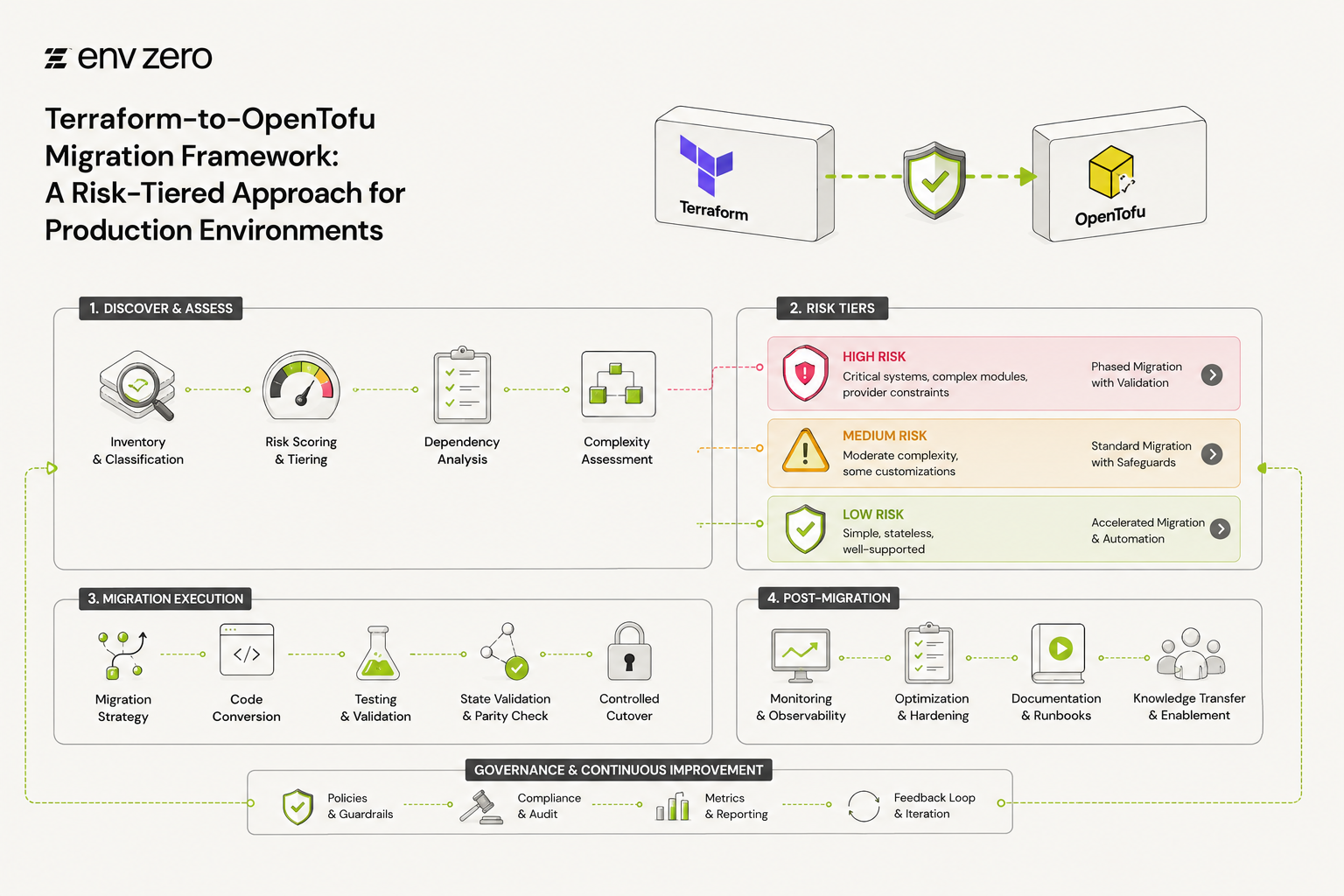
Terraform-to-OpenTofu migration should never be treated as a simple binary replacement in production environments.
OpenTofu is designed to preserve familiar Terraform-style workflows, but platform teams still need a structured framework for state files, providers, secrets, CI/CD pipelines, approvals, and rollback planning.
For DevOps teams and enterprise platform leaders, the real risk is not whether OpenTofu can run familiar infrastructure code.
The risk is whether the migration changes production behavior in ways the team did not expect.
A safe migration plan should classify workloads by risk, validate compatibility in stages, and keep governance consistent before, during, and after the move.
This framework explains how to migrate Terraform to OpenTofu using a risk-tiered model that helps teams protect production infrastructure while building a more flexible IaC strategy.
What Is OpenTofu in a Migration Context?
Before migration planning starts, teams should clearly answer: what is OpenTofu?
OpenTofu is an open-source infrastructure as code tool created as a Terraform-compatible alternative.
It keeps a familiar configuration style, which makes it attractive for teams that already use Terraform modules, providers, and state-driven workflows.
That compatibility is helpful, but it should not create false confidence.
Platform teams still need to test how OpenTofu behaves with their providers, modules, state backends, pipelines, and governance requirements.
In enterprise environments, migration is not just about the IaC engine. It is about the operating model around that engine.
Why a Risk-Tiered Framework Matters
Not every Terraform workspace carries the same risk. A development sandbox is not the same as a production networking layer.
A stateless preview environment is not the same as a shared database or identity system.
A risk-tiered framework helps teams avoid a big-bang migration. Instead of moving everything at once, teams classify workloads by business impact, dependency depth, compliance sensitivity, and rollback difficulty.
Low-risk workloads are good candidates for early testing. Medium-risk workloads need more validation and approvals.
High-risk production environments should move only after the process has been proven elsewhere.
Tier One: Low-Risk Workloads
Low-risk workloads are usually non-production environments, internal tools, temporary environments, or isolated resources with limited dependencies.
These are the best places to begin a terraform to OpenTofu migration.
The goal in this tier is to validate the basic workflow.
Teams should install OpenTofu in a controlled runner, initialize the configuration, check provider behavior, and compare plan results against the existing Terraform workflow.
This stage should answer practical questions. Does OpenTofu read the state correctly? Do providers resolve as expected? Are modules loading properly?
Do plans show unexpected changes? If the answer is no, teams can fix issues before higher-risk systems are involved.
Tier Two: Medium-Risk Workloads
Medium-risk workloads include shared services, staging environments, application infrastructure, and resources with moderate dependencies.
These systems may not be production-critical, but mistakes can still affect engineering velocity or release confidence.
At this stage, teams should review state file handling more carefully. State should be backed up, locking behavior should be confirmed, and rollback options should be documented.
Any provider version constraints, private modules, registry dependencies, or pipeline assumptions should be reviewed before migration.
This is also where governance should be tested. Approval workflows, RBAC, audit logs, cost visibility, and policy checks should work the same way after migration as they did before.
If governance changes during migration, teams may create gaps without realizing it.
Tier Three: High-Risk Production Workloads
High-risk workloads include production networking, identity, databases, Kubernetes clusters, compliance-sensitive systems, and infrastructure with complex dependencies.
These workloads should be migrated only after low- and medium-risk tiers have been tested successfully.
Before moving this tier, the team should prepare a formal migration window, rollback plan, approval path, and validation checklist.
Plans should show no unexpected changes. State backups should be recent and recoverable.
Owners should be clear. Observability should be ready before and after the change.
This is also the point where opentofu secrets require extra attention. Secrets may live in CI/CD variables, Terraform Cloud workspaces, cloud secret managers, or platform-level variable stores.
Migration should not expose secrets, duplicate them unnecessarily, or move them into unsafe locations.
Provider, Module, and Registry Review
Providers and modules are common sources of migration risk.
Even when configuration syntax is compatible, provider versions, lock files, and module sources can create unexpected behavior.
Teams should review provider constraints, private provider usage, private module registry access, and source references.
If the organization uses internal modules, those modules should be tested across representative environments before broad migration.
A good rule is simple: do not assume compatibility because one workspace worked. Test the patterns your organization actually uses.
CI/CD and Terraform Cloud Considerations
Many teams run Terraform through CI/CD pipelines, Terraform Cloud, or a TACOS platform. That means the migration must include more than code changes.
Pipeline runners may need OpenTofu installed. Command references may need updates.
Environment variables, credentials, approval gates, and plan artifact handling may need review.
If your team uses Terraform Cloud today, decide whether you are only changing the IaC engine or also moving the workflow to a broader governance platform.
This is where env0 becomes useful. env0 supports OpenTofu and Terraform workflows, helping teams manage migration without losing approval rules, policy controls, drift visibility, cost monitoring, and auditability.
Governance Checklist for Migration Readiness
A migration is ready only when the team can answer the operational questions. Who owns the workspace? Who can approve the application?
Where is the state stored? How are secrets managed? What policies must pass? How is drift detected? What is the rollback process?
If those answers are unclear, the migration is not ready for production.
OpenTofu adoption should improve infrastructure strategy, not introduce hidden operational risk.
env0 helps platform teams keep migration governed by centralizing workflow controls across Terraform, OpenTofu, and related IaC processes.
Conclusion: Migrate by Risk, Not by Repository Count
A successful Terraform-to-OpenTofu migration is not measured by how quickly teams move repositories.
It is measured by whether infrastructure remains stable, governed, auditable, and recoverable throughout the transition.
The safest approach is risk-tiered. Start with low-risk workloads, validate behavior, move to medium-risk systems, and leave production-critical environments until the process is proven.
With env0, teams can support Terraform and OpenTofu together while maintaining the governance controls needed for production infrastructure.
Build a Safer OpenTofu Migration With env0
env0’s IaC Platform & Terraform Automation service helps teams plan and govern OpenTofu migration with approval workflows, RBAC, policy controls, drift detection, cost visibility, and audit logs.
Consult with env0 to build a safer Terraform-to-OpenTofu migration plan for production environments.
FAQs
What is a Terraform-to-OpenTofu migration?
A Terraform-to-OpenTofu migration is the process of moving Terraform workflows, state, providers, modules, and pipelines to OpenTofu. It should be planned carefully because production environments depend on predictable state handling, provider behavior, and governance controls.
Should teams install OpenTofu directly in production pipelines?
No, teams should install OpenTofu first in controlled test runners or non-production pipelines. After validating initialization, plan output, provider behavior, and approval workflows, the team can expand migration to higher-risk environments.
What is the biggest risk when migrating to OpenTofu?
The biggest risk is changing production infrastructure behavior unexpectedly. This can happen through state issues, provider differences, module assumptions, secrets handling, or CI/CD changes. A phased migration reduces this risk.
How should teams handle OpenTofu secrets?
OpenTofu secrets should remain in secure systems such as secret managers, protected variables, or platform-managed stores. Teams should avoid copying secrets into plain text during migration and should confirm that access controls and audit logs remain intact.
How does env0 help with terraform to OpenTofu migration?
env0 helps teams run Terraform and OpenTofu workflows with consistent governance. Platform teams can manage approvals, RBAC, policies, drift detection, cost visibility, and audit logs while migrating gradually instead of moving every workload at once.
Should migration happen all at once?
Most enterprise teams should avoid a big-bang migration. A risk-tiered approach is safer because it lets teams test low-risk workloads first, validate medium-risk systems next, and move production only after the process is proven.