.webp)
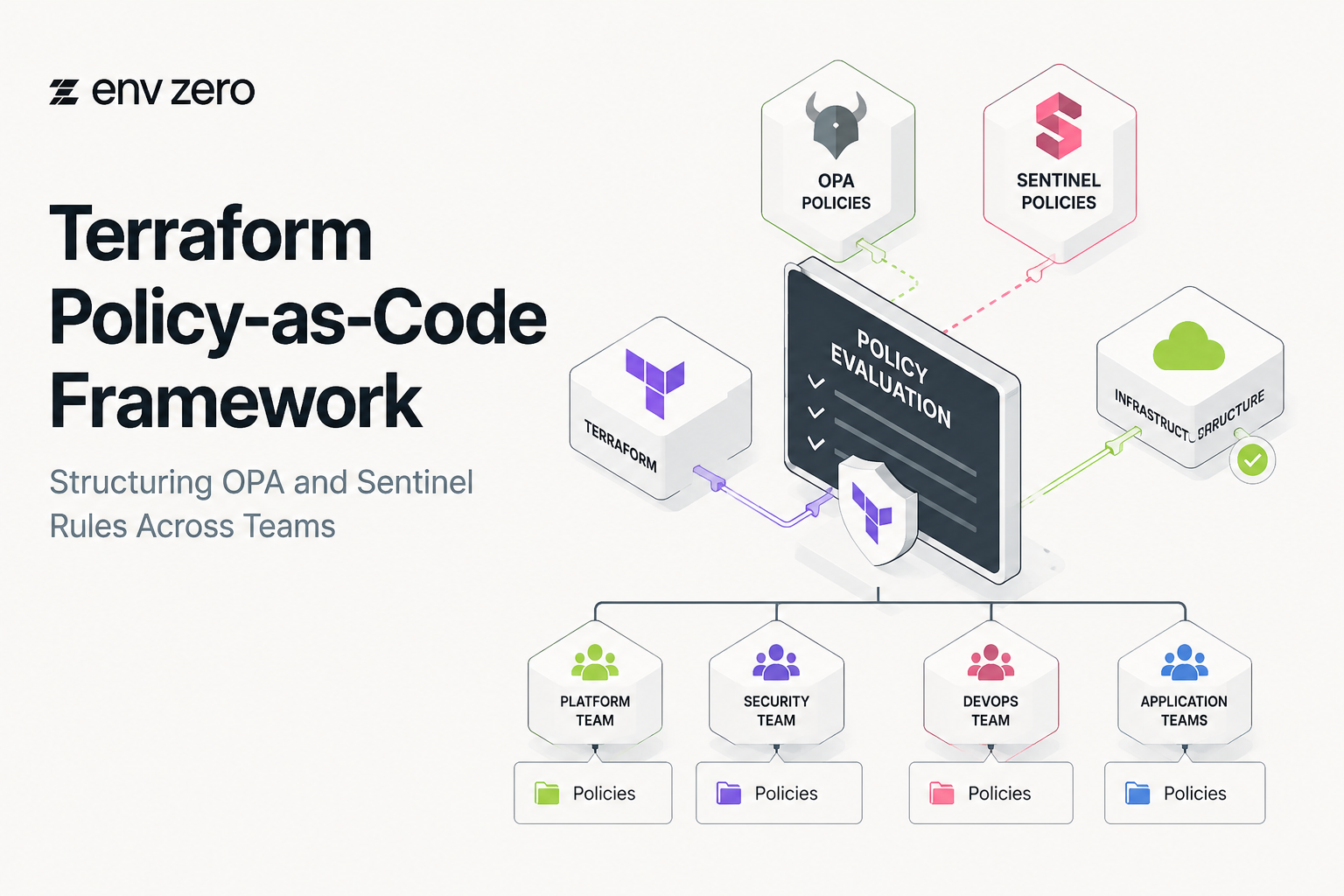
Terraform governance tools such as OPA and Sentinel help platform teams enforce infrastructure rules before risky changes reach production.
But many organizations run into the same problem: they adopt policy-as-code without a framework for ownership, rule structure, exceptions, testing, or team-level enforcement.
The result is usually messy. Security writes one set of rules. Platform teams write another.
Application teams create exceptions in pipelines. Some policies block too much, while others only warn and get ignored. Over time, Terraform governance becomes inconsistent across teams.
This framework explains how platform engineering teams can structure Terraform policy-as-code across OPA and Sentinel workflows, while using env0’s IaC Platform & Terraform
Automation service as the governance layer for approvals, RBAC, drift detection, audit logs, and self-service infrastructure.
Why Terraform Policy-as-Code Needs Structure
Policy-as-code is powerful because it turns infrastructure rules into versioned, testable code.
Instead of relying only on manual reviews, teams can automatically check Terraform plans for security, compliance, cost, and operational requirements.
But policy-as-code can also become difficult to manage. A rule that makes sense for production may be too strict for a sandbox.
A security policy may conflict with a platform standard. A warning may need to become mandatory after teams have time to fix existing issues.
Without structure, policy-as-code becomes another source of friction. With the right framework, it becomes a scalable governance system.
OPA and Sentinel: Different Tools, Similar Governance Goals
OPA and Sentinel are both used for policy enforcement, but they fit different operating models.
OPA is a flexible, general-purpose policy engine that uses Rego.
It is often attractive to teams that want vendor-neutral policy logic across Terraform, Kubernetes, APIs, and other systems.
Sentinel is HashiCorp’s policy-as-code framework. It is commonly used by teams operating inside HCP Terraform or Terraform Enterprise workflows.
The decision does not have to be only OPA or only Sentinel. Some organizations use one standard.
Others use different tools in different environments. The key is to create one governance framework so policy logic, ownership, and enforcement remain consistent.
Layer One: Define Policy Categories
The first step is organizing policies by purpose. This helps teams avoid random rule creation and makes ownership clearer.
Common Terraform policy categories include:
- Security rules, such as blocking public storage or open network access
- Compliance rules, such as encryption, tagging, and region restrictions
- Cost rules, such as limiting oversized resources
- Operational rules, such as required naming standards or approved modules
- Environment rules, such as stricter controls for production
Categorization helps teams understand why a policy exists and who should own it. A security rule should not be managed the same way as a naming convention.
Layer Two: Define Enforcement Levels
Not every policy should block deployments immediately. Mature Terraform governance uses different enforcement levels.
Advisory policies warn teams without blocking the run. These are useful when a new rule is being introduced.
Soft-mandatory policies require review or exception approval. Hard-mandatory policies block changes that should never be allowed.
For example, missing tags may start as advisory. Public database access may be hard-mandatory from day one. Large instance sizes may require approval rather than automatic blocking.
This tiered approach prevents policy-as-code from becoming too disruptive. It gives teams room to adopt standards while still protecting critical infrastructure.
Layer Three: Assign Policy Ownership
Every policy needs an owner. Without ownership, rules become outdated, noisy, or ignored.
Security teams should usually own high-risk security and compliance policies. Platform teams should own workflow, module, naming, and environment standards.
Finance or FinOps teams may own cost-related policies. Application teams may contribute feedback when policies affect delivery.
Ownership should include rule design, review, testing, documentation, and exception decisions. If nobody owns a policy, it should not be enforced in production.
env0 helps teams connect policy controls to governed workflows, so ownership and approvals are part of the infrastructure delivery process.
Layer Four: Structure Policies by Environment
Production, staging, development, and sandbox environments should not always use the same enforcement model.
Production should usually have stricter rules, required approvals, detailed audit logs, and limited apply permissions.
Development environments may allow more flexibility but still enforce basic security and cost controls.
This is especially important for platform teams supporting self-service infrastructure. Developers need speed in lower environments, but production changes must remain controlled.
A strong framework maps policies to environmental risk. This keeps governance practical instead of applying one rigid standard everywhere.
Layer Five: Create an Exception Process
Every real-world policy program needs exceptions. The mistake is allowing exceptions through informal messages, one-off pipeline edits, or undocumented bypasses.
A good exception process should answer:
- Who requested the exception?
- Which policy is affected?
- Which environment is involved?
- How long does the exception last?
- Who approved it?
- What risk is accepted?
Exceptions should be tracked and reviewed. Temporary exceptions should expire. Permanent exceptions should be rare and well documented.
Without this process, policy-as-code becomes easy to bypass.
Layer Six: Test Policies Before Enforcement
Policy testing is one of the most overlooked parts of Terraform governance.
A bad policy can block valid infrastructure changes or allow risky ones.
Before enforcement, teams should test policies against real Terraform plans from multiple environments. They should include allowed cases, blocked cases, and edge cases.
Policy testing also helps reduce developer frustration. When policies behave predictably, teams trust them more.
When policies fail without explanation, teams look for ways around them.
Platform teams should treat policy code like production code: versioned, reviewed, tested, and documented.
Layer Seven: Connect Policies to Workflow Governance
OPA and Sentinel can enforce rules, but policy-as-code alone does not create a complete governance model.
Teams still need RBAC, approval workflows, audit logs, drift detection, cost visibility, and self-service controls.
This is where env0 fits. env0 helps platform teams apply policy controls inside governed Terraform and broader IaC workflows.
Instead of scattering policy enforcement across disconnected pipelines, teams can manage approvals, access, drift, and auditability through one platform.
This matters because governance is not only about whether a policy passes.
It is also about who can deploy, who approved the change, what happened after apply, and whether infrastructure drifted later.
Practical Policy Rollout Model
Platform teams should roll out Terraform policy-as-code gradually.
Start with visibility. Run policies in advisory mode and collect results.
Then fix high-volume issues in shared modules and templates. Next, move critical policies to mandatory enforcement.
Finally, connect policy results to approvals, audit logs, and self-service workflows.
This rollout reduces resistance because teams can see what will fail before policies become blocked. It also gives platform teams time to improve rules and documentation.
The goal is not to create the largest policy library. The goal is to create useful, trusted, enforceable governance.
Why env0 Strengthens Terraform Policy-as-Code
env0 gives platform teams a stronger operating model for Terraform governance tools.
Teams can use policy controls alongside RBAC, approvals, drift detection, cost visibility, audit logs, and developer self-service.
This helps organizations move beyond isolated policy checks. Instead of asking every team to maintain its own enforcement process, env0 gives platform teams a centralized way to govern Terraform, OpenTofu, and broader IaC workflows.
For enterprise teams, that is the difference between policy-as-code as a scanner and policy-as-code as part of a real governance platform.
Scale Terraform Policy Enforcement Across Teams
env0 helps teams implement policy-as-code across Terraform workflows while keeping approval processes, RBAC, drift detection, cost tracking, and auditability in place.
Enable consistent governance without slowing down infrastructure delivery, ensuring policies scale smoothly across your organization.
FAQs
What are Terraform governance tools?
Terraform governance tools help teams enforce policies, manage approvals, control access, detect drift, track audits, and reduce infrastructure risk. OPA and Sentinel are common policy-as-code tools used in Terraform workflows.
What is Terraform policy-as-code?
Terraform policy-as-code is the practice of writing infrastructure rules as code so they can be automatically tested and enforced before changes are applied. Policies may cover security, compliance, cost, naming, regions, or approved modules.
Should teams use OPA or Sentinel for Terraform?
OPA is often better for teams that want vendor-neutral policy logic across multiple systems. Sentinel is often better for teams already using HashiCorp workflows. The right choice depends on platform strategy and governance requirements.
How should teams organize Terraform policies?
Teams should organize policies by category, enforcement level, environment, and owner. This makes rules easier to manage, test, explain, and enforce across different teams.
Why do Terraform policies need exception workflows?
Exception workflows prevent informal bypasses. They make sure policy exceptions are approved, documented, time-bound, and reviewed. This protects governance while allowing teams to handle real-world edge cases.
How does env0 help with Terraform policy-as-code?
env0 helps teams connect policy-as-code with RBAC, approvals, audit logs, drift detection, cost visibility, and self-service workflows. This turns Terraform policies into part of a broader governance platform.