.webp)
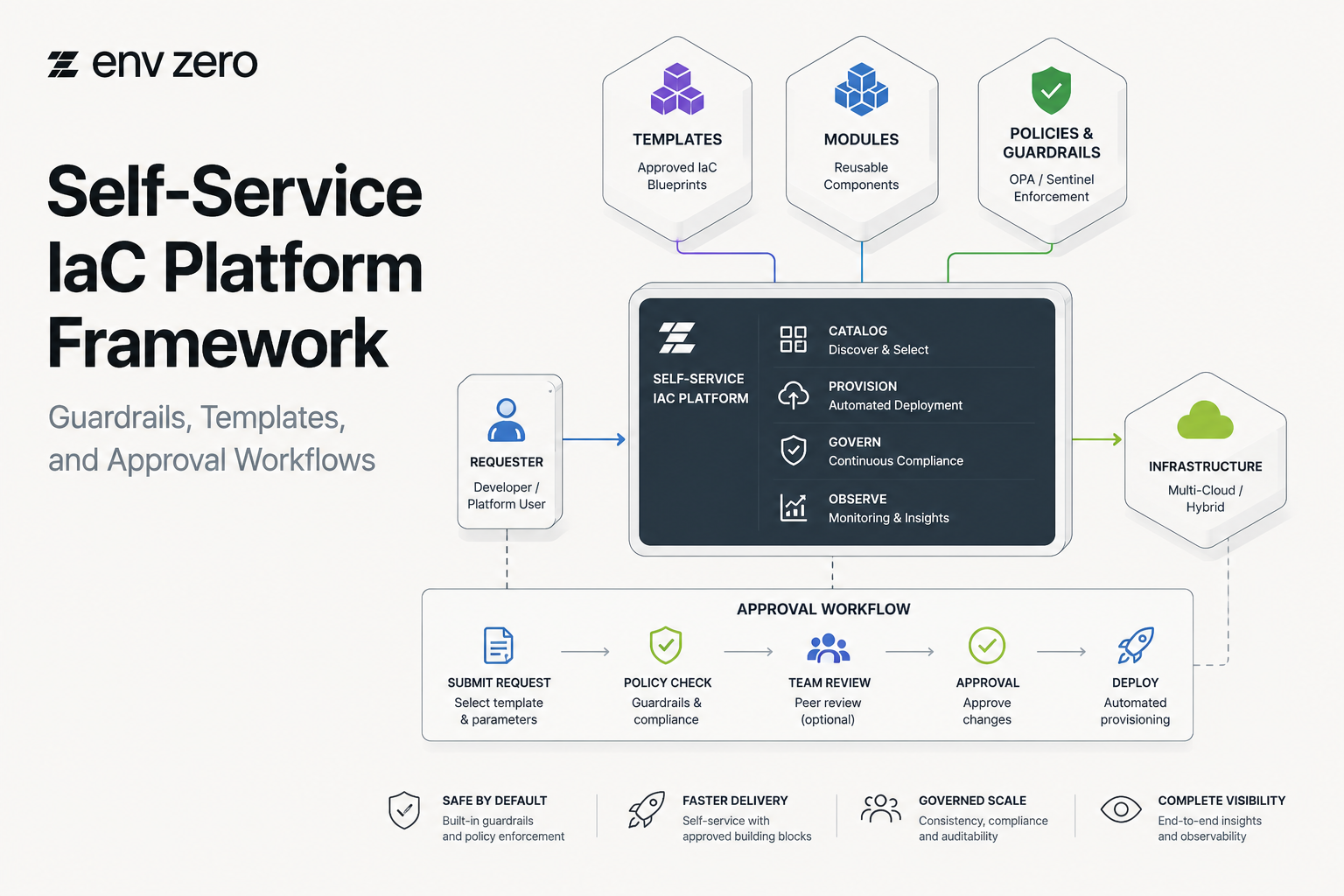
IaC automation self-service infrastructure helps platform teams stop acting as the manual gatekeeper for every infrastructure request.
Instead of asking developers to wait for tickets, approvals, and one-off Terraform runs, platform teams can provide approved templates, guardrails, and workflows that developers can safely use on demand.
The key is structure. Self-service infrastructure should never mean unrestricted cloud access.
It should mean controlled autonomy: developers get faster access to approved infrastructure patterns, while platform teams keep control over security, cost, compliance, drift, and production risk.
This framework gives DevOps teams, platform engineering teams, and enterprise IT leaders a practical model for building a self-service IaC platform without losing governance.
Key Takeaways
A strong self-service IaC platform should include:
- Reusable templates for common infrastructure patterns
- Guardrails that enforce security, cost, and compliance rules
- Approval workflows based on environment risk
- RBAC to control who can request, approve, and apply changes
- Audit logs, drift detection, and cost visibility
- Clear ownership for every template and workflow
env0’s IaC Platform & Terraform Automation service helps teams bring these pieces together in one governed self-service model.
Why Self-Service IaC Needs a Framework
Many platform teams want self-service infrastructure, but they start with the wrong question.
They ask, “How do we let developers provision infrastructure faster?”
The better question is, “How do we let developers provision the right infrastructure safely?”
Without a framework, self-service can create infrastructure sprawl.
Developers may deploy inconsistent resources, skip tagging standards, exceed budget expectations, or bypass security controls.
That creates more work for platform, security, and finance teams later.
A framework prevents that problem. It defines what developers can request, which paths are approved, which policies apply, and when human approval is still required.
Layer One: Define the Self-Service Catalog
The first layer is the catalog. This is where developers find approved infrastructure options.
A good self-service catalog should include common requests such as:
- Development environments
- Preview environments
- Storage buckets
- Databases
- Kubernetes namespaces
- Service accounts
- Network patterns
- Application infrastructure templates
The catalog should not include every possible cloud resource. It should focus on the most common, repeatable, and high-value requests.
Platform teams should start with the requests that create the biggest bottlenecks today.
env0 Templates help platform teams package reusable IaC configurations so developers can deploy approved patterns without starting from scratch.
Layer Two: Build Templates With Safe Defaults
Templates are the foundation of self-service IaC. A template should give developers enough flexibility to meet real needs without exposing every low-level cloud setting.
For example, a database template may allow developers to choose an environment, region, size tier, and retention option.
But it should not allow public exposure, missing encryption, or unapproved backup settings.
Safe defaults reduce mistakes. They also reduce cognitive load. Developers do not need to understand every cloud policy before they can request infrastructure.
The platform team builds best practices into the template.
A strong template should include clear naming, approved variables, required tags, cost-aware options, policy checks, and ownership metadata.
Layer Three: Add Guardrails
Guardrails make self-service safe. They define what is allowed, what requires approval, and what should be blocked.
Guardrails may include policy-as-code, required tags, allowed regions, encryption rules, budget limits, approved modules, role restrictions, and environment-specific controls.
The best guardrails are not designed to slow developers down.
They are designed to make the safe path the easiest path. If a request follows the approved template and stays within policy, it should move quickly.
If it introduces risk, it should trigger review or block automatically. env0 helps teams apply guardrails directly inside governed IaC workflows, so self-service does not become a bypass around platform standards.
Layer Four: Design Approval Workflows by Risk
Not every infrastructure request needs the same approval process. A sandbox storage bucket is not the same as a production database.
A development namespace is not the same as a network change.
Approval workflows should match risk level. Low-risk requests can often be fully self-service.
Medium-risk requests may need platform approval. High-risk production changes may need platform, security, or compliance review.
This risk-based model keeps developers moving while protecting sensitive infrastructure.
It also reduces approval fatigue because platform teams only review changes that actually need human judgment.
Layer Five: Use RBAC to Control Access
Role-Based Access Control, or RBAC, defines who can request, approve, modify, and deploy infrastructure.
A developer may be allowed to request dev infrastructure but not approve production applies. A team lead may approve staging changes.
A platform engineer may manage templates and production workflows.
RBAC is essential because self-service infrastructure gives users powerful capabilities. Without access control, self-service can become risky.
With RBAC, teams can provide autonomy while maintaining accountability.
env0 supports controlled access models that help platform teams define who can do what across teams, projects, and environments.
Layer Six: Track Audit Logs, Drift, and Cost
Self-service does not end after infrastructure is deployed. Platform teams still need visibility into what changed, who approved it, whether infrastructure drifted, and what cost impact it created.
Audit logs help teams understand the history of changes.
Drift detection helps identify when real infrastructure no longer matches the approved IaC configuration.
Cost visibility helps teams understand the financial impact of infrastructure requests.
These capabilities are especially important at enterprise scale. Without them, platform teams may move faster at first but lose control later.
Layer Seven: Define Ownership and Lifecycle
Every self-service template needs an owner. Every deployed environment needs a lifecycle.
Platform teams should define who maintains each template, who updates policies, who handles exceptions, and when temporary environments should expire. Without ownership, self-service catalogs become outdated and unreliable.
Lifecycle rules are also important. Preview environments, sandboxes, and test resources should not run forever.
Teams should define expiration, cleanup, and review processes to reduce waste and sprawl.
How env0 Fits the Self-Service IaC Framework
env0 helps teams build self-service infrastructure with governance built in.
It supports reusable templates, policy controls, RBAC, approval workflows, drift detection, cost visibility, audit logs, and developer self-service.
This makes env0 useful for organizations that have outgrown basic CLI workflows or scattered CI/CD pipelines.
Instead of forcing every team to build its own IaC process, env0 gives platform teams a centralized way to standardize infrastructure delivery.
Developers get faster access to approved infrastructure. Platform teams keep control over risk, cost, and compliance. That is the balance a self-service IaC platform should create.
Conclusion: Self-Service Works When Guardrails Come First
Self-service infrastructure is not about removing platform teams from the process.
It is about changing their role from manual ticket handler to platform builder.
The right framework starts with a catalog, builds templates with safe defaults, adds guardrails, applies risk-based approvals, controls access with RBAC, and tracks drift, cost, and audit history.
For teams building a mature platform engineering model, self-service IaC is one of the most important steps toward faster, safer infrastructure delivery.
Enable Self-Service Infrastructure Safely with env0
env0 empowers teams to create self-service infrastructure workflows with templates, guardrails, approvals, RBAC, drift detection, cost visibility, and audit tracking.
Developers can move faster while platform teams maintain control and enforce governance across all deployments.
FAQs
What is a self-service IaC platform?
A self-service IaC platform lets developers request and deploy approved infrastructure using reusable templates and automation. It includes guardrails, access controls, approvals, and visibility so infrastructure remains governed.
Why are guardrails important for self-service infrastructure?
Guardrails prevent self-service from becoming uncontrolled cloud access. They enforce policies for security, cost, compliance, regions, tags, and approved infrastructure patterns before changes are deployed.
What should be included in a self-service IaC template?
A self-service IaC template should include safe defaults, approved variables, required tags, policy checks, ownership metadata, and environment-specific controls. It should simplify developer requests without exposing risky configuration options.
How should approval workflows work in self-service IaC?
Approval workflows should be based on risk. Low-risk development requests can be automated, while production or compliance-sensitive changes should require platform, security, or leadership approval.
How does env0 support self-service IaC?
env0 supports self-service IaC with reusable templates, RBAC, policy controls, approval workflows, drift detection, cost visibility, audit logs, and support for Terraform, OpenTofu, and broader IaC workflows.
Does self-service IaC replace platform engineers?
No. Self-service IaC changes the platform team’s role. Platform engineers design templates, policies, workflows, and guardrails so developers can move faster without bypassing governance.