.webp)
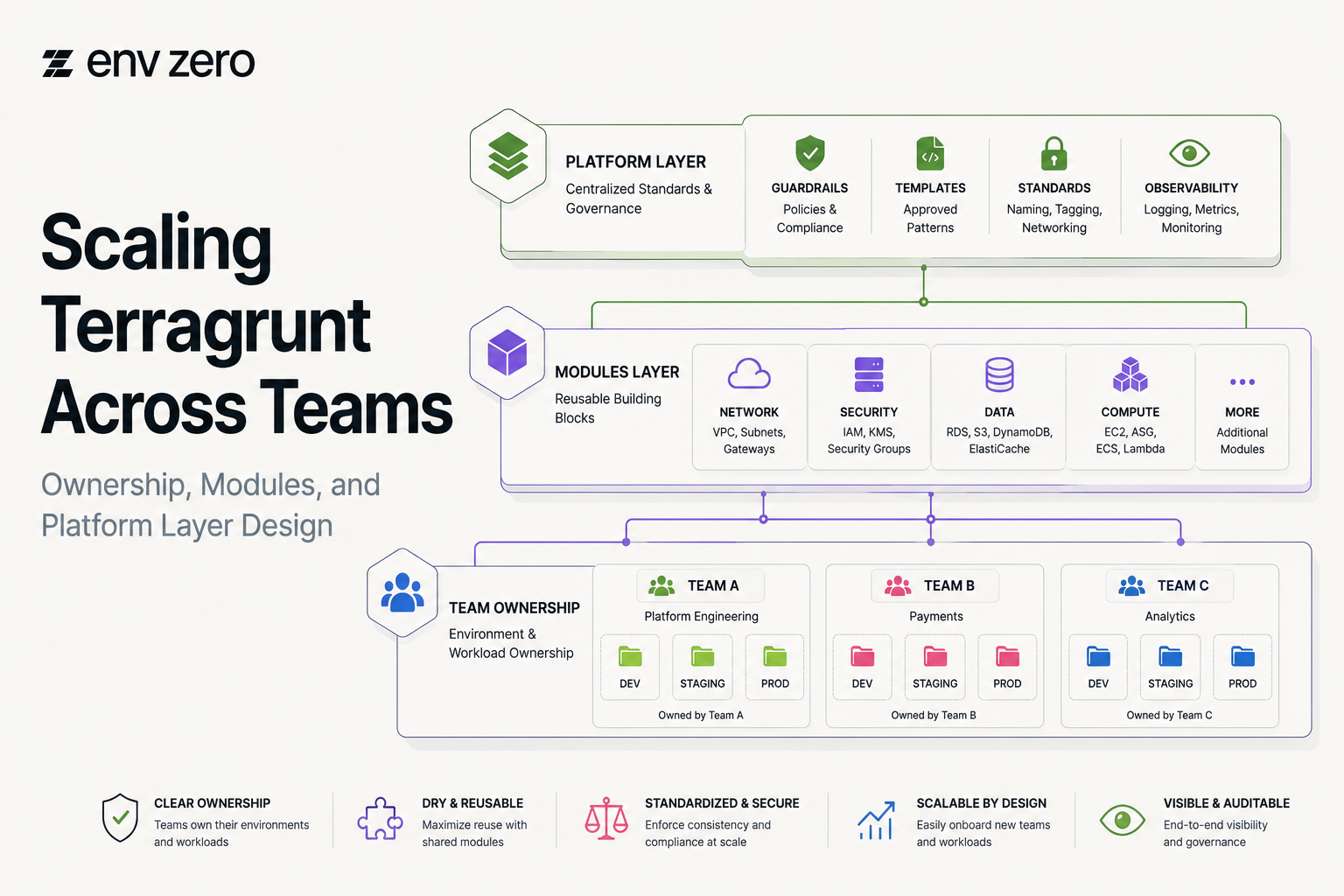
A terragrunt management platform becomes important when Terragrunt grows beyond one platform team and starts supporting many application teams, environments, modules, dependencies, and approval paths.
Terragrunt can help teams keep Terraform or OpenTofu configurations DRY, but scaling it across teams creates a different challenge: ownership.
At small scale, one team may understand every terragrunt.hcl file, dependency, and module reference.
At enterprise scale, that knowledge becomes fragmented. Platform teams own shared foundations.
Application teams own service infrastructure. Security owns guardrails. Finance cares about cost. Leadership wants faster delivery without losing control.
This framework explains how to scale Terragrunt across teams by defining ownership, module boundaries, dependency rules, stacks, and a platform layer for governance.
It also explains how env0’s IaC Platform & Terraform Automation service helps teams manage Terragrunt workflows with approvals, RBAC, drift detection, cost visibility, and auditability.
Key Takeaways
Scaling Terragrunt requires more than clean folders. Teams need clear ownership, reusable modules, visible dependencies, risk-based approvals, and platform-level governance.
A strong model should define who owns each unit, which modules are approved, how dependencies are documented, when stacks should be used, and how production changes are controlled.
env0 helps teams move from local Terragrunt execution or scattered pipelines to govern workflows across teams and environments.
What Is Terragrunt in a Team Context?
Many teams first ask, “what is Terragrunt?” In simple terms, Terragrunt is a thin wrapper that helps teams organize Terraform or OpenTofu configuration, reduce duplication, manage remote state, and coordinate dependencies.
In a team context, Terragrunt is not only a convenience tool. It becomes part of the infrastructure operating model.
It defines how teams call modules, pass environment inputs, manage state, and coordinate changes across infrastructure components.
That means Terragrunt needs standards. Without standards, each team may create its own folder structure, dependency patterns, naming rules, and apply process.
That creates inconsistency and makes governance harder.
Start With Ownership Boundaries
The first step in scaling Terragrunt is deciding who owns what.
Platform teams usually own shared infrastructure such as networking, identity, account baselines, Kubernetes foundations, and reusable modules.
Application teams may own service-level infrastructure such as queues, databases, storage, and application environments. Security teams may own policies and guardrails. FinOps teams may own cost rules.
Ownership should be visible in the repository and the workflow.
Each Terragrunt unit should have a clear owner, review path, and escalation path. If nobody owns a unit, it should not be considered production-ready.
A simple ownership model prevents confusion when a plan fails, a dependency changes, or drift appears in production.
Define Module Boundaries Clearly
Modules are the reusable building blocks behind many Terragrunt workflows.
A good module should represent a stable infrastructure pattern, such as a VPC, database, cluster, service account, or storage configuration.
The mistake many teams make is allowing every team to create its own version of the same module. That leads to duplication, inconsistent security settings, and harder upgrades.
Platform teams should define approved modules and document how they should be used.
Application teams can still have flexibility through inputs, but the core infrastructure pattern should remain governed.
This is where Terragrunt helps: teams can reuse modules across environments while keeping environment-specific inputs separate.
But module governance still requires ownership, versioning, review, and lifecycle rules.
Manage Terragrunt Dependencies With Care
A terragrunt dependency lets one unit reference outputs from another unit. This is useful because infrastructure often depends on other infrastructure.
An application may need network outputs.
A database may need subnet IDs. A monitoring unit may need cluster details.
At scale, dependencies can become difficult to follow. If every unit depends on several others, teams may create a fragile dependency graph.
A small change in one area can affect many teams. Platform teams should keep dependency rules simple. Foundational infrastructure should be clearly separated from application infrastructure.
Cross-team dependencies should be documented. Production dependencies should require stronger review.
The goal is not to avoid dependencies. The goal is to make them visible, intentional, and governed.
Use Terragrunt Stacks for Operational Grouping
Terragrunt stacks help teams group related units into higher-level workflows.
A stack may represent a complete application environment, an account baseline, a regional deployment, or a shared services layer.
Stacks are useful when teams need to manage multiple related units together without merging everything into one oversized configuration.
They help platform teams think in systems while preserving unit-level separation.
However, stacks should have clear boundaries. A stack should not become a random collection of unrelated units. Each stack should have a purpose, owner, lifecycle, and approval model.
For example, a production application stack may include service infrastructure, database configuration, monitoring, and required dependencies.
A platform baseline stack may include account setup, IAM, logging, and network foundations.
Design Team Workflows by Risk
Different teams and environments need different levels of control.
A development environment can often support faster self-service workflows. A production networking change should require stricter approvals.
A scalable Terragrunt model should define workflow rules by risk. Low-risk changes can be automated.
Medium-risk changes may require team lead approval. High-risk production changes may require platform, security, or compliance review.
This keeps delivery moving while protecting critical infrastructure.
It also prevents platform teams from becoming the approval bottleneck for every small change.
env0 helps teams apply this model by supporting approvals, RBAC, templates, and governed Terragrunt workflows across environments.
Add a Platform Layer Above Terragrunt
Terragrunt helps with structure, reuse, and orchestration. But it does not replace the need for a platform layer.
A platform layer should answer questions Terragrunt alone does not fully solve. Who can apply changes? Who approved the run? What policy checks passed?
Has the environment drifted? What cost impact did the change create? Which teams can access which workflows?
Without a platform layer, teams often build separate CI/CD jobs, scripts, and approval processes.
That may work at first, but it becomes difficult to audit and maintain across teams.
env0 provides the platform layer that helps teams manage Terragrunt with governance built in.
Common Scaling Mistakes
The first mistake is scaling without ownership. If teams do not know who owns units, modules, or stacks, every incident becomes harder to resolve.
The second mistake is overusing dependencies. Too many hidden dependency chains can make plans harder to understand and changes harder to approve.
The third mistake is treating Terragrunt as the full governance system.
Terragrunt is valuable, but teams still need RBAC, approvals, drift detection, cost visibility, audit logs, and self-service controls.
The fourth mistake is letting every team build its own Terragrunt workflow. That creates inconsistent standards and increases platform support burden.
How env0 Helps Teams Scale Terragrunt
env0 helps teams standardize Terragrunt workflows across teams, environments, and repositories.
Platform teams can provide approved templates, manage run settings, control access, approve sensitive changes, detect drift, and monitor cost.
This is valuable for organizations that want developer autonomy without losing platform control.
Developers can use approved Terragrunt workflows, while platform teams maintain governance across production and shared infrastructure.
env0 also helps reduce workflow sprawl. Instead of every team maintaining its own scripts and pipelines, Terragrunt workflows can be managed through a centralized platform model.
Conclusion: Scaling Terragrunt Is an Ownership Problem
Scaling Terragrunt is not only about modules, folders, or dependency syntax. It is about ownership, workflow design, and governance.
Platform teams need to define who owns each unit, how modules are reused, how dependencies are managed, when stacks should be used, and how approvals should work across environments.
With the right structure and platform layer, Terragrunt can support large-scale infrastructure delivery without creating chaos.
Streamline Terragrunt Workflows with Governance
env0 enables teams to manage Terragrunt with templates, approvals, RBAC, drift detection, cost monitoring, audit logs, and self-service capabilities.
Scale Terragrunt across multiple teams while ensuring safer workflows, clear ownership, and platform-level governance.
FAQs
What is Terragrunt used for?
Terragrunt is used to organize Terraform or OpenTofu configurations, reduce repeated code, manage remote state, and coordinate dependencies across infrastructure units and environments.
What is a Terragrunt management platform?
A Terragrunt management platform helps teams run and govern Terragrunt workflows at scale. It adds capabilities such as approvals, RBAC, audit logs, drift detection, cost visibility, and self-service controls.
How should teams manage Terragrunt ownership?
Teams should assign a clear owner to every unit, module, stack, and production workflow. Ownership should include review responsibility, lifecycle maintenance, incident response, and approval authority.
What is a Terragrunt dependency?
A Terragrunt dependency allows one unit to use outputs from another unit. Dependencies are useful for connected infrastructure, but they should be documented and kept visible to avoid hidden risk.
What are Terragrunt stacks?
Terragrunt stacks group related units into higher-level infrastructure workflows. They are useful for application environments, account baselines, shared services, and regional deployments.
How does env0 help teams scale Terragrunt?
env0 helps teams manage Terragrunt workflows with templates, approvals, RBAC, drift detection, cost visibility, audit logs, and self-service automation. It gives platform teams a governance layer above Terragrunt.