.webp)
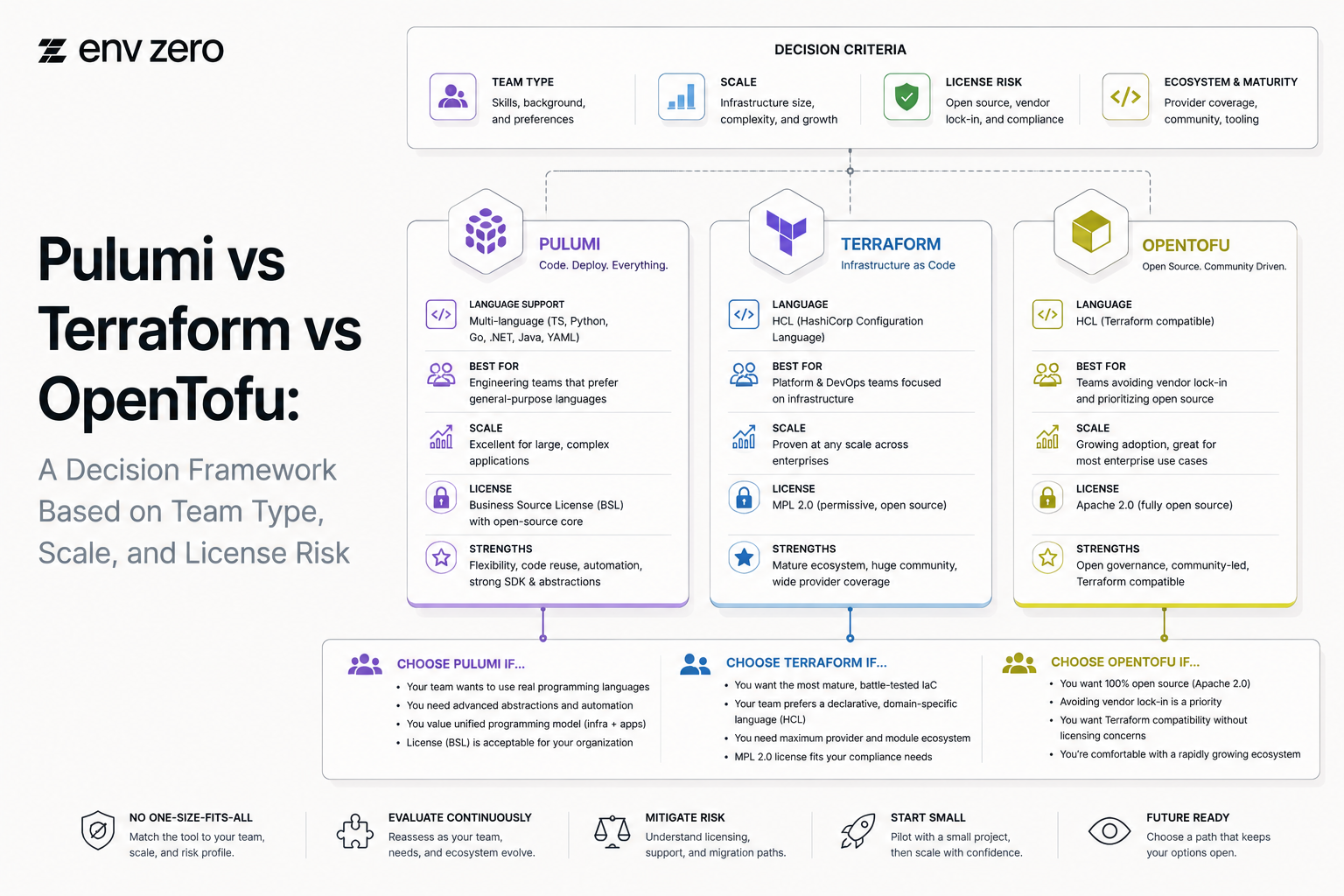
Pulumi vs Terraform vs OpenTofu is not only a tool comparison.
For platform teams in 2026, it is a decision about language preference, governance, migration cost, licensing risk, developer experience, and long-term infrastructure strategy.
Terraform remains a familiar infrastructure as code standard for many teams.
OpenTofu gives Terraform-style teams an open-source alternative with a similar workflow.
Pulumi takes a different approach by letting teams define infrastructure using general-purpose programming languages.
The right choice depends on how your organization builds, reviews, governs, and scales infrastructure.
This framework helps DevOps teams, platform engineering teams, and enterprise IT leaders compare the three options through practical decision criteria.
Choosing the Right Infrastructure Tool for Your Team
Terraform: For Teams With Established Workflows
Terraform is ideal for teams with strong HCL knowledge, mature modules, and existing Terraform workflows.
Teams benefit from years of existing code, state files, and provider usage.
OpenTofu: For Open-Source Terraform-Style Workflows
OpenTofu suits teams that want to maintain Terraform-style workflows while reducing long-term licensing or ecosystem concerns. It’s a good choice for continuity without a full rewrite.
Pulumi: For Developer-Led Infrastructure
Pulumi fits teams comfortable defining infrastructure using programming languages like TypeScript, Python, Go, or C#.
It’s especially attractive when infrastructure is closely tied to application logic.
env0: Unified Governance Across Multiple IaC Tools
env0 enables teams to govern multi-IaC environments, so you can manage Terraform, OpenTofu, Pulumi, and other tools without fragmenting workflows.
This helps maintain consistency, policy enforcement, and governance across platforms.
How to Decide
Instead of choosing a tool based solely on features, consider which platform fits your team’s skills, workflows, and long-term strategy.
The right tool aligns with your team type, existing expertise, and the governance model you want to establish.
Compare Language and Workflow Fit
Language is one of the biggest differences in the pulumi vs terraform conversation.
Terraform and OpenTofu use HCL-style configuration. Pulumi uses general-purpose programming languages.
HCL is readable, declarative, and widely understood across infrastructure teams. It works well when teams want standardized configuration patterns.
General-purpose languages can feel more natural for software engineers who want loops, classes, functions, packages, and testing patterns from their normal development workflow.
The tradeoff is governance. General-purpose language flexibility can be powerful, but platform teams still need standards.
HCL can be easier to standardize, but it may feel limiting for some developer-heavy teams.
The best choice depends on whether your organization wants infrastructure to feel like configuration or software development.
Evaluate Scale and Governance
At a small scale, any of these tools can work. At enterprise scale, governance becomes the deciding factor.
Platform teams need to control who can deploy, which policies apply, how changes are approved, how drift is detected, and how cost is monitored.
Terraform, OpenTofu, and Pulumi define infrastructure, but they do not automatically create a complete governance model.
This is where env0 becomes important. env0’s IaC Platform & Terraform Automation service helps teams govern Terraform, OpenTofu, Pulumi, Helm, Kubernetes, and broader IaC workflows from one platform. That gives teams flexibility without letting every tool become its own silo.
Consider Migration Cost
Migration cost is often underestimated. Moving from Terraform to OpenTofu may be more direct than moving from Terraform to Pulumi because OpenTofu preserves familiar Terraform-style workflows.
However, teams still need to test state files, providers, modules, CI/CD pipelines, secrets, and policy controls.
Moving from Terraform to Pulumi is a larger workflow shift.
Teams may need to rewrite infrastructure logic, retrain engineers, rebuild modules as packages, and update governance practices.
That does not mean Pulumi is the wrong choice. It means platform teams should treat it as a strategic change, not a simple replacement.
A good framework asks: how much existing code must move, how risky is the state transition, how much retraining is required, and how will governance stay consistent during migration?
Account for License and Ecosystem Risk
License risk is one reason OpenTofu entered the discussion.
Some teams want a Terraform-compatible workflow with open-source governance.
Others are comfortable staying with Terraform because they value ecosystem familiarity, vendor support, or existing investments.
Pulumi introduces a different ecosystem decision. Teams should review pulumi pricing, language support, cloud integrations, policy features, state management, and team adoption requirements.
There is no universal answer. A heavily regulated enterprise may weigh long-term governance and auditability more heavily.
A developer platform team may value language flexibility and product team adoption. A cost-sensitive team may focus on pricing predictability and operational overhead.
Where Pulumi Fits Best
Pulumi fits best when infrastructure is owned closely by software engineering teams.
It can work well for teams that want to use existing programming language skills, package managers, testing frameworks, and code reuse patterns.
Pulumi can also be appealing for teams exploring pulumi ai or AI-assisted infrastructure workflows.
However, AI features should not replace governance. Platform teams still need approvals, policy checks, audit logs, and cost visibility.
Choose Pulumi when your team is ready for a developer-centric infrastructure model and has the discipline to govern it properly.
Where Terraform Fits Best
Terraform fits best when teams already have mature HCL workflows, module libraries, registry usage, and platform processes.
It remains familiar to many infrastructure teams and has broad provider coverage.
Terraform may also fit teams that want continuity with existing Terraform Cloud workflows.
However, teams should still evaluate pricing, governance needs, and whether the platform supports the operating model they want long term.
Choose Terraform when existing workflows are stable and the main need is stronger governance around them.
Where OpenTofu Fits Best
OpenTofu fits best when teams want Terraform-style workflows with an open-source direction.
It is especially relevant for teams evaluating long-term roadmap control, Terraform compatibility, and migration options.
OpenTofu can be a practical path for teams that do not want to rewrite their infrastructure into another language model.
But like Terraform, OpenTofu still needs governance around policies, approvals, drift, access control, cost, and auditability.
Choose OpenTofu when continuity and open-source strategy both matter.
Use a Multi-IaC Governance Model
Many organizations will not choose only one tool. They may keep Terraform for existing workloads, adopt OpenTofu for new projects, and use Pulumi for developer-led services.
That reality creates a governance problem. If each tool has its own workflow, teams may end up with inconsistent policies, approvals, and audit trails.
env0 helps solve this by providing a multi-IaC governance layer. Platform teams can support different infrastructure tools while maintaining consistent controls across teams and environments.
Conclusion: Choose by Operating Model
The terraform vs pulumi or Pulumi vs Terraform vs OpenTofu decision should not be based on popularity alone.
It should be based on team type, language fit, migration risk, license strategy, pricing, and governance maturity.
Terraform offers continuity. OpenTofu offers Terraform-style workflows with open-source direction.
Pulumi offers programming-language flexibility. env0 helps teams govern whichever path they choose.
Build Multi-IaC Governance With env0
env0’s IaC Platform & Terraform Automation service helps teams manage Terraform, OpenTofu, Pulumi, and broader IaC workflows with approvals, RBAC, policy controls, drift detection, cost visibility, and audit logs.
Talk to env0 to compare IaC options and build a governed platform strategy that fits your teams.
FAQs
What is the main difference between Pulumi, Terraform, and OpenTofu?
Terraform and OpenTofu use HCL-style infrastructure configuration, while Pulumi uses general-purpose programming languages. Terraform is widely adopted, OpenTofu offers a Terraform-compatible open-source path, and Pulumi is more developer-language focused.
Is Pulumi better than Terraform?
Pulumi may be better for teams that want infrastructure in programming languages. Terraform may be better for teams that prefer HCL, mature modules, and established workflows. The better choice depends on team skills and governance needs.
Is OpenTofu a Terraform replacement?
OpenTofu can be used as a Terraform-compatible alternative for many workflows, but teams should still test providers, modules, state, pipelines, and governance before production migration.
Should platform teams support more than one IaC tool?
Some platform teams should support multiple IaC tools when different teams have different needs. The key is using a governance platform like env0 so policies, approvals, cost controls, and audit logs stay consistent.
How does env0 help with Pulumi, Terraform, and OpenTofu?
env0 helps teams govern multi-IaC workflows with policy controls, RBAC, approvals, drift detection, cost visibility, audit logs, and self-service automation across Terraform, OpenTofu, Pulumi, and related tools.
What should teams consider about Pulumi pricing?
Teams should evaluate Pulumi pricing based on users, managed resources, deployment needs, team size, and platform features. Pricing should also be compared with the operational cost of governance, migration, and workflow management.