.webp)
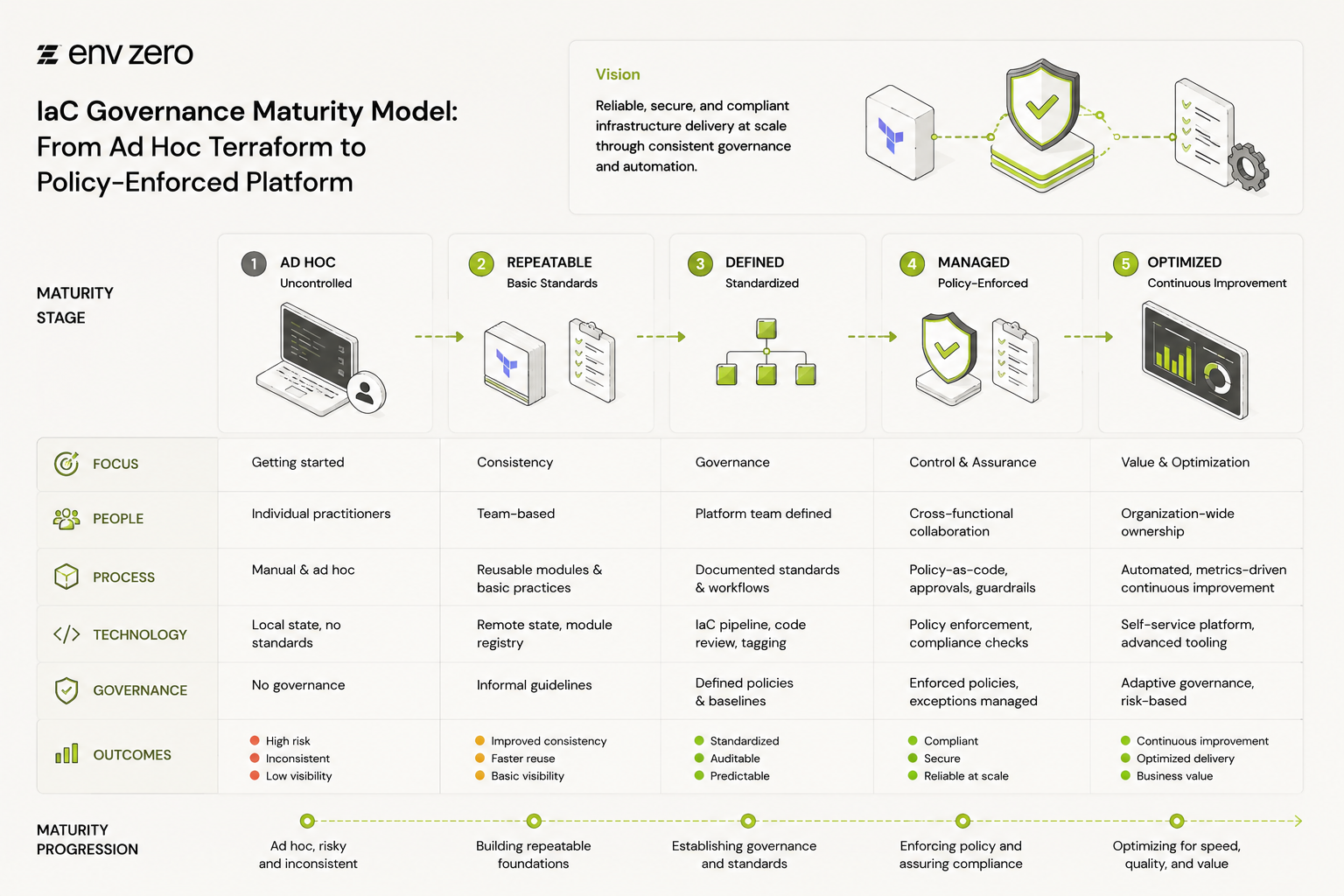
IaC governance tools help platform teams move from scattered Terraform workflows to a policy-enforced infrastructure platform.
The challenge is that most organizations do not reach mature governance in one step.
They move through stages: local Terraform usage, shared pipelines, early policies, drift visibility, and eventually governed self-service infrastructure.
For DevOps teams, platform engineering leaders, and enterprise IT teams, the goal is not simply to write more infrastructure as code.
The goal is to make infrastructure changes safe, visible, repeatable, cost-aware, and compliant across teams.
This maturity model gives platform teams a practical way to assess where they are today and what they should build next.
Maturity Model at a Glance
Most teams fall into one of five stages:
- Ad hoc Terraform
- Shared automation
- Controlled workflows
- Policy-enforced governance
- Self-service platform
Each stage improves consistency, but also introduces new requirements. A team running Terraform locally needs state discipline.
A team running Terraform in CI/CD needs approvals. A team managing Terraform and OpenTofu across business units needs policy-as-code, RBAC, drift detection, audit logs, and cost visibility.
env0 helps teams move toward the later stages by providing a governed platform for Terraform, OpenTofu, and broader IaC workflows.
Stage One: Ad Hoc Terraform
At this stage, engineers run Terraform from local machines or team-specific scripts. This may work for small teams, but it creates risk as infrastructure grows.
Common problems include unclear ownership, inconsistent state handling, limited auditability, manual reviews, and no standard approval path.
One team may follow best practices, while another team uses a different process entirely.
The immediate goal is not to over-engineer governance. The goal is to standardize the basics: remote state, version control, naming standards, provider versioning, and peer review.
If your team cannot answer who applied a change, where state is stored, or which workflow controls production, you are still in this stage.
Stage Two: Shared Automation
In the second stage, teams move Terraform into CI/CD pipelines. This is an improvement because infrastructure changes become more repeatable and tied to source control.
However, CI/CD alone is not full governance. A pipeline can run a plan and apply, but it does not automatically define who is allowed to approve production, which policies must pass, how drift is detected, or how cost impact is reviewed.
Many teams get stuck here. They believe automation equals governance, but scattered pipelines often create inconsistent controls across repositories and environments.
At this stage, platform teams should create standard workflow templates, define production approval rules, and begin centralizing audit trails.
Stage Three: Controlled Workflows
Controlled workflows introduce stronger structure around infrastructure changes.
Teams begin defining role-based access, approval workflows, environment separation, and documented ownership.
This is where governance becomes intentional. Production changes may require platform-team approval.
Development environments may allow faster paths. Sensitive resources may require additional review.
This stage is important because it creates a bridge between automation and policy enforcement.
Teams are no longer relying only on trust or manual review. They are building repeatable controls.
However, controlled workflows still need deeper enforcement. If policies are only written in documentation, they are easy to miss. The next stage turns rules into automated checks.
Stage Four: Policy-Enforced Governance
Policy-enforced governance is where IaC governance tools become essential.
Instead of relying only on reviewers to catch issues, policies automatically evaluate infrastructure plans before changes are applied.
Policy-as-code can check for required tags, encryption, approved regions, public access, instance size limits, and compliance standards.
Tools such as OPA-style policy engines help teams evaluate Terraform plans against rules before deployment.
This stage reduces review burden and improves consistency. Developers get faster feedback, while platform teams enforce standards across environments.
But policy enforcement must be managed carefully.
Too many unclear policies can slow teams down. Strong governance should make the safe path easier, not make every deployment harder.
env0 helps teams apply policy controls inside governed IaC workflows, connecting policies with approvals, RBAC, audit logs, drift detection, and cost visibility.
Stage Five: Self-Service Platform
The most mature stage is governed self-service. At this point, developers can request and deploy approved infrastructure patterns without opening tickets for every routine change.
Self-service does not mean unrestricted cloud access. It means developers use approved templates, variables, policies, and workflows created by the platform team.
A developer may deploy a standard development environment quickly, while production changes still require approval.
This model changes the role of the platform team. Instead of being the bottleneck for every request, the platform team becomes the builder of paved roads.
They define templates, policies, access models, and controls that developers can safely use.
env0 supports this model by helping teams create governed self-service workflows with policy enforcement, RBAC, drift detection, cost monitoring, and auditability.
How to Assess Your Current Stage
Platform teams should assess maturity by asking practical questions.
- Can we see every infrastructure change?
- Do we know who approved production changes?
- Are policies enforced automatically?
- Can we detect drift after deployment?
- Do developers have safe self-service workflows?
- Can we govern Terraform and OpenTofu consistently?
- Do we have cost visibility before infrastructure is applied?
If the answer to most of these questions is no, the team likely needs stronger IaC governance tools and a clearer platform model.
Common Governance Gaps
The most common gap is treating CI/CD as the governance layer.
Pipelines are useful, but they do not automatically provide policy enforcement, RBAC, auditability, drift detection, or cost control.
Another gap is inconsistent policy ownership. If no one owns the policy library, rules become outdated or too noisy.
Platform teams should assign ownership for policy design, exceptions, and updates.
A third gap is ignoring drift. Governance does not end after apply.
Real cloud infrastructure can change outside IaC, and platform teams need a way to detect and respond to those changes.
Why env0 Fits the Mature Governance Model
env0 is built for teams that need to govern infrastructure as code at scale.
It supports Terraform, OpenTofu, and broader IaC workflows from one platform.
With env0, platform teams can manage policy controls, approval workflows, RBAC, drift detection, cost visibility, audit logs, and developer self-service.
This helps teams move from fragmented workflows to a governed platform model.
For organizations growing beyond basic Terraform automation, env0 provides the structure needed to standardize infrastructure delivery without slowing developers down.
Conclusion: Governance Maturity Is a Platform Journey
IaC governance maturity does not happen all at once.
Teams usually move from ad hoc Terraform to shared automation, then controlled workflows, policy enforcement, and finally governed self-service.
The key is knowing which stage your team is in and what capability should come next.
Adding policies before the state is standardized may create confusion. Launching self-service before RBAC and approvals are ready may create risk.
A strong maturity model helps platform teams build governance in the right order.
Enforce Policies and Governance Across Your IaC Platform
env0 provides a centralized platform to manage infrastructure with robust policy enforcement, approval workflows, RBAC, drift detection, cost tracking, and audit-ready reporting.
Empower teams with self-service automation while maintaining compliance and building a faster, safer infrastructure delivery model.
FAQs
What are IaC governance tools?
IaC governance tools help teams control infrastructure as code workflows through policy enforcement, approvals, RBAC, drift detection, audit logs, and cost visibility. They are especially important for teams running Terraform, OpenTofu, or multi-cloud workflows at scale.
What is an IaC governance maturity model?
An IaC governance maturity model shows how teams progress from ad hoc infrastructure workflows to controlled, policy-enforced, and self-service infrastructure platforms. It helps platform teams identify gaps and prioritize the next governance capability.
What is the first step toward better IaC governance?
The first step is standardizing the basics: version control, remote state, ownership, naming conventions, and workflow visibility. Without those foundations, advanced policies and self-service workflows are harder to manage safely.
Why is policy-as-code important for Terraform governance?
Policy-as-code helps teams enforce rules automatically before infrastructure changes are applied. It can check for security, compliance, cost, and operational requirements, reducing the burden on manual reviewers.
How does drift detection fit into IaC maturity?
Drift detection helps teams identify when real infrastructure no longer matches the approved IaC configuration. It is a key maturity step because governance must continue after deployment, not just before apply.
How does env0 support IaC governance maturity?
env0 helps teams mature IaC governance by centralizing policy controls, approvals, RBAC, drift detection, cost visibility, audit logs, and self-service workflows across Terraform, OpenTofu, and broader IaC environments.