.webp)
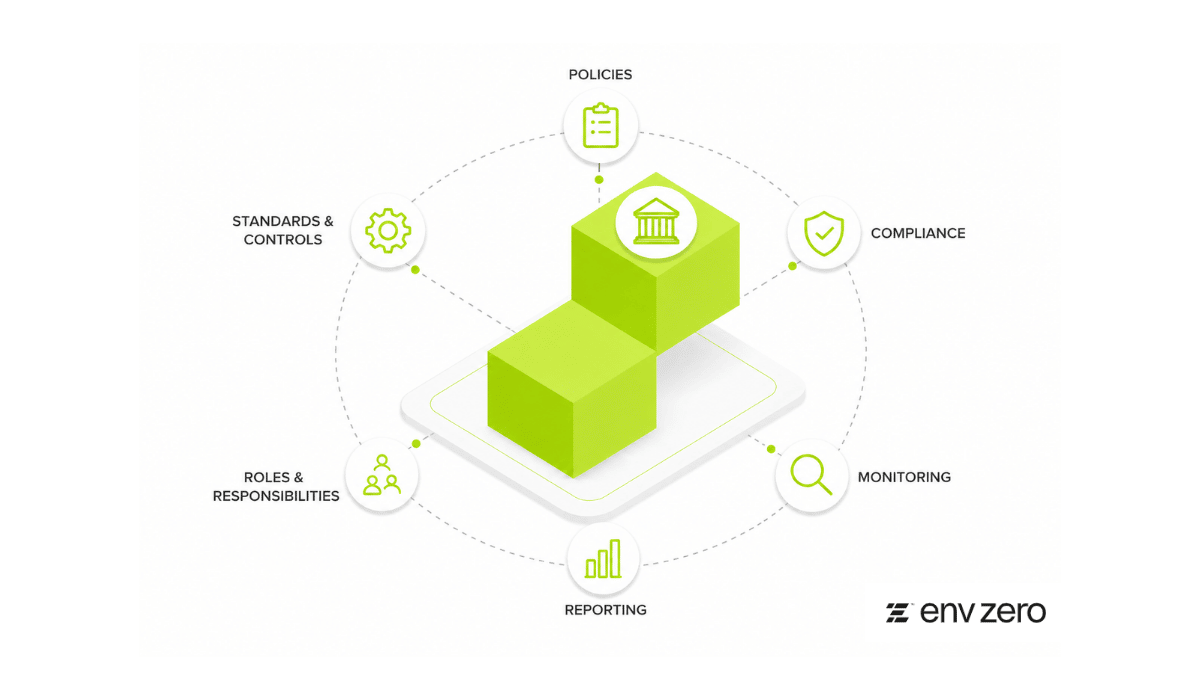
A cloud governance framework is the structured model for how cloud resources get requested, approved, deployed, managed, and monitored across teams, accounts, regions, and providers. For the plain-language case for why this matters, see Cloud Governance Explained for Enterprise Infrastructure.
In practice, the framework splits into five domains that platform teams need controls for: policy and compliance, access and identity, cost and FinOps, drift and observability, and audit and reporting. The rest of this framework walks through each.
Core Components of a Cloud Governance Framework
A cloud governance framework should cover multiple areas of cloud management.
Identity and Access Management
Organizations need clear rules around who can access cloud resources and what actions they can perform.
Identity and access management policies should define:
- User roles and permissions
- Multi-factor authentication requirements
- Least-privilege access rules
- Temporary access processes
- Service account management
- Periodic access reviews
Strong access controls reduce security risks and improve accountability.
Resource Provisioning Standards
Organizations should define how cloud resources are requested, approved, and deployed.
Provisioning standards often include:
- Approved infrastructure templates
- Standard environment configurations
- Required approval workflows
- Naming conventions
- Resource tagging requirements
- Environment expiration policies
These standards help teams create environments consistently.
Security and Compliance Controls
Security should be integrated into every stage of the cloud lifecycle.
Cloud governance frameworks should define:
- Encryption requirements
- Network security policies
- Logging and monitoring standards
- Vulnerability management processes
- Data retention rules
- Compliance reporting expectations
These controls help organizations reduce risk and meet regulatory obligations.
Cost Management Policies
Cloud spending can grow quickly if organizations do not create financial controls.
Cost management policies may include:
- Budget thresholds
- Environment limits
- Approval requirements for large resources
- Resource rightsizing rules
- Cost reporting dashboards
- Idle resource detection
These policies support better financial accountability.
Ownership and Accountability
Every environment, application, account, and resource should have a clearly defined owner.
Ownership helps organizations answer questions such as:
- Who requested this resource?
- Who approved it?
- Who manages it?
- Who is responsible for security?
- Who pays for it?
Clear ownership reduces confusion and supports faster decision-making.
The Importance of Policy Guardrails
Policy guardrails are one of the most important parts of a cloud governance framework, and they typically operate on two tiers.
The first tier is always-on and applies regardless of what a team is deploying: destroy protection on production environments, time-to-live limits on temporary environments, environment count limits per project, drift detection triggers, mandatory cost estimation before every plan, and secrets handling rules. These run automatically without anyone writing a policy for them.
The second tier is deployment-specific, evaluated at plan time against the actual infrastructure change. This is where organizations write their own rules — for example, denying any plan that creates a publicly readable storage bucket, or requiring manual approval when a change touches production network configuration. These policies are typically invoked as part of the approval step, after a plan and its cost estimate are generated but before anything is applied.
Splitting guardrails this way means teams don’t have to write custom logic for the baseline protections every organization needs, and can focus their policy-writing effort on the rules specific to their own risk profile.
How Platform Teams Support Cloud Governance
Platform teams play an important role in governance because they often manage the tools, templates, workflows, and automation that developers use.
Platform teams can support governance by:
- Creating approved infrastructure templates
- Building self-service workflows with guardrails
- Automating policy enforcement
- Maintaining cost visibility dashboards
- Monitoring environment health
- Supporting audit readiness
This allows developers to provision environments more quickly without bypassing governance requirements.
Challenges Organizations Face With Cloud Governance
Many organizations struggle to maintain strong governance because cloud environments are constantly changing.
Some common challenges include:
Multi-Cloud Complexity
Organizations often use multiple cloud providers, each with different tools, policies, and security models.
This can make governance harder to standardize.
Lack of Visibility
Without centralized dashboards and reporting, teams may not know which resources exist, who owns them, or how much they cost.
Inconsistent Processes
If different teams use different workflows, templates, and approval processes, governance becomes difficult to enforce.
Manual Oversight
Manual governance processes do not scale well in large cloud environments.
Organizations need automation to maintain consistency across teams.
Best Practices for Building a Strong Governance Framework
Organizations can improve governance by following a few best practices.
Standardize Policies Across Teams
All teams should follow the same baseline rules for security, tagging, approvals, and cost management.
Automate Governance Controls
Automation helps organizations enforce policies more consistently and reduce manual work.
Maintain Centralized Visibility
Dashboards, reporting tools, and audit logs help organizations understand how environments are being used.
Review Governance Policies Regularly
Cloud environments change over time. Governance policies should be reviewed regularly to ensure they remain relevant.
Align Governance With Business Goals
Governance should support the organization’s broader goals around growth, security, compliance, and efficiency.
How This Looks in Practice: Western Union
Western Union scaled this model across more than 2,000 developers, over 200 applications, and three cloud providers. Rather than reviewing infrastructure changes after they were deployed, the platform team moved policy checks earlier: dynamic RBAC controlled who could touch which environments, and OPA-based policies were evaluated before deployment instead of scanning for problems afterward.
Combined with a standardized template library (a "golden path" every team could follow instead of building infrastructure patterns from scratch), this took deployment cycles that used to take weeks down to minutes — without removing governance, just moving it earlier in the process where it’s cheaper to enforce.
Conclusion
A cloud governance framework gives organizations the structure they need to manage cloud environments effectively.
Without governance, cloud usage can become expensive, inconsistent, and difficult to secure.
By creating clear policies around access, provisioning, security, compliance, cost management, and ownership, organizations can reduce risk while still supporting innovation.
Strong governance does not slow teams down. Instead, it creates the guardrails needed to help teams move faster with greater confidence.
This framework covers the general model. For the specific pieces, see Cost Governance Model, Policy Enforcement Matrix, Approval Policy Framework, Drift Risk Detection Framework, Cloud Accountability Model, and FinOps Governance Framework.
FAQs
What is a cloud governance framework?
A cloud governance framework is a set of policies, controls, and processes that guide how cloud environments are managed. It helps organizations maintain security, compliance, cost control, and operational consistency.
Why is cloud governance important?
Cloud governance is important because it helps organizations reduce risk, improve visibility, control costs, and maintain security across cloud environments.
What are policy guardrails in cloud governance?
Policy guardrails are automated rules that prevent teams from creating resources or configurations that violate organizational standards. Examples include required tags, encryption settings, and spending limits.
How does cloud governance support compliance?
Cloud governance supports compliance by defining how security controls, access permissions, logging, data retention, encryption, and audit processes should be managed. A strong governance framework helps ensure that environments consistently follow internal policies and external regulations such as SOC 2, HIPAA, GDPR, or ISO standards. This reduces the risk of compliance gaps, failed audits, and security issues.
Who is responsible for cloud governance?
Cloud governance is usually shared across multiple teams, including platform teams, security teams, finance teams, operations teams, compliance teams, and leadership. Platform teams often manage provisioning standards and automation, while security teams oversee access controls and policies. Finance teams focus on cloud spending, and leadership helps define governance priorities and accountability across the organization.
How can organizations improve cloud governance?
Organizations can improve cloud governance by standardizing policies, automating controls, improving visibility, defining ownership, and regularly reviewing governance processes. They should also create clear approval workflows, enforce resource tagging, monitor cloud activity, and use dashboards to track costs, security, and compliance. These practices help teams maintain better control as cloud environments grow.