.webp)
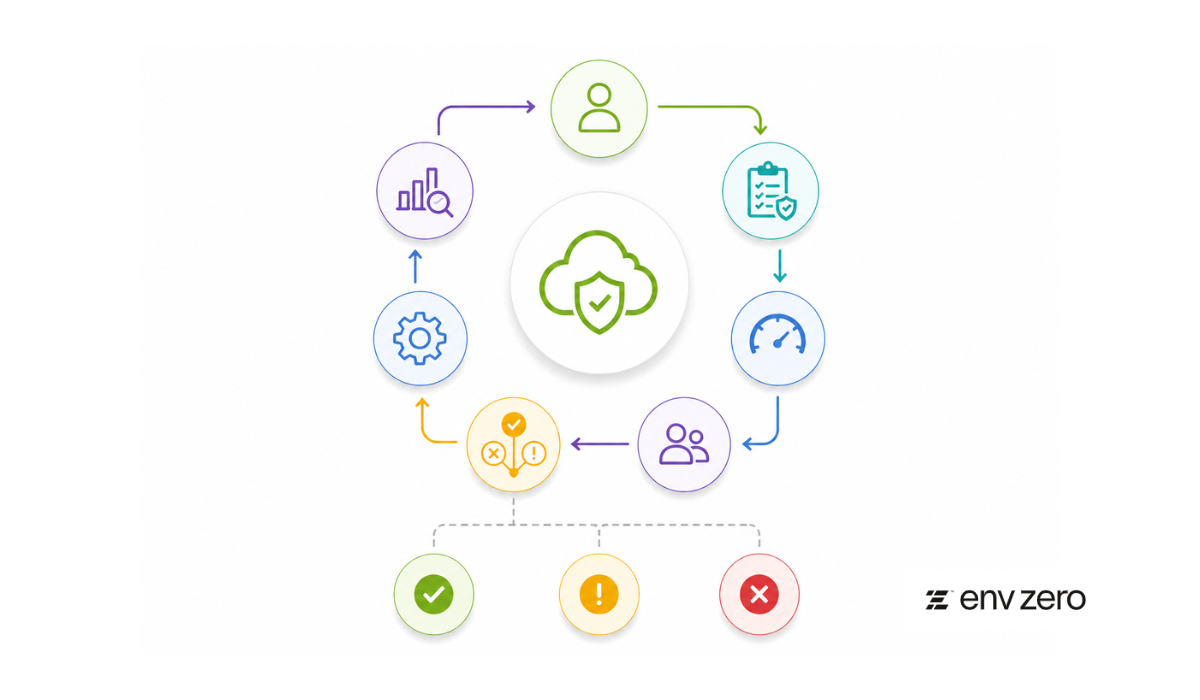
An approval policy is what an enforcement matrix resolves to pending for: a change is sensitive enough to need a human decision, but not risky enough to deny outright. This framework covers how to design that decision point — who reviews it, what triggers it, and how exceptions get handled. For the plain-language case for why this matters, see Approval Policies for Cloud Teams.
What an Approval Policy Framework Should Include
Each approval rule in the framework needs to answer the same handful of questions:
- The types of actions that require approval
- The conditions that trigger approval
- The risk level of the change
- The appropriate approver
- The required supporting context
- Response times and escalation paths
- Exception handling rules
- Reporting and audit requirements
Without these elements, approval policies can become difficult to enforce and difficult for teams to follow.
The Core Components of an Approval Policy Framework
Define the Exact Trigger for Approval
Every approval policy should have a clear trigger.
Examples include:
- Deployment to production
- Changes affecting shared environments
- Creation of resources above a cost threshold
- Policy violations requiring exception handling
- Changes to identity, network, or security controls
If teams cannot tell when a rule applies, they may either overuse approvals or bypass them completely.
Align Approvals to Risk Level
Not every action needs the same level of oversight. A risk-based model creates faster decision-making for low-risk actions and stronger review for higher-risk ones.
Low risk — development environment changes, small cost increases, tagging updates — needs only approval from the owning team, and should resolve quickly.
Medium risk — shared environment changes, moderate budget increases, new vendor integrations — often needs input from more than one team: platform, finance, or security.
High risk — major production changes, large spending commitments, compliance exceptions — should include senior or governance-committee review, with documentation and impact analysis attached before sign-off.
Identify the Right Approver
Approvals are only effective when the right person is involved, and every stage of the request needs an assigned role: who requests it, who reviews it, who approves or rejects it, who communicates the decision, and who verifies it was actually completed.
Depending on the use case, the approver may be a platform team lead, a security reviewer, a finance owner, an application owner, or a compliance stakeholder — but whoever it is needs both the authority to decide and enough context to decide well. Leaving any of these roles undefined is how requests end up stuck with no one accountable for moving them.
Require the Right Supporting Context
Approvals should be informed, not symbolic.
Requests should include:
- What is changing
- Which environment is affected
- Why the change is needed
- Expected impact
- Relevant policy conditions
- Rollback or remediation plans when applicable
Providing clear context improves approval quality and reduces delays.
Set Response Times and Escalation Paths
Approval policies should define what happens when requests remain unresolved.
Organizations should define:
- Expected response times
- Escalation paths for urgent requests
- Alternate approvers when the primary reviewer is unavailable
- Rules for emergency changes
Without these controls, approvals can become delivery bottlenecks.
Document Exception Handling
Some requests need a temporary exception rather than a flat denial. Every exception should carry: why it's needed, which policy and environment it affects, which risks remain and which controls reduce them, who approved it, and when it expires.
Temporary exceptions that go undocumented are the ones that quietly become permanent. Time-limiting and logging every exception is what keeps that from happening.
Make Approvals Auditable
Approval policies should create a record of governance decisions.
Organizations should log:
- The approval trigger
- Request details
- The approver
- The decision
- The timestamp
- Any related exception or escalation
Auditability helps organizations improve governance and answer questions about delays, repeated exceptions, and manual reviews.
Build Approval Into the Pipeline, Not Around It
The best approval design does not maximize approvals — it minimizes unnecessary review by building approval logic directly into the systems where changes already happen: CI/CD pipelines, provisioning platforms, and change management tools, rather than a separate manual step bolted on afterward.
Many manual reviews can be replaced with policy-based automation for standard, pre-approved actions — a low-cost development environment, for example, can be approved automatically if it meets tagging, security, and budget requirements, with no human in the loop at all. See Approval Pipelines in Infrastructure Delivery for how that gatekeeping gets built into a deployment pipeline, and Approval Automation for Platform Teams: Where to Start for where to begin if setting this up from scratch.
Review Approval Policies Regularly
Approval policies should evolve as teams, environments, and risks change.
Organizations should review:
- Policies that no longer reflect current risk
- Manual reviews that could be automated
- Approval steps that duplicate existing controls
- New governance requirements
- Patterns in delays or exception requests
Regular reviews help organizations avoid outdated approval processes.
Common Approval Policy Mistakes
The most common mistake is applying approvals too broadly.
If every action requires approval, teams often experience delays and begin searching for workarounds.
Another common mistake is assigning approvals to the wrong people. Approvers without the right context may approve requests automatically without fully understanding the risk.
Organizations also sometimes fail to define response times. When approvals sit unresolved, delivery can slow down significantly.
Finally, some organizations rely entirely on manual approvals even when automation could handle low-risk actions more efficiently.
Best Practices for Building Approval Policies
Getting approval policies right in practice tends to come down to a handful of habits.
Focus on High-Risk Changes
Production deployments, security changes, high-cost resources, and policy exceptions should receive the strongest oversight.
Keep Approval Rules Simple
Teams should clearly understand when approval is required and what information is needed.
Match Approvers to the Type of Risk
Security teams should review security-related changes, while finance teams should review high-cost requests.
Use Automation for Standard Actions
Automation can reduce manual review volume for low-risk requests.
Track Approval Trends
Organizations should monitor which approvals create delays, which teams request the most exceptions, and which rules are triggered most often — average approval time, requests by team, most common categories, rejected requests, and expired exceptions are the metrics worth watching. Reviewed regularly, this data is what turns "approvals feel slow" into a specific bottleneck someone can actually fix.
Conclusion
An approval policy framework helps organizations create more structured, consistent, and scalable governance across cloud environments.
It ensures that high-risk changes receive the right level of oversight while lower-risk actions move through workflows more efficiently.
For organizations focused on cloud governance and risk management, strong approval policies improve security, compliance, cost control, and operational consistency.
The goal is not to create more approvals. The goal is to create better decisions, stronger accountability, and more efficient delivery.
Not every approval resolves cleanly — for what happens when a request needs to go beyond the first reviewer, see Policy Escalation Framework. For how approvals fit into the broader governance model, see Cloud Governance Framework.
FAQs
What is an approval policy framework?
An approval policy framework is a structured model that defines which cloud actions require approval, who should review them, and how approval workflows should operate.
Why are approval policies important?
Approval policies are important because they help organizations reduce risk, improve change control, strengthen compliance, and prevent unnecessary spending.
Which changes should require approval?
Changes related to production environments, security controls, access management, high-cost resources, and policy exceptions often require approval.
How can organizations improve approval workflows?
Organizations can improve approval workflows by defining clear triggers, assigning the right approvers, using automation, and tracking approval trends.